- Best and Worst Reasons for Job Change
- Reasons for Job Change Sample Answers
- How to Answer the Job Switch Reason Question – Simple formula
- Why do recruiters ask about your reasons for leaving a job
- How to Share Reasons for Changing Jobs
Are you ready to quit and begin your job hunt?
Then you must prepare for one of the most crucial questions – What is the reason for your job change?
Irrespective of your reasons, the one thing you must remember is to answer this question honestly, but without bad-mouthing your former employers, as that may leave a poor impression of you on the recruiters.
To help you answer this question better, we bring to you 20+ good reasons for job change that you can use to express your resignation to potential employers.
We have also included sample answers for the most common reasons for leaving a job to help you frame your response smartly.
Best and Worst Reasons for Job Change
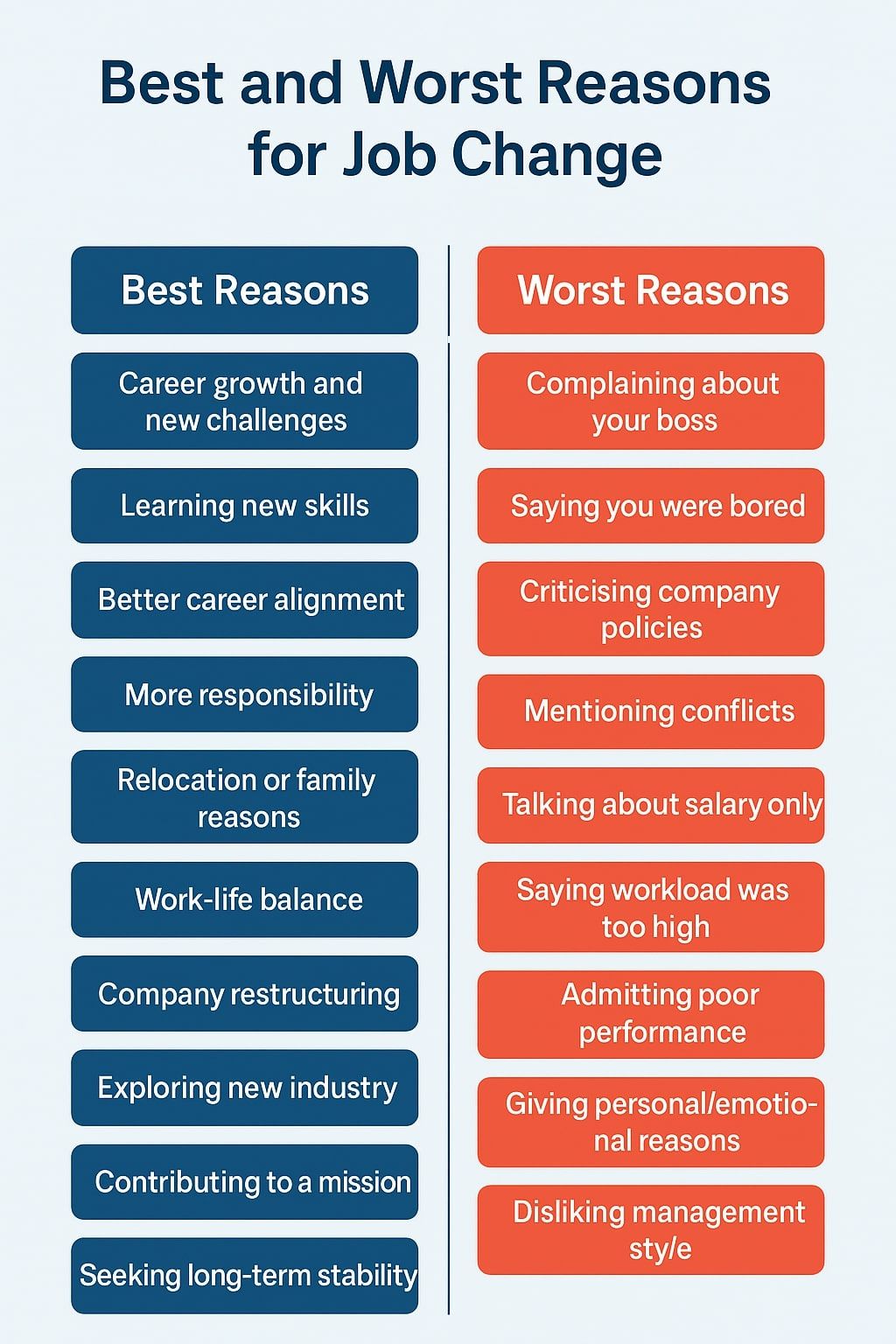
Recruiters value honesty but also professionalism. Some reasons for leaving a job create a strong impression, while others can raise concerns.
Read more: How to Answer "Why Do You Want to Leave Your Current Job?"
|
Best reasons for leaving job |
Worst reasons for leaving job |
|
Seeking career growth and new challenges |
Complaining about your boss or coworkers |
|
Wanting to learn new skills or technologies |
Saying you were bored or unmotivated |
|
Looking for better career alignment |
Criticising company policies or culture |
|
Desiring more responsibility or leadership
roles |
Mentioning conflicts or disagreements |
|
Relocating for personal or family reasons |
Talking about salary as the only reason |
|
Searching for work-life balance |
Saying the workload was too much |
|
Company restructuring or layoffs |
Admitting you couldn’t handle the job |
|
Exploring a new industry or domain |
Sharing overly personal or emotional reasons |
|
Wanting to contribute to a meaningful
mission |
Saying you didn’t like management style |
|
Looking for stability and long-term growth |
Blaming others for lack of success |
Reasons for Job Change Sample Answers
Here are a few reasons to change jobs with sample answers to help you explain this in different scenarios.
1. Career growth opportunities
This is the best reason for leaving job because it expresses your desire for upward mobility and the chance to take on more challenging roles within the company.
Sample answer
I am seeking a new opportunity that provides a clear path for career advancement. I have achieved significant milestones in my current role and am now eager to take on more responsibilities and contribute to the growth of the organization.
2. Skill diversification
Highlighting the aspiration to broaden skill sets and gain experience in various areas to become a more versatile professional. This is one of the most common reasons for job change.
Sample answer
I am excited about the prospect of diversifying my skill set. While I have excelled in my current role, I believe that acquiring additional skills in [specific area] will not only benefit my career but also bring a fresh perspective to any team I join.
3. Industry shift
Explaining the decision to transition to a different industry and applying existing skills in a new and challenging context.
Read more: Tips to Switch Careers Successfully
Sample answer
I am looking to bring my skills and experience to a new industry where I can contribute in a unique way. The [new industry] presents an exciting opportunity for me to leverage my expertise and make a meaningful impact in a different business environment.
4. Company reputation
Expressing a desire to work for a company known for its positive work culture, values, and employee satisfaction.
Sample answer
I am attracted to your organization because of its stellar reputation for fostering a positive work environment and commitment to employee development. I believe that my skills and values align seamlessly with your company's mission, making it an ideal fit for my professional growth.
5. Innovative environment
Seeking a workplace that fosters creativity and encourages innovative thinking. Here is an example for this reason for job change best answer.
Sample answer
I am eager to join a company that values innovation and creativity. Your organization's commitment to staying at the forefront of industry trends and implementing cutting-edge solutions aligns perfectly with my passion for pushing boundaries and finding innovative solutions to challenges.
6. Flat learning curve
Learning new things is crucial for people across industries and experience levels. There is no specific age, limit, or time for learning.
But, if you have been in a role for a while and the scope of growth seems bleak, then it is a good idea to set out and look for the next challenge.
Sample answer
In my current role, I've noticed a somewhat stagnant learning curve, and I'm eager to immerse myself in an environment that presents continuous learning opportunities. I believe that a more dynamic learning curve will not only keep me engaged but also allow me to bring fresh perspectives and innovative solutions to the challenges presented in the [new role/industry].
7. High attrition rate
A very valid yet less looked upon reason is a company's high attrition rate. Working in a dynamic workplace can make it difficult to focus on work as there is a lack of stability and no ownership over processes.
Also, when there is a constant exodus around you, you can identify patterns that are causing dissatisfaction amongst employees (especially the good ones), leading to them resigning and seeking exits for a quick departure.
Read more: Highest-Paying Skills for Career Growth
Sample answer
While I have valued my time at my current company, I've observed a higher-than-preferred attrition rate. I am seeking a workplace where employee retention is prioritized, fostering a stable and collaborative environment. Your company's reputation for valuing and retaining talent aligns with my career goals and commitment to long-term contributions.
8. Regular reorganization of company management
You have noticed constant shuffles and reshuffles in the senior leadership and higher management. These are signs showing that your company has a shaky core strategy, and your job is at risk as well.
Sample answer
The frequent reorganization of the management structure in my current company has led to some uncertainties and challenges in maintaining a consistent workflow.
I am interested in joining an organization that provides a more stable work environment, allowing me to focus on my role and contribute to the company's goals without frequent organizational changes.
I believe that this stability will contribute positively to my professional growth and productivity.
9. Company went out of business – seeking stability
The company is facing financial challenges, and you are looking for a more stable job.
Sample answer
Unfortunately, my current company is undergoing a challenging phase and is facing financial difficulties, which has prompted me to explore opportunities in more stable organizations.
I am eager to contribute my skills and expertise to a company with a strong foundation and a promising future.
10. Dream job offer
You received a job offer for a position you have always dreamt of.
Sample answer
I recently received a dream job offer that aligns perfectly with my long-term career goals and aspirations. The role not only complements my skills and experience but also offers an exciting opportunity to contribute to projects that I am truly passionate about.
11. Flexible schedule - Seeking work-life balance
Your current job lacks flexibility in terms of working hours.
Sample answer
In my current role, the lack of flexibility in work hours has become a challenge. I value work-life balance and am actively seeking a position that offers a more flexible schedule. I believe that a balanced approach to work will enhance my productivity and job satisfaction.
12. Job was outsourced
Your job was outsourced, and you felt your contributions were limited. This is how you can explain this job switch reason.
Sample answer
Due to recent changes in the company's strategy, my role was outsourced, and I realized that I had limited opportunities to contribute meaningfully. I am now eager to find a new role where I can actively contribute to projects and be an integral part of a team.
13. Laid off
You were laid off from your previous position. Make sure you avoid giving negative reasons for job change.
Sample answer
Regrettably, I was part of a recent downsizing at my previous company, which resulted in my position being eliminated. I am now actively seeking new opportunities where I can leverage my skills and contribute to the success of a forward-thinking organization.
14. Limited growth at company – Seeking skill enhancement
You did not have sufficient opportunities for skill improvement and growth at your previous company.
Sample answer
While I appreciate the experience gained at my current company, I found limited opportunities for professional growth and skill enhancement. I am now eager to join a company that fosters continuous learning and provides a platform for employees to develop and excel in their careers.
Read more: Top HR Interview Questions and Answers
15. Long commute – Looking for better work-life balance
Your current job requires a tiringly long daily commute.
Sample answer
The long and tiring daily commute to my current job has become a significant challenge.
I am seeking a new opportunity closer to home, as I believe it will not only enhance my overall job satisfaction but also allow me to invest more time and energy into my work.
16. Looking for a new challenge
You are seeking a more challenging position to push your professional boundaries. This is another best reason for leaving job.
Sample answer
I am currently seeking a new challenge in my career. While I have gained valuable experience in my current role, I am eager to take on new responsibilities and contribute to projects that require a higher level of expertise.
I believe that this shift will not only keep me engaged but also contribute to my continuous professional development.
17. Seeking more responsibility – Work satisfaction
You believe you are capable of taking on more responsibilities, and your current role is not providing the level of work satisfaction you desire in terms of challenging tasks and increased responsibilities.
Sample answer
In my current position, I have demonstrated my ability to handle tasks efficiently and effectively.
However, I find that my current role does not provide me with the level of responsibility and challenges that I am capable of and, quite frankly, crave.
I am seeking a new opportunity where I can contribute more significantly, take on additional responsibilities, and play a more integral role in the success of the team and the organization.
I am confident that my skills and experience make me well-suited for a position that aligns with my career goals and desire for greater professional fulfillment.
18. Industry networking
Seeking a position that facilitates greater networking opportunities within the industry can be a way to enhance professional connections, stay updated on industry trends, and open doors to new possibilities.
Sample answer
I am excited about the prospect of joining a company where I can actively engage with industry leaders, attend relevant events, and contribute to the professional dialogue.
I believe this will not only enrich my understanding of the industry but also provide opportunities for valuable collaborations and partnerships.
Read more: What is Work-Life Balance?
19. Flexible work arrangements
Transitioning to a job that allows for more flexible work schedules and remote work options can be motivated by a desire for a better work-life balance and increased autonomy.
Sample answer
I am seeking a role that values work-life balance and offers flexibility in work arrangements.
I believe that a flexible schedule enhances productivity and creativity, allowing me to contribute effectively while maintaining a healthy balance between professional and personal commitments.
20. Inclusive workplace
Pursuing employment in an organization that values diversity and promotes an inclusive work culture reflects a commitment to working in an environment that respects and appreciates differences.
Sample answer
I am drawn to companies that prioritize diversity and inclusivity. I believe that diverse perspectives drive innovation, and I am eager to contribute my skills and experiences to a workplace that values and celebrates individual differences, fostering a collaborative and supportive atmosphere.
21. Industry trends
Shifting to an industry with more promising long-term prospects and growth potential can be a strategic move based on a keen awareness of market trends and future opportunities. Here’s how to explain this job switch reason.
Sample answer
I am excited about transitioning to an industry with robust growth prospects and evolving trends.
My research indicates that this sector aligns with my long-term career goals, and I am eager to contribute my skills to an industry where I see significant potential for both personal and professional development.
22. Geographic relocation
Moving to a different location due to personal or family reasons can be a valid reason for a job change, emphasizing the importance of work-life integration.
Sample answer
My decision to explore opportunities in this region is rooted in personal considerations. I am excited about the prospect of aligning my professional growth with my family's needs.
Relocating to this area not only supports my personal life goals but also allows me to bring my skills to contribute meaningfully to a new professional community.
23. Mentorship opportunities
Looking for a workplace with strong mentorship programs reflects a desire for continuous learning and professional guidance.
Sample answer
I am actively seeking a workplace that places a strong emphasis on mentorship. I believe that learning from experienced professionals is crucial for personal and career development. I am eager to contribute my skills while benefiting from the guidance and insights of seasoned mentors within the organization.
24. Better work-life balance
Striving for a job that aligns more closely with personal and family priorities underscores the importance of achieving a healthy work-life balance.
Sample answer
I am pursuing opportunities that prioritize work-life balance. Achieving harmony between my professional and personal life is important to me, and I am confident that a role in this organization will provide the conducive environment I am seeking. I believe that a balanced life positively impacts overall job satisfaction and performance.
Note: These sample answers should be customized to your specific circumstances and preferences. Adjust them accordingly to align with your own experiences and aspirations.
How to Answer the Job Switch Reason Question – Simple formula
A strong job switch reason answer needs structure. The key is to sound confident and genuine – not rehearsed when talking about reasons for leaving a job. Here is a simple formula that works in most interviews:
1. Mention the trigger: Briefly explain what prompted your job switch reason (growth, new skills, or change in goals).
2. Add a positive spin: Frame it around what you learned or achieved in your previous role.
3. Link to the new role: Show how the opportunity matches with your next career step.
4. End with intent: Close with enthusiasm for the role and what you hope to contribute.
Example of reason for job change best answer:
I have really enjoyed my time in my current role and learned a lot about [specific skill or area]. But I have reached a point where I am ready to take on new challenges and grow further. What attracted me to this opportunity is the chance to work on [specific responsibility or project] and contribute to a team that’s focused on [company goal or value]. It feels like the right next step for my career.
Why do recruiters ask about your reasons for leaving a job?
Recruiters often ask about your reasons for leaving a job to learn what truly drives your career decisions. They want to see if you have made a thoughtful and professional move rather than an emotional one.
Here’s why they ask about your reasons for job change:
● To understand your main job switch reason and what made you consider a change
● To check if you handle workplace changes in a positive way
● To see if your reason for leaving is valid and professional
● To find out what motivates you in your career
● To identify whether the new position fits your long-term goals
● To observe how you speak about your previous employer and team
● To spot any warning signs before moving forward with your application
How to Share Reasons for Changing Jobs?
When discussing your reasons for leaving a job, focus on growth and positive career moves instead of dissatisfaction or conflicts. Here are some tips you can follow:
1. Emphasize professional growth
Highlight the desire for continuous professional growth as a primary motivator for the job change. Discuss specific skills you aim to develop and how the new position aligns with your long-term career goals.
Example
I am seeking a new opportunity to further expand my skill set and take on challenges that contribute to my professional development. The role aligns perfectly with my career trajectory, allowing me to enhance my expertise in [specific skills].
2. Cite positive company traits
When giving your reasons for job change, focus on the positive attributes of the prospective company rather than the shortcomings of the current one. Discuss how the values, culture, or mission of the new organization resonate with your personal and professional aspirations.
Example
I am drawn to your company because of its commitment to [specific values]. This aligns with my own principles, and I am eager to contribute to a workplace that shares my dedication to [shared value].
3. Connect to passion and purpose
Articulate how the new role allows you to align your passion and purpose more closely with your daily work. Share how the job change represents a move toward more meaningful and fulfilling professional contributions.
Example
I am pursuing this opportunity because it allows me to combine my passion for [specific area] with my professional expertise. I am excited about the prospect of contributing to a cause that aligns with my values.
4. Highlight contributions to a larger mission
Express a desire to contribute to a larger mission or purpose. Discuss how the new position offers a chance to make a positive impact beyond individual job responsibilities.
Example
I am seeking a role where my work contributes to a larger mission. Your company's commitment to [specific cause] resonates with me, and I am eager to bring my skills to contribute meaningfully to this important initiative.
5. Stress positive changes in industry dynamics
Frame the job change as a response to positive shifts in the industry. Discuss how the new sector presents exciting opportunities for growth and innovation.
Example
The dynamics of the industry are evolving, and I am enthusiastic about transitioning to a field where innovation and growth are prominent. This move aligns with my vision for staying at the forefront of industry trends.
6. Express gratitude for previous experience
Acknowledge the positive aspects of your current or previous job. Express gratitude for the opportunities, learning experiences, and relationships gained, emphasizing that the decision to change is driven by a pursuit of new challenges.
Example
I am grateful for the experiences and skills I've gained in my current role. However, I believe that exploring new opportunities is essential for my continued growth. I am excited about the potential to apply my knowledge in a different context.
7. Demonstrate adaptability and learning orientation
Showcase your adaptability by explaining how the new role aligns with your ability to learn quickly and take on new challenges. Emphasize your enthusiasm for acquiring new skills and adapting to a dynamic work environment.
Example
I am a firm believer in continuous learning, and I am seeking a role that challenges me to adapt and grow. Your company's commitment to innovation and learning aligns perfectly with my values, and I am eager to contribute to a culture that values professional development.
All the best!
FAQs
What could be the best reason for a job change?
The best reason for a job change is typically professional growth and advancement opportunities. Seeking new challenges, skill development, and career progression in a role that aligns better with your long-term goals can be compelling reasons to change.
How do you answer why I am changing jobs?
When asked why you are changing jobs, focus on positive reasons such as seeking new challenges, professional growth, or aligning with a company's mission and values. Emphasize how the new role offers opportunities for skill development and career advancement that your current job lacks.
How do you explain reasons for career change?
Explaining a career change involves highlighting relevant skills, experiences, and transferrable qualities that make you well-suited for the new role. Emphasize your passion for the new field or industry, and how your previous experiences have prepared you to excel in this new career path.
Why do you change your current job?
Changing a job may be motivated by various factors, including seeking better growth opportunities, a more supportive work environment, or alignment with personal values. Emphasize positive reasons such as career advancement, professional development, or a desire for greater job satisfaction.
What are the most common reasons for leaving a job?
Common reasons for leaving a job include limited growth opportunities, a desire for better work-life balance, relocation, company restructuring, or changing career goals. Always explain these reasons in a positive and forward-looking way during interviews.
How do I choose the best reason for leaving job during an interview?
The best reason for leaving job depends on your situation. Pick one that aligns with your career goals – like learning new skills, exploring a leadership role, or joining a company whose values match yours. Keep it brief and honest.
What is the reason for job change best answer for experienced professionals?
For experienced professionals, a good reason for job change best answer could be:
“After several years in my current position, I’m looking for new challenges that allow me to use my experience in a larger capacity and continue growing professionally.”
What reasons for job change should I avoid mentioning?
Avoid negative reasons for job change like conflicts with management, dissatisfaction with salary alone, or boredom. These can make you seem unprofessional or disengaged. Keep your answers solution-oriented and respectful toward past employers.
