A central excise inspector is a government official under the excise department who monitors the production and distribution of excisable goods within the country and makes sure all taxes are paid correctly. The role of excise inspectors is important because they prevent revenue loss and keep businesses compliant with tax laws. You need the right skills and qualifications to enter this field.
In this guide, we will discuss what an excise inspector does by covering their key duties and job responsibilities. We will also look at the excise inspector salary and the skills required for this role. And if you feel this career suits your goals, we will also explain how to become an excise inspector step by step.
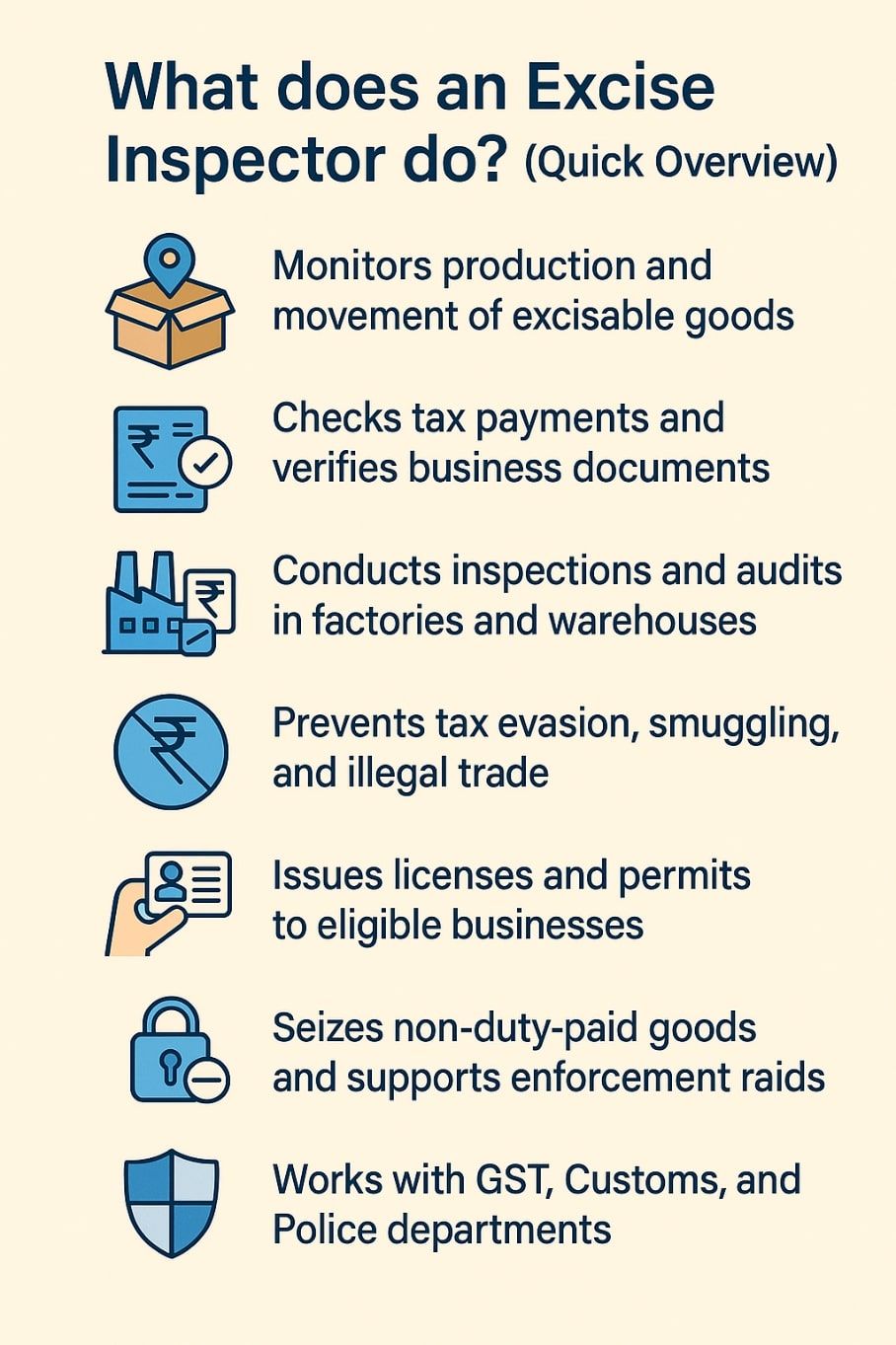
Excise inspector – Key highlights
- What is excise department? Central Board of Indirect Taxes and Customs (CBIC). It is a government body that regulates excisable goods and collects indirect taxes.
- Who is an excise inspector? An excise inspector is a government officer who checks that businesses follow tax rules on goods like alcohol, tobacco, and petroleum.
- Excise inspector job profile: The excise inspector job profile includes field inspections, checking documents, and preventing tax evasion.
- What does an excise inspector do? The work of excise inspector includes both desk duties and field inspections. They keep track of the production, storage, and movement of excisable goods so that the correct taxes are paid.
- Excise inspector salary: The excise inspector salary generally ranges from ₹8 Lakhs to ₹11 Lakhs per year (varies by location & allowances).
- Excise inspector skills: This role requires analytical skills, communication skills, legal knowledge, and field readiness.
- How to become an excise inspector? You can follow this path to become an excise inspector – Clear SSC CGL exam → training → departmental posting
Who is an Excise Inspector?
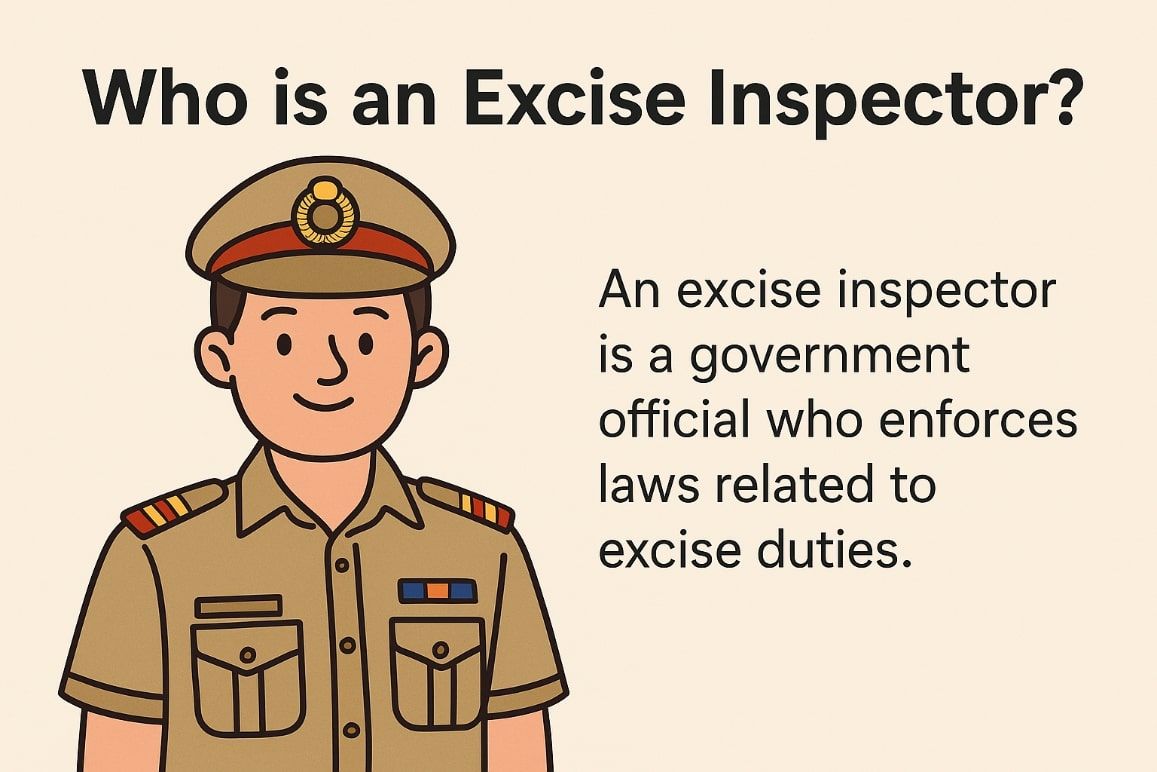
An excise inspector is a government officer who works under the Central Board of Indirect Taxes and Customs (CBIC). They are responsible for enforcing excise laws and regulations related to the production, distribution, and sale of certain goods, typically alcoholic beverages, tobacco products, and sometimes other items such as petroleum products. Their duties are assigned by the excise department across various units.
What does an Excise Inspector do?
This section explains the work of excise inspector in detail. A central excise inspector is a Group B government officer with duties related to taxation and regulation of excisable goods such as alcohol, tobacco, and petroleum. Their work focuses on checking whether businesses follow tax rules and helping the government prevent revenue loss.
The role of an excise inspector can differ based on their posting, mainly divided into desk duty and field duty:
1. Desk posting
This part of the excise inspector job profile deals with paperwork. Office postings offer regular working hours and an indoor work environment with focus on administrative tasks. In an office-based role, an excise inspector:
- Checks paperwork related to production and movement of excisable goods
- Verifies tax returns and maintains compliance records
- Reviews applications for licenses and permits
- Handles letters, reports, and internal communication within the department
This role is mostly office-based and involves coordination with other officers.
2. Field posting
These activities form a major part of the excise inspector job profile in enforcement roles. Field postings involve travel to different locations and more direct interaction with industries and goods movement. During field duty, an excise inspector:
- Visits factories, warehouses, ports, and markets to track excisable goods
- Checks stock, invoices, and packaging to detect tax evasion
- Confiscates illegal or non-duty-paid goods
- Supports raids and inspections against smuggling or fraud
- Works closely with GST, Customs, and Police teams
Field postings involve more travel and physical verification of goods.
Duties and responsibilities of an Excise Inspector
The duties and responsibilities of an excise inspector can vary depending on the country, state, or region in which they work, as well as the specific laws and regulations governing excise duties and taxes.
However, here are some common duties and responsibilities typically associated with the role of an excise inspector:
- Monitoring compliance: Excise inspectors ensure that individuals and businesses are compliant with excise tax laws and regulations. They monitor the production, distribution, and sale of excisable goods to make sure they adhere to the legal requirements.
- Licensing and permits: Excise inspectors often handle the issuance of licenses and permits to businesses involved in the production, import, export, or sale of excisable goods. They review applications, conduct inspections, and grant or deny licenses as appropriate.
- Tax collection: Excise inspectors collect excise taxes and duties on the specified goods. This involves verifying the accuracy of tax returns, conducting audits, and ensuring that businesses pay the correct amount of excise taxes.
- Inspections and audits: The work of excise inspectors also include inspections. They conduct regular inspections and audits of businesses involved in the production and sale of excisable goods. These inspections may involve checking inventory, records, and production processes to ensure compliance with regulations.
- Seizures and penalties: In cases of non-compliance or violations, excise inspectors may have the authority to seize contraband goods, impose fines, or take legal action against individuals or businesses breaking excise laws.
- Education and outreach: Excise inspectors may also be responsible for educating businesses and the public about excise laws and regulations. They may guide compliance and help businesses understand their obligations.
- Record keeping: Excise inspectors maintain records of businesses and individuals involved in the excise industry, including license information, tax payments, and compliance history.
- Collaboration: They often collaborate with other law enforcement agencies, such as police and customs officials, to ensure that illegal activities related to excisable goods are detected and addressed.
- Test samples: Inspectors may take samples of excisable goods for laboratory testing to ensure that they meet the specified quality and safety standards.
- Reporting: Central excise inspectors generate reports on their findings and activities, which are often used for decision-making by government agencies and for maintaining transparency and accountability.
- Monitoring tax evasion: They are tasked with monitoring and investigating potential tax evasion, which may include looking into suspicious financial transactions, unreported sales, or other forms of tax fraud.
- Legal procedures: Excise inspectors may be involved in legal proceedings, such as testifying in court, to support actions taken against violators of excise laws.
It is important to note that the specific duties and responsibilities of an excise inspector can vary significantly based on the jurisdiction and the nature of the excisable goods involved. So it is important to consult the specific laws and guidelines in your region to fully understand the work of an excise inspector.
What is Excise Inspector salary in India?
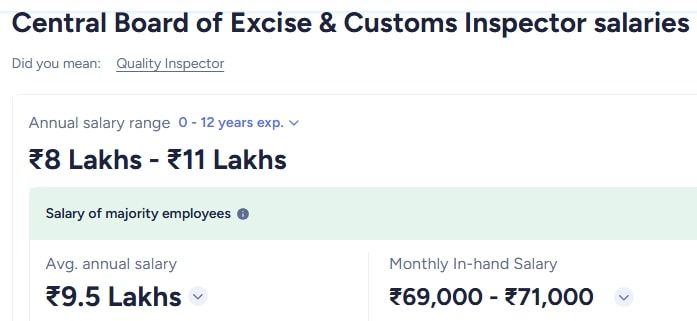
According to salary insights shared by AmbitionBox, Excise Inspectors working under the Central Board of Indirect Taxes and Customs (CBIC) receive a competitive government salary along with various allowances.
Here are the details on central excise inspector salary in India:
Average salary: ₹9.5 lakhs per year (approx.)
Salary range: ₹8 lakhs – ₹11 lakhs per year
Monthly in-hand salary: ₹69,000 – ₹71,000
Basic pay: Usually ranges from ₹25,000 to ₹40,000 per month, depending on seniority and posting
Allowances: Includes DA, HRA, medical allowance, and travel allowance
Benefits: Pension (NPS), provident fund, job security, and insurance coverage
Excise inspector salary may differ based on:
- City of posting (X/Y/Z classification)
- Field posting vs. office posting
- Seniority, promotions, and performance-based increments
- Additional allowances (HRA, DA, TA, etc.)
For the most up-to-date and region-specific excise inspector salary information, refer to the official website of the respective state government or union territory administration, as they often provide details on pay scales and allowances for government employees.
Work environment of an Excise Inspector
The work environment of a central excise inspector can vary depending on the specific responsibilities and location. Excise inspectors work in both offices and field locations. They follow regular government hours, but field duties may sometimes extend due to inspections or unexpected enforcement tasks.
Key aspects of the work of an excise inspector:
- Mostly office timings: Monday to Friday (or upto Saturday), 9:30 AM to 5:30 PM
- Extra hours possible during enforcement activity or urgent investigations
- Combination of desk tasks and field inspections
- Travel within the assigned jurisdiction for factory and warehouse checks
- Interaction with business owners, staff, and law enforcement teams
- Work may involve exposure to sensitive commercial data
- Pressure during tax review periods and anti-evasion drives
- Senior officers supervise operations and guide decision-making
- Use of computers, GST systems, and mobile devices for reporting
- Professional conduct needed while dealing with resistance or disputes
Additionally, the work environment may differ based on the specific excisable goods they are responsible for regulating and the policies of the jurisdiction in which they work.
Skills required to be an Excise Inspector
To be an effective central excise inspector, you need a combination of technical skills, interpersonal skills, and specific knowledge related to excise laws and regulations.
Here are some of the key skills and qualifications required for this role:
- Legal and regulatory knowledge: A strong understanding of excise laws and regulations, including knowledge of the specific rules governing excisable goods, such as alcohol, tobacco, or petroleum products, is essential.
- Analytical skills: The ability to analyze financial records, tax returns, and business operations to identify irregularities or non-compliance is crucial.
- Communication skills: Effective verbal and written communication skills are essential for interacting with businesses, colleagues, and the public. You need to explain regulations, provide guidance, and write detailed reports.
- Investigative skills: The ability to conduct investigations, gather evidence, and prepare cases for legal action is important, especially when dealing with non-compliance and tax evasion.
- Problem-solving: Inspectors often encounter complex compliance issues that require creative problem-solving to address effectively.
- Computer literacy: Proficiency in using computer applications, databases, and software for record-keeping, data analysis, and report generation is necessary.
- Mathematics and accounting skills: A solid foundation in mathematics and accounting is important for verifying tax calculations, conducting financial audits, and analyzing financial statements.
- Interpersonal skills: Inspectors often work with a wide range of individuals and organizations. The ability to build relationships, handle conflicts, and maintain professionalism in difficult situations is crucial.
- Ethical conduct: High ethical standards and integrity are vital, as excise inspectors handle sensitive financial and business information and must be impartial and fair in enforcing the law.
- Teamwork: In many cases, inspectors work as part of a team or department, collaborating with colleagues and other law enforcement agencies on cases and investigations.
- Physical stamina: Fieldwork may involve physical activities such as visiting multiple sites, conducting inspections, and handling excisable goods. Physical fitness may be necessary, especially in situations that require lifting and moving heavy items.
- Safety awareness: Depending on the goods being inspected, inspectors should be aware of safety hazards and follow safety protocols and guidelines.
- Cultural sensitivity: In some regions, excisable goods are tied to cultural practices, and inspectors should be sensitive to cultural considerations when enforcing regulations.
How to become an Excise Inspector?
Becoming a central excise inspector typically involves meeting specific educational, eligibility, and examination requirements set by the government agency or department responsible for excise enforcement in your region.
The exact process and qualifications can vary from one jurisdiction to another, but here are some general steps you can follow to become an excise inspector:
1. Complete graduation
You must hold a bachelor’s degree in any stream from a recognized university. There is no restriction on subject choice, so students from commerce, science, and arts backgrounds are all eligible. Good communication and basic numerical skills developed during graduation can help during the exam and in the job later.
2. Check basic eligibility
Before applying, candidates must review the eligibility rules published in the SSC CGL notification each year. These mainly include:
- Age limit: Usually 18 to 30 years (relaxation for reserved categories)
- Citizenship: Indian
- Medical fitness: Good physical and mental health
Eligibility confirmation is important to avoid disqualification later in the recruitment process.
3. Apply for SSC CGL exam
Excise Inspector posts are filled through the Staff Selection Commission – Combined Graduate Level (SSC CGL) Examination. You must clear all four tiers of the SSC CGL exam. Each stage tests different skills required for the job.
Final selection is based on performance across these stages and the preference candidates provide during the application. Candidates must clear each stage to move to the next.
4. Meet physical standards (Field posting requirement)
Since excise inspectors may work in field enforcement roles, candidates must satisfy basic physical standards specified by SSC.
For male candidates:
- Height: 157.5 cm or above
- Chest: 81 cm (with 5 cm expansion)
- Walking test and cycling test may be conducted for certain postings
For female candidates:
- Height: 152 cm or above
- Weight: 48 kg or above
- Walking test and cycling test may be required for field roles
Note: Relaxations are offered to candidates from specific communities and to persons with certain disabilities, depending on the nature of the position assigned.
5. Document verification and final allotment
Once all tests are cleared:
- Documents are verified
- Rank and preference decide department posting under CBIC
If selected, candidates join training at the department after appointment.
6. Training and on-job learning
After selection, new recruits undergo training. It may include both classroom learning and real-world field experience. New inspectors receive training on:
- Excise laws
- GST and tax procedures
- Inspection and enforcement techniques
- Report writing and departmental systems
Once training is completed, candidates are posted to their assigned region and officially begin their duties as Excise Inspectors.
Advantages of being an Excise Inspector
A career as an excise inspector offers several advantages, especially for those interested in government service and revenue administration:
- Job security as a permanent government employee
- Stable income with regular salary revisions
- Good benefits including pension, paid leave, and medical facilities
- Career growth opportunities to higher roles such as Superintendent or Assistant Commissioner
- Varied work profile with both office duties and field exposure
- Skill development in investigation, taxation, and legal processes
- Contribution to society by helping the government prevent revenue loss
- Professional network through interaction with businesses and enforcement agencies
- Continuous learning due to changes in tax laws and compliance rules
Disadvantages of being an Excise Inspector
While the role of an excise inspector is rewarding, it also comes with a few challenges:
- Work can be stressful during inspections, audits, or tax deadlines
- Field duties may require long hours and travel in tough weather
- Dealing with tax evasion cases can lead to difficult or confrontational situations
- Job pressure due to strict rules, legal responsibilities, and departmental expectations
- Public resistance or negative perception toward tax enforcement
- Need to stay updated with changing laws and regulatory procedures
Career progression of an Excise Inspector
Excise Inspectors have good opportunities for advancement within the Central Board of Indirect Taxes and Customs (CBIC). Generally, it may take around five to eight years for the first promotion, depending on performance, vacancies, and departmental requirements.
A typical career growth path includes:
- Excise Inspector (Group B – entry level)
- Superintendent (Group B – gazetted officer)
- Assistant Commissioner (Group A)
- Deputy Commissioner (Group A)
- Joint Commissioner (Group A)
- Additional Commissioner (Group A)
- Commissioner (Group A – senior leadership role)
Growth depends on performance, posting area, and responsibilities assigned by the excise department.
FAQs
What is the Excise Department in India?
The Excise Department is a government authority that regulates the production and distribution of excisable goods like alcohol, tobacco, and petroleum, while collecting taxes on them to support national revenue.
What is the highest salary in the Excise Department?
The highest post in the Excise Department is the Commissioner under CBIC. A Commissioner can earn a salary in the Pay Level 14, where the monthly salary can go beyond ₹2,00,000 including allowances. The exact amount may vary based on experience, location, and government pay revisions.
Who is an Excise Inspector?
An Excise Inspector is a Group B government officer under CBIC who checks whether businesses comply with excise laws and tax rules related to excisable goods.
What does a Central Excise Inspector do?
A Central Excise Inspector conducts inspections, reviews documents, checks tax payments, and helps prevent smuggling or tax evasion in industries dealing with excisable goods.
What is the job profile of an Excise Inspector?
The role includes both office work and field duties such as audits, paperwork, monitoring goods movement, and coordinating with other enforcement teams.
What is the work of an Excise Inspector on a daily basis?
Their daily duties may involve checking business records, visiting factories or warehouses, verifying tax compliance, and preparing reports for the department.
What is the uniform of an Excise Inspector in India?
Excise Inspector uniform is a formal shirt and trousers for office work. During field duties or enforcement operations, excise Inspector uniform is similar to other CBIC enforcement officers, depending on departmental guidelines.
