

Every year, thousands of students in India ask the same question: “Should I do CA?” Some are fresh out of Class 12, weighing their options between B.Com, MBA, and the CA route. Others are midway through college, wondering if it’s too late to start. And a few are already deep into their preparation, looking for clarity on what lies ahead.
The CA (Chartered Accountant) qualification, awarded by the Institute of Chartered Accountants of India (ICAI), is one of the most rigorous and rewarding professional credentials in the country. It opens doors to careers in Big 4 firms, corporate finance, banking, government bodies, and even entrepreneurship. The path isn’t easy, but it is well-defined. And once you understand it step by step, it becomes far less intimidating.
This guide breaks down everything, from CA course details and eligibility to CA salary expectations, skills, certifications, and career opportunities in a way that actually makes sense for a student just starting.
What is a CA (Chartered Accountant)?
A CA (Chartered Accountant) is one of the most respected and sought-after finance professionals in India. A chartered accountant is a licensed expert in accounting, taxation, auditing, and financial management, recognized by the Institute of Chartered Accountants of India (ICAI), the statutory body that regulates the CA profession in the country.
Whether it’s helping a startup manage its books, advising a multinational on tax compliance, or auditing a listed company’s financial statements, a CA is at the center of it all. If you’re a college student wondering whether the CA route is right for you, this guide answers every question you have.
What Does a CA (Chartered Accountant) Do?
Before jumping into the “how,” it helps to understand the responsibilities of a chartered accountant in the real world.
| Core Function | What It Involves |
| Auditing | Examining financial records of companies to ensure accuracy and legal compliance |
| Taxation | Filing tax returns, advising on tax planning for individuals and businesses |
| Financial Reporting | Preparing balance sheets, P&L statements, and annual reports |
| Advisory & Consulting | Guiding businesses on mergers, acquisitions, investments, and risk management |
| Compliance | Ensuring businesses follow SEBI, RBI, MCA, and GST regulations |
| Forensic Accounting | Detecting financial fraud and irregularities |
| Management Accounting | Helping internal teams with budgeting, forecasting, and cost control |
In short, a CA chartered accountant’s work spans nearly every financial decision a business makes, making them indispensable across industries.
Qualification for a Chartered Accountant: Eligibility Criteria
One of the most common questions students ask is, “What are the basic qualifications needed to start the CA journey?”
| Stage | Minimum Qualification Required |
| CA Foundation | Class 10 pass (registration) + Class 12 pass (to appear in exam) |
| CA Intermediate | CA Foundation pass OR graduation/post-graduation (Commerce with 55% / Other streams with 60%) |
| CA Final | CA Intermediate pass + 3 years of Articleship completed |
Good news for graduates: If you already have a commerce degree with 55% marks (or 60% in non-commerce), you can skip the foundation level and register directly for CA Intermediate; this is called the direct entry route.
How to Become a CA in India: Step-by-Step Roadmap
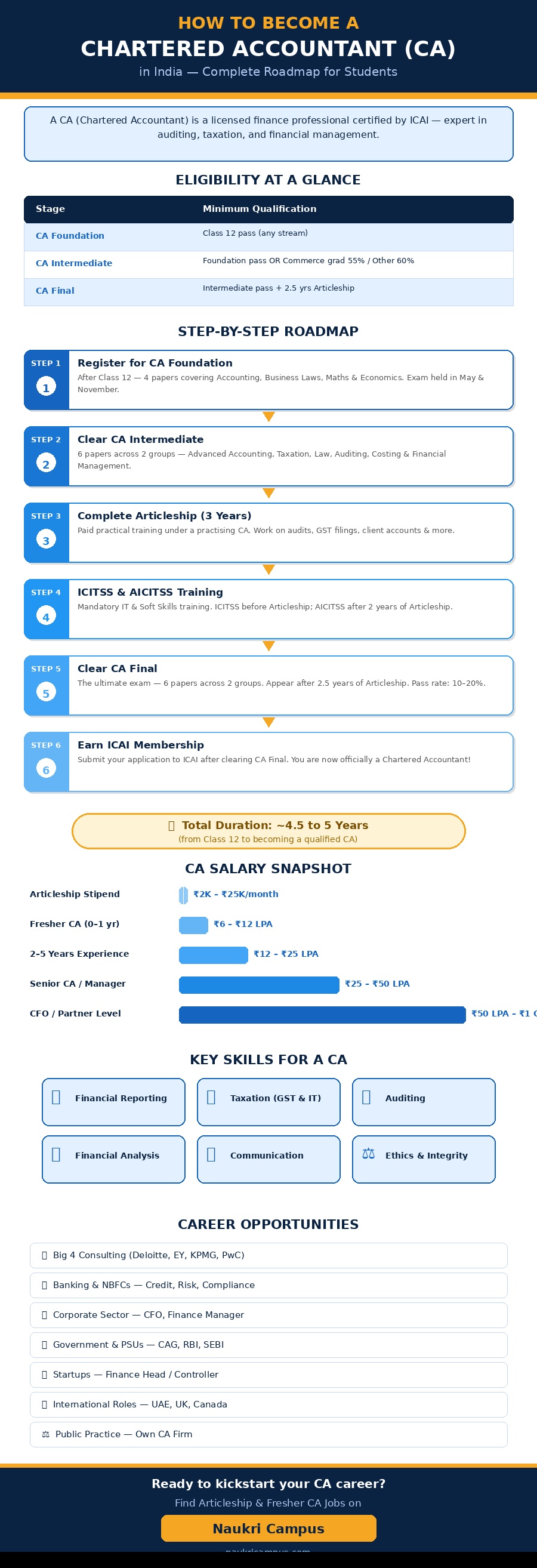
The process to become a chartered accountant can be very rewarding. To become a CA, follow the steps:
Step 1: Register for CA Foundation (After Class 12)
The journey officially starts after Class 12. You register with ICAI for the CA Foundation course, which is the entry-level exam.
CA Foundation has 4 papers:
- Paper 1: Principles and Practice of Accounting
- Paper 2: Business Laws
- Paper 3: Quantitative Aptitude
- Paper 4: Business Economics
The exam is held twice a year — in May/June and November/December.
Step 2: Clear CA Intermediate
After clearing Foundation, you move to CA Intermediate, a two-group exam that tests deeper knowledge of accounting, taxation, law, and auditing.
| Group | Papers |
| Group 1 | Advanced Accounting, Corporate & Other Laws, Taxation |
| Group 2 | Cost & Management Accounting, Auditing & Ethics, Financial Management & Strategic Management |
You can appear for one or both groups together. Passing both groups clears CA Intermediate.
Step 3: Complete Articleship (3 Years of Practical Training)
This is the most unique and important part of the CA journey. After clearing at least one group of CA Intermediate, you begin a 3-year paid articleship under a practicing CA.
Articleship is not just a formality. It’s where you actually do the job, filing GST returns, sitting in audit meetings, handling client queries, and working under real financial pressure. Most students consider this the most valuable part of their training.
Tip for students: Articleship firms range from Big 4s (Deloitte, EY, KPMG, and PwC) to mid-size and boutique CA firms. Getting into a reputed firm can significantly shape your career. Browse articleship opportunities early; platforms like Naukri Campus list articleship and internship openings from top CA firms across India, making it easier to find the right fit for your profile.
Step 4: Clear CA Final
The final hurdle. CA Final is the most advanced and challenging exam in the entire journey.
| Group | Papers |
| Group 1 | Financial Reporting, Advanced Financial Management, Advanced Auditing & Professional Ethics |
| Group 2 | Direct Tax Laws & International Taxation, Indirect Tax Laws, Integrated Business Solutions (Case Study) |
You can appear for the CA final only after completing 2.5 years of articleship. The pass rates are typically in the range of 10–20%, which is why preparation must begin well in advance.
Step 5: Complete ICITSS and AICITSS Training
ICAI mandates two IT and soft skills training programs:
- ICITSS (Integrated Course on Information Technology and Soft Skills): Must be done after the foundation and before the articleship.
- AICITSS (Advanced ICITSS): Must be done after 2 years of articleship and before appearing in CA Final.
Step 6: Apply for ICAI Membership
Once you clear CA Final and complete all training requirements, you apply for ICAI membership and receive your CA designation. You are now officially a chartered accountant.
How to Become a CA After 12th
This is the most-searched question by students right out of school. Here’s a realistic timeline:
| Year | Milestone |
| After Class 12 | Register for CA Foundation |
| 4–6 months later | Appear and clear the CA Foundation |
| Next 8–12 months | Clear CA Intermediate (one or both groups) |
| Years 1–3 | Articleship + ICITSS/AICITSS training |
| Year 3–4 | Appear and clear CA Final |
| After completion | Apply for ICAI membership → Become a CA |
Total duration: Approximately 4.5 to 5 years (if exams are cleared in the first or second attempt).
CA Chartered Accountant Skills You Need to Develop
Beyond clearing exams, employers look for a specific set of CA chartered accountant skills in the real world.
| Skill Category | Examples |
| Technical Skills | Financial reporting (Ind AS, IFRS), Taxation (Income Tax, GST), Auditing standards, ERP tools (SAP, Tally), Excel advanced functions |
| Analytical Skills | Ratio analysis, variance analysis, cash flow modelling, and financial forecasting |
| Communication Skills | Presenting financial data to clients, writing audit reports, and liaising with regulatory authorities |
| Attention to Detail | Spotting errors in financial statements, reconciling ledgers, and ensuring regulatory compliance |
| Ethics & Integrity | Maintaining client confidentiality and adherence to the ICAI Code of Ethics |
| Time Management | Managing multiple clients and deadlines simultaneously, especially during tax season |
If you’re not sure which skills to highlight when applying for your first job, Naukri Campus has resume-building tools and job listings specifically for freshers and CA students, helping you present your articleship experience in the most impactful way.
Professional Certifications Needed for a CA Chartered Accountant
While the CA designation itself is a powerful credential, many CAs pursue additional certifications to specialize:
| Certification | Relevance |
| CFA (Chartered Financial Analyst) | Investment banking, equity research, portfolio management |
| CPA (Certified Public Accountant – US) | International accounting roles, US GAAP compliance |
| CIA (Certified Internal Auditor) | Internal audit and risk management roles |
| DISA (Diploma in Information System Audit) | IT audit, cybersecurity compliance—offered by ICAI |
| Concurrent Audit Certification | Banking sector audit roles |
| Forensic Accounting Certification | Fraud investigation, litigation support |
| ACCA (Association of Chartered Certified Accountants) | Global accounting roles, particularly UK and Middle East markets |
These certifications are not mandatory to work as a CA in India, but they dramatically expand your career options and earning potential.
CA Chartered Accountant Pay
One of the biggest motivators and questions for students is the CA chartered accountant salary in India. Here’s a realistic picture:
| Stage / Experience | Approximate Annual Salary (India) |
| Articleship Stipend | ₹2,000 – ₹25,000/month (varies by firm and city) |
| Fresher CA (0–1 year) | ₹6 – ₹12 LPA |
| CA with 2–5 years experience | ₹12 – ₹25 LPA |
| Senior CA / Manager (5–10 years) | ₹25 – ₹50 LPA |
| Partner at CA Firm / CFO role | ₹50 LPA – ₹1 Cr+ |
| Big 4 Freshers (Campus Placements) | ₹8 – ₹12 LPA |
Note: ICAI conducts campus placement drives where Big 4 firms, PSUs, and MNCs directly recruit fresh CAs. Median salaries at ICAI campus placements have historically ranged from ₹8–10 LPA for domestic roles. For international placements, packages can go significantly higher.
Career Opportunities for a CA in India and Abroad
This is where the CA qualification truly shines; the career opportunities for a CA are incredibly diverse.
In India:
- Public Practice: Set up your own CA firm and serve individual, SME, and corporate clients
- Corporate Sector: CFO, Finance Manager, Controller roles at Indian companies
- Banking & NBFCs: Credit analysis, compliance, risk management
- Big 4 Consulting: Assurance, Tax, Advisory at Deloitte, EY, KPMG, PwC
- Government & PSUs: Positions in CAG, RBI, SEBI, IRDAI, or public sector banks
- Startups: Finance head roles, startups actively look for CAs who can set up financial systems from scratch
Internationally:
- Middle East (UAE, Saudi Arabia): high demand for tax and compliance roles
- UK, Canada, Australia: CA qualification recognized through MoUs with ICAI
- USA: CPA certification alongside CA is ideal for the US market
Becoming a CA (Chartered Accountant) in India is demanding, but the reward is a career that’s financially strong, intellectually rich, and professionally respected. Whether you want to run your own practice, work at a multinational, or build a startup’s financial backbone, the CA qualification gives you the tools to do all of it.

Ready to take your first step? Explore internship, articleship, and fresher job listings on Naukri Campus and get your CA career off to the right start.
FAQs on CA (Chartered Accountant)
Can I pursue CA along with a regular degree?
Yes. Many students pursue B.Com alongside CA Foundation and Intermediate. The Direct Entry Route even rewards graduation. However, managing both simultaneously requires strict time management.
Is coaching mandatory for CA?
No, but highly recommended, especially for Intermediate and Final. Most students take coaching from ICAI Study Centers or private institutes like ICAI BOS (Board of Studies), Becker, or other reputed names.
What is the CA exam pass percentage?
CA final pass rates typically hover between 10 and 20% per attempt. CA Intermediate and Foundation have higher pass rates (25–40%). This is why most students take 2–4 attempts before clearing, especially the final.
Can I switch to a different career after doing CA?
Absolutely. CA qualifications open doors to investment banking, management consulting, entrepreneurship, and even MBA programs at top B-schools, where ICAI students often receive direct admission benefits.
Where can I find CA fresher jobs and articleship openings?
After clearing your exams and completing articleship, Naukri Campus is one of the best platforms to explore fresher CA roles, Big 4 openings, and campus placement opportunities tailored specifically for finance and accounting graduates in India.
Can I do CA if I have a non-commerce background?
Yes. Science and arts students can pursue CA via the foundation route after Class 12. Alternatively, if you hold a non-commerce graduation degree with 60% marks, you qualify for the Direct Entry Route into CA Intermediate, with no foundation required.
How many attempts does it usually take to clear the CA Final?
Most students clear CA Final in 2–4 attempts. The pass rate per attempt is typically between 10–20%, so don’t be discouraged by a failed attempt. Consistent preparation, quality study material, and mock test practice significantly improve your chances each time.
Is there an age limit to become a CA in India?
No, ICAI has no upper age limit for CA registration or exams. Whether you’re 18 or 35, you can start the CA journey at any point. However, starting early, ideally right after Class 12, gives you the advantage of completing it before your mid-20s.
What is the difference between a CA and a CMA?
A CA (Chartered Accountant) focuses on auditing, taxation, and financial reporting, regulated by the ICAI. A CMA (Cost and Management Accountant) specializes in cost accounting and management accounting, regulated by the ICMAI. Both are respected credentials, but CA has broader industry recognition and typically higher starting salaries.
Do CAs need to keep updating their knowledge after qualifying?
Yes. ICAI mandates Continuing Professional Education (CPE) for all members; a minimum number of CPE hours must be completed every year. This keeps CAs updated on evolving tax laws, accounting standards, and regulatory changes, ensuring their expertise stays relevant throughout their career.