

If you’ve been scrolling through LinkedIn or job boards lately, you’ve probably noticed Product Manager popping up everywhere, at startups, in big tech, and even in legacy enterprises going digital. It sounds glamorous. It sounds vague. And for most college students, it sounds like something only IIT/IIM grads with 10 years of experience can land. None of that is entirely true.
Product management is one of the most accessible high-growth career tracks for smart, curious graduates, and this guide will break down everything you need to know: what product management actually is, what the job looks like on a day-to-day basis, the key concepts every aspiring PM should know, and a roadmap to land your first role.
Let’s get into it.
What is Product Management?
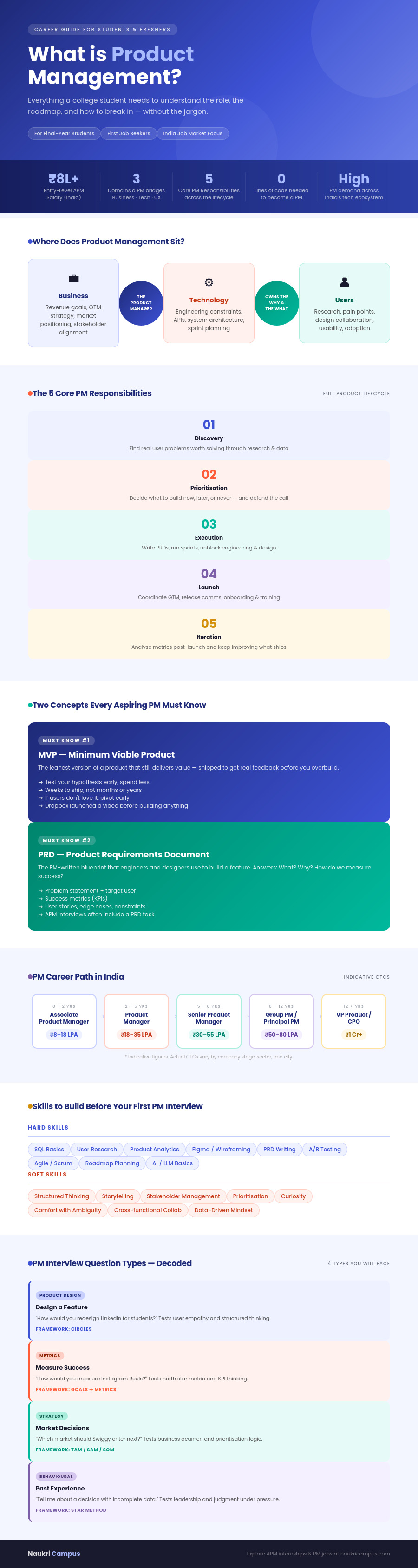
Product management sits at the intersection of business, technology, and user experience, making it one of the most dynamic roles in any company.
Product management is the function responsible for guiding a product, a digital app, a SaaS platform, or a consumer website from an idea all the way to the hands of its users and then continuously improving it based on feedback and data.
A product manager (PM) is essentially the person who owns the “why” and “what” of a product. They don’t write code, design screens, or run marketing campaigns, but they define what gets built, why it gets built, and what success looks like. Think of them as the CEO of a product, minus the org-wide authority.
In practical terms, product management involves:
- Identifying user problems through research, interviews, and data analysis
- Defining the product vision and roadmap, where the product is headed, and in what priority
- Collaborating with engineering, design, marketing, and sales to bring features to life
- Measuring outcomes after launch and iterating based on what works
For students new to this world, a simple mental model: if you’ve ever used an app and thought, “Why doesn’t this feature exist?” or “This is so broken,” the product manager owns that problem.
What Does a Product Manager Do?
A product manager wears many hats: strategist, communicator, analyst, and user champion, often all in the same week.

On paper, a product manager “manages the product.” In reality, no two days look the same. Here’s what a PM’s week might actually look like:
- Monday: Review last week’s product metrics — DAU (daily active users), conversion rates, feature adoption. Identify what moved and what didn’t.
- Tuesday: Run a user research session or review customer support tickets to understand pain points.
- Wednesday: Write a PRD (Product Requirements Document) for an upcoming feature. Sync with the engineering team to estimate effort and timelines.
- Thursday: Present the product roadmap to leadership. Push back on a request from the sales team that doesn’t align with the user’s core needs.
- Friday: Review designs from the UX team. Sign off on a release. Update the backlog for the next sprint.
The core responsibilities of a product manager break down across five stages of the product lifecycle:
| PM Responsibility | What It Means | Key Activities |
| Discovery | Find the right problems to solve | User interviews, competitive research, data analysis, survey synthesis |
| Prioritization | Decide what gets built and when | Roadmap planning, effort vs. impact scoring, stakeholder alignment |
| Execution | Keep the build on track | Sprint planning, writing PRDs, unblocking the engineering/design team |
| Launch | Get the product into users’ hands | GTM coordination, release notes, onboarding copy, internal training |
| Iteration | Improve based on what you learn | A/B test analysis, feature flags, user feedback loops, metric review |
One thing students often ask: “Do I need to know how to code?” The short answer is no, but you need to be technically literate. You need to understand how systems work well enough to have intelligent conversations with engineers and know what’s feasible.
Key PM Concepts You Must Know: MVP and PRD
Before diving into any PM job application or interview, two concepts will come up constantly — MVP and PRD. Understanding them signals that you’re serious.
What is an MVP in Product Management?
MVP stands for Minimum Viable Product. It’s the simplest, most stripped-down version of a product that still delivers value to the user and can be shipped to get real-world feedback.
The logic behind an MVP is straightforward: instead of spending 12 months building a full-featured product that might not solve the right problem, you build the smallest version that tests your core hypothesis. If users love the MVP, you build more of it. If they don’t, you pivot early, before wasting resources.
Classic example: Dropbox didn’t build a full product first. They launched a simple explainer video to test whether people actually wanted cloud file storage. The waitlist exploded. Only then did they build the product.
Here’s how an MVP approach differs from building a fully-featured product upfront:
| MVP Approach | Full Product Approach | |
| Time to ship | Weeks to months | 6–18 months |
| Cost | Low | High |
| Risk | Low — test before you commit | High — invest before validation |
| Learning | Early, real-world feedback | Feedback only after full build |
| Flexibility | Easy to pivot or kill | Hard and expensive to change direction |
| Best for | New ideas, unproven hypotheses | Established products with known demand |
For aspiring PMs, understanding the MVP concept means knowing how to avoid over-engineering and ship fast, learn fast, and improve fast.
What is PRD in Product Management?
A PRD (Product Requirements Document) is the blueprint a product manager writes before a feature gets built. It answers three questions:
- What are we building?
- Why are we building it?
- How will we know if it worked?
A well-structured PRD typically contains these sections:
| PRD Section | What Goes Here |
| Problem Statement | The user pain point or business gap this feature addresses |
| Target User | Who specifically will use this—persona, behaviour, context |
| Goals & Success Metrics | KPIs that define whether the feature worked (e.g., +15% activation rate) |
| User Stories | “As a [user], I want to [do X] so that…” |
| Scope | What is and isn’t included in this version |
| Edge Cases | Unusual scenarios the dev team needs to handle |
| Technical & Design Constraints | API limitations, platform restrictions, brand guidelines |
| Timeline | Target launch date and key milestones |
Writing a crisp, well-reasoned PRD is one of the most important skills you can build as a student trying to break into PM. Many interview processes for associate PM (APM) roles will actually ask you to write one as a take-home assignment.
What is Digital Product Management?
Digital product management focuses specifically on software, apps, and online platforms, and it’s the dominant form of PM in today’s market.
Digital product management refers to managing products that exist entirely or primarily in the digital space: mobile apps, web platforms, SaaS tools, e-commerce sites, and more. As opposed to physical product management (think FMCG or manufacturing), digital PM deals with software development cycles, A/B testing, analytics dashboards, and continuous deployment.
If you’re a college student aiming for a PM role in a tech company, an edtech platform, a fintech startup, or an e-commerce brand, digital product management is exactly what you’ll be doing.
Key areas unique to digital product management include:
- Agile and Scrum methodology — iterative development cycles called “sprints.”
- Analytics tools like Mixpanel, Amplitude, or Google Analytics to track user behaviour
- A/B testing — running experiments to make data-backed decisions
- API understanding — knowing how different software components communicate
- UX collaboration — working closely with designers on user flows and wireframes
Here are the core tools a digital PM works with, worth getting familiar with before your first interview:
| Tool Category | Popular Tools | What You Use It For |
| Product Documentation | Notion, Confluence | Writing PRDs, roadmaps, and sprint notes |
| Project & Sprint Management | Jira, Linear, Asana | Managing backlogs, tracking dev progress |
| Design Collaboration | Figma, Miro | Reviewing wireframes, creating user flow diagrams |
| Analytics & Data | Mixpanel, Amplitude, Google Analytics | Tracking user behaviour, feature adoption, funnels |
| User Research | Hotjar, Maze, UserTesting | Session recordings, usability testing, surveys |
| A/B Testing | Optimizely, VWO, LaunchDarkly | Running experiments, managing feature flags |
| SQL / Data Queries | MySQL, BigQuery, Metabase | Pulling product data without relying on analysts |
The digital PM space in India is booming. Companies like Flipkart, Swiggy, BYJU’S, Razorpay, and Nykaa all have large product teams and hire fresh graduates at the associate PM level.
What is AI Product Management?
AI product management is one of the fastest-growing specializations in tech right now, and getting familiar with it early puts you miles ahead.
AI product management involves building and managing products that are powered by artificial intelligence, machine learning, or large language models. It’s a relatively new but rapidly expanding specialization.
As a student, you’re probably already interacting with AI products daily: the recommendation engine on YouTube, the spam filter in Gmail, and the chatbot on a customer support page. Someone is managing those AI features. That someone is an AI PM.
What makes AI product management different from traditional digital PM:
- You need a working understanding of how ML models are trained and what affects their performance (though you don’t need to build them)
- AI products have unique failure modes: model bias, hallucinations, and data drift that PMs need to account for
- The feedback loop is different: you’re not just tracking clicks, but also model accuracy, confidence scores, and user override rates
- Ethical considerations, fairness, transparency, and user consent are a central part of the roadmap conversation
With generative AI reshaping industries, every major product team is now integrating AI features. Aspiring PMs who understand prompt engineering basics, LLM capabilities and limitations, and AI ethics will have a genuine edge in the hiring market.
Some companies, especially in edtech, fintech, and health tech, are specifically hiring for AI APM (associate product manager) roles.
Why is Product Management a Good Career?
Here’s why product management is one of the best career bets you can make coming out of college:
- Compensation is excellent. Entry-level APM roles in India typically pay ₹8–18 LPA at funded startups and larger tech firms. Senior PMs and Group PMs at Series B+ companies or Big Tech often earn ₹30–70 LPA. The ceiling is high.
Here’s a quick look at the typical PM career ladder in India:
| Role | Experience | Typical CTC (India) | What You Own |
| Associate Product Manager (APM) | 0–2 years | ₹8–18 LPA | A feature or sub-product area |
| Product Manager (PM) | 2–5 years | ₹18–35 LPA | A full product or major product area |
| Senior Product Manager | 5–8 years | ₹30–55 LPA | Multiple product areas, junior PM mentoring |
| Group PM / Principal PM | 8–12 years | ₹50–80 LPA | A product portfolio, cross-team strategy |
| Director of Product / VP Product | 10+ years | ₹80 LPA–1.5 Cr+ | Org-wide product strategy, team leadership |
| Chief Product Officer (CPO) | 15+ years | ₹1.5 Cr+ | Company-level product vision |
Note: Figures are indicative and vary significantly by company stage, funding, and sector.
- You own something that matters. Unlike many early-career roles where you’re executing small pieces of a large puzzle, PMs have ownership. You define what gets built, influence strategy, and see direct user impact from your decisions.
- The skill set is transferable. A background in PM gives you pathways to entrepreneurship, consulting, VC, and general management. Many founders and startup CEOs come from product backgrounds.
- The learning curve is steep and stimulating. No two products are the same. You’re constantly switching context: data analysis one hour, user research the next, and stakeholder presentation after that. If you like variety, PM is ideal.
- The job market is growing. India’s product ecosystem is driven by SaaS, fintech, edtech, and consumer internet, which is expanding rapidly. Demand for skilled PMs is outpacing supply, which creates a genuine opportunity for well-prepared freshers.
How to Become a Product Manager – Complete Roadmap
Breaking into product management without prior experience is challenging but very doable with the right approach. Here’s a practical roadmap:
Step 1: Build the Foundational Skills
Start with the basics. Learn about Agile methodology, user research techniques, product analytics, and UX principles. Free and paid resources like Reforge, Product School, Coursera (Google’s PM Certificate), and books like Inspired by Marty Cagan are excellent starting points.
Step 2: Work on Real or Side Projects
Nothing signals PM readiness more than having built or contributed to a product. This could mean:
- Building a simple app or website and iterating based on user feedback
- Contributing to a college club’s digital platform
- Taking up freelance or internship projects that involve defining features or improving UX
Step 3: Build a PM Portfolio
Create case studies, problem statements, your analysis, solutions you proposed, and what outcome you’d measure success by. Even hypothetical product teardowns (“How would I improve Google Maps’ transit feature?”) demonstrate product thinking.
Step 4: Pursue APM or PM Internship Roles
Look for Associate Product Manager (APM) programs, such as those of Flipkart, Meesho, Razorpay, and several edtech companies that run structured APM tracks for fresh graduates. These are competitive but attainable with good preparation.
Step 5: Network Actively
Join PM communities on Discord, Slack, and LinkedIn. Follow PMs at companies you admire. Many APM offers happen through referrals or community conversations, not just job portals.
Product Management Interview Questions
Product management interview questions are unlike any other. They don’t just test knowledge; they test how you think. Here’s a breakdown of every question type you’ll face, with examples and the framework to crack each one:
| Question Type | Example Question | What It Tests | Recommended Framework |
| Product Design | “How would you redesign the LinkedIn profile page for college students?” | User empathy, structured problem-solving, and creativity | CIRCLES Method |
| Metrics & Analytics | “How would you measure the success of Instagram Reels?” | Understanding of KPIs, north star metrics, funnel thinking | Goals → Metrics → Guardrails |
| Estimation / Guesstimate | “How many people in India use food delivery apps daily?” | Structured thinking, comfort with ambiguity, logical reasoning | Segmentation approach |
| Product Strategy | “Which market should Swiggy enter next — grocery or travel?” | Business acumen, competitive awareness, prioritisation logic | Market sizing + TAM/SAM/SOM |
| Behavioural | “Tell me about a time you had to make a decision with incomplete data.” | Leadership, judgment, communication under pressure | STAR Method |
| Technical | “How does a recommendation engine work at a high level?” | Technical literacy, ability to work with engineers | Conceptual explanation + tradeoffs |
| Prioritisation | “You have 3 feature requests and 1 sprint — how do you decide?” | Judgment, stakeholder management, impact thinking | RICE or MoSCoW scoring |
Common PM Interview Questions for Freshers:
- What is your favorite product, and how would you improve it?
- How do you prioritize features when everything seems urgent?
- Walk me through how you would launch a new feature for [specific app].
- What metrics would you track for a newly launched onboarding flow?
- How would you decide between two competing feature requests?
Tip: Use structured frameworks like CIRCLES (for product design), MECE thinking (for analysis), and STAR (for behavioral answers).
Difference between a Product Manager and a Project Manager
These two roles are often confused but are very different in scope and accountability:
| Product Manager | Project Manager | |
| Focus | What to build and why | How and when to deliver it |
| Owns | Product vision and strategy | Timeline, resources, and execution |
| Success looks like | User adoption, revenue, retention | On-time, on-budget delivery |
| Mindset | Outcome-driven | Output-driven |
| Works with | Engineering, design, marketing, data | Cross-functional teams, vendors, stakeholders |
| Common tools | Figma, Mixpanel, Amplitude, Jira | MS Project, Asana, Smartsheet |
They’re complementary roles in many companies, especially startups; a PM plays both.
Conclusion
Product management is not for everyone, and that’s okay. It’s the right career path if you’re someone who loves solving user problems, is comfortable with ambiguity, enjoys collaborating across functions, and is energized by having ownership over outcomes.
If you’re a college student reading this, the best time to start building toward a PM career is now, before you graduate. Build your product thinking, document your learning, work on side projects, and stay curious about the products you use every day.
FAQs on Product Management
Is product management a technical or non-technical role?
Product management is primarily non-technical, but technical literacy is essential. You don’t code, but you need to understand technical concepts well enough to collaborate with engineers, evaluate feasibility, and make informed tradeoffs.
Can a student from a non-engineering background get into product management?
Absolutely. Many successful PMs come from design, business, economics, and even humanities backgrounds. What matters more is structured thinking, curiosity, and communication ability than your degree.
What tools should an aspiring PM learn?
Start with Figma (for design collaboration), Notion or Confluence (for documentation), Jira or Linear (for sprint management), and Mixpanel or Google Analytics (for data). SQL basics are a major bonus.
How is AI changing product management?
AI is transforming both the products PMs build and the way they work. PMs are now building AI-powered features, using AI tools for faster research and documentation, and grappling with new challenges like model bias and data privacy. AI fluency is fast becoming a baseline expectation.
Do I need an MBA to get into product management?
No, an MBA is not a requirement for product management, though it can help in certain contexts. Most tech companies, startups, and product-first organizations hire PMs based on demonstrated product thinking, analytical ability, and relevant skills, not degrees. That said, an MBA can accelerate your path to senior or strategic PM roles, especially at traditional enterprises or consulting-adjacent companies.
What is the difference between a Product Manager and a Business Analyst?
Both roles work closely together, but their scope and ownership are quite different. A business analyst (BA) typically focuses on gathering and documenting requirements, analyzing data, and bridging the gap between business stakeholders and the technical team. They answer, “What does the system need to do?” A product manager owns the full product vision; they decide what to build, why, and what success looks like. In many companies, especially early-stage startups, a PM absorbs some BA responsibilities.