





Citrix interview experience Real time questions & tips from candidates to crack your interview

SDE - 1
Citrix


4 rounds | 6 Coding
problems

 Selected
 Interview preparation journey

Preparation
Duration: 3 months
Topics: Data Structures, Algorithms, Databases, Operating systems, AWS basics.

Tip 1 : Practice at least 300 questions
Tip 2 : Have 2 projects on your resume.
Tip 3 : Upload projects and add a link in resume. update readme of project highlighting how to setup the project
Application process
Where: Campus
Eligibility: 8.5 CGPA
Tip 1: 1 or 2 pages max
Tip 2: Mention frameworks for each project put up on the resume

Interview rounds
01
Round
Medium
Online Coding Interview
Duration60 minutes
Interview date2 Jul 2019
Coding problem3
2 DSA problems and 30 MCQ's
1. MCQ Questions
Logical reasoning and aptitude
Number Of MCQs - 30
2. Snake and Ladder
Moderate
30m average time
60% success

0/80
Asked in companies



You have been given a Snake and Ladder Board with 'N' rows and 'N' columns with the numbers written from 1 to (N*N) starting from the bottom left of the board, and alternating direction each row.
For example
For a (6 x 6) board, the numbers are written as follows:
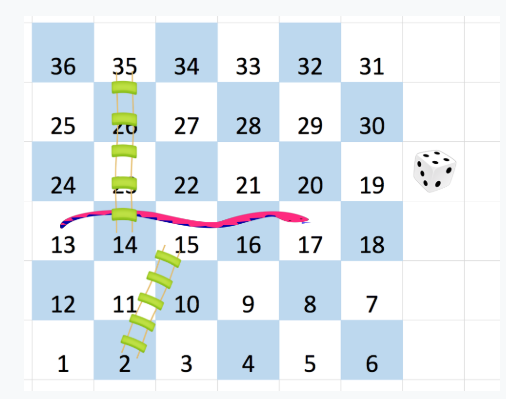
You start from square 1 of the board (which is always in the last row and first column). On each square say 'X', you can throw a dice which can have six outcomes and you have total control over the outcome of dice throw and you want to find out the minimum number of throws required to reach the last cell.
Some of the squares contain Snakes and Ladders, and these are possibilities of a throw at square 'X':
You choose a destination square 'S' with number 'X+1', 'X+2', 'X+3', 'X+4', 'X+5', or 'X+6', provided this number is <= N*N.
If 'S' has a snake or ladder, you move to the destination of that snake or ladder.  Otherwise, you move to S.
A board square on row 'i' and column 'j' has a "Snake or Ladder" if board[i][j] != -1. The destination of that snake or ladder is board[i][j].
Note :
You can only take a snake or ladder at most once per move: if the destination to a snake or ladder is the start of another snake or ladder, you do not continue moving - you have to ignore the snake or ladder present on that square.

For example, if the board is:
-1 1 -1
-1 -1 9
-1 4 -1
Let's say on the first move your destination square is 2  [at row 2, column 1], then you finish your first move at 4 [at row 1, column 2] because you do not continue moving to 9 [at row 0, column 0] by taking the ladder from 4.

A square can also have a Snake or Ladder which will end at the same cell.
For example, if the board is:
-1 3 -1
-1 5 -1
-1 -1 9
Here we can see Snake/Ladder on square 5 [at row 1, column 1] will end on the same square 5.
Problem approach
Create an explicit map and insert the ladder, snake jumping possibilities.
Now declare a queue and a variable level incremented with 1.
Now push 1 to queue and start doing a level order search.
Calculate the size of the queue and traverse on each possible value.
The new position will be x + i if x+i is a value in map then we move to that like pos = m[x+i].
If the new value is n then we return the variable level.
Otherwise if the new position was not visited before then we mark it visited and push it into the queue.
If we are out of queue then we return -1.
3. Longest Palindromic Subsequence
Hard
45m average time
50% success
0/120
Asked in companies



You have been given a string ‘A’ consisting of lower case English letters. Your task is to find the length of the longest palindromic subsequence in ‘A’.
A subsequence is a sequence generated from a string after deleting some or no characters of the string without changing the order of the remaining string characters. (i.e. “ace” is a subsequence of “abcde” while “aec” is not).
A string is said to be palindrome if the reverse of the string is the same as the actual string. For example, “abba” is a palindrome, but “abbc” is not a palindrome.
Problem approach
Dynamic programming approach
1) Reverse the given sequence and store the reverse in another String
2) Now find the longest common subsequence between the 2 strings
02
Round
Medium
Face to Face
Duration30 minutes
Interview date2 Jul 2019
Coding problem2
Face to face round
1. System Design Question
Design the HashMap API in java.
Problem approach
Tip 1 : Create an interface highlighting the methods that the HashMap exposes.
Tip 2 : Create a class that extends this interface.
Tip 3 : Use OOPS properties and properly identify access modifiers for each of the methods in the class.
2. DBMS Question
Design the database for a university containing entities Course, Students and Teachers.
Problem approach
Tip 1 : Clearly mention the attributes of each of the entities
Tip 2 : Mention the primary key of each attribute
Tip 3 : Map the FK and PK references between the entities and highlight the relationship between the 2
03
Round
Medium
Face to Face
Duration45 minutes
Interview date2 Jul 2019
Coding problem1
The interview was a senior engineer having been at Citrix for 3 years
1. Convert binary tree to mirror tree
Easy
15m average time
85% success
0/40
Asked in companies



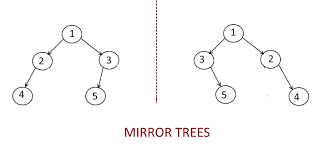
Given a binary tree, convert this binary tree into its mirror tree.
A binary tree is a tree in which each parent node has at most two children.
Mirror of a Tree: Mirror of a Binary Tree T is another Binary Tree M(T) with left and right children of all non-leaf nodes interchanged.
Note:
1. Make in-place changes, that is, modify the nodes given a binary tree to get the required mirror tree.
Problem approach
Recursive solution
1) Recursively call function on both left and right subtree
3) Finally assign left child to right and right child to left using a temp variable
04
Round
Easy
Face to Face
Duration45 minutes
Interview date2 Jul 2019
Coding problem0
Managerial round.
Culture fit check.
Was more of a conversation than interview


Here's your problem of the day 
Solving this problem will increase your chance to get selected in this company
Skill covered: Programming
How do you remove whitespace from the start of a string?
Choose another skill to practice
Similar interview experiences
SDE - 1
2 rounds | 4 problems
Interviewed by Citrix
 Selected
1710 views

0 comments

0 upvotes
SDE - 1
4 rounds | 8 problems
Interviewed by Citrix
Selected 1275 views
0 comments
0 upvotes
Software Engineer
3 rounds | 3 problems
Interviewed by Citrix
 Selected
 1931 views
0 comments
0 upvotes
SDE - 1
4 rounds | 9 problems
Interviewed by Citrix
Selected 1369 views
0 comments
0 upvotes
Companies with similar interview experiences

SDE - 1
5 rounds | 12 problems
Interviewed by Amazon
 Selected
 117551 views
24 comments
0 upvotes
SDE - 1
4 rounds | 5 problems
Interviewed by Microsoft
Selected 60142 views
5 comments
0 upvotes
SDE - 1
3 rounds | 7 problems
Interviewed by Amazon
 Selected
 36137 views
7 comments
0 upvotes