





IBM interview experience Real time questions & tips from candidates to crack your interview

SDE - 1
IBM


2 rounds | 4 Coding
problems

Rejected
Interview preparation journey

Preparation
Duration: 3 Months
Topics: Data Structures, Pointers, OOPS, System Design, Algorithms, Dynamic Programming

Tip 1 : You must have a grip over Data Structures and algorithms. Your concepts must be crystal clear. Pick one coding platform and try to practice at least 7-10 coding questions everyday. I completed around 200+ questions on Leetcode, 200+ questions on Geek For Geeks and around 30-40 questions on InterviewBit.
Tip 2 : After attempting any coding problem, analyze its time and space complexity. See, if you can further optimize your solution. You can always check the editorials and compare your solution with it.
Tip 3 : Apart from coding questions keep studying concepts of Operating Systems, databases and object oriented programming. You can always refer to Geeks For Geeks articles for it. Also, Coding Ninja's Data Structures and algorithms course in C++ helped me a lot in improving my OOPS concepts specifically.
Application process
Where: Campus
Eligibility: Above 7 CGPA
Tip 1 : You do not need to have a long list of projects on your resume. One good project with proper knowledge of it will do good. Similarly, do not list down several number of skills. Few skills but roper knowledge of them are enough.
Tip 2 : Do not fake anything on your resume. The interviewer gets to know about it by asking questions. If you aren't able to answer, it leaves a negative impact.

Interview rounds
01
Round
Easy
Video Call
Duration45 Minutes
Interview date9 Jul 2022
Coding problem2
1. Minimum number of swaps required to sort an array
Easy
10m average time
90% success

0/40
Asked in companies


You have been given an array 'ARR' of 'N' distinct elements.
Your task is to find the minimum no. of swaps required to sort the array.
For example:
For the given input array [4, 3, 2, 1], the minimum no. of swaps required to sort the array is 2, i.e. swap index 0 with 3 and 1 with 2 to form the sorted array [1, 2, 3, 4].
Problem approach
You have been given an array 'ARR' of 'N' distinct elements.
Your task is to find the minimum no. of swaps required to sort the array.
2. Evaluate Division
Moderate
15m average time
85% success
0/80
Asked in companies


You are given an array of pairs of strings 'EQUATIONS', and an array of real numbers 'VALUES'. Each element of the 'EQUATIONS' array denotes a fraction where the first string denotes the numerator variable and the second string denotes the denominator variable, and the corresponding element in 'VALUES' denotes the value this fraction is equal to.
You are given ‘Q’ queries, and each query consists of two strings representing the numerator and the denominator of a fraction. You have to return the value of the given fraction for each query. Return -1 if the value cannot be determined.
Example :
'EQUATIONS' = { {“a”, ”s”} , {“s”, “r”} }
'VALUES' = { 1.5, 2 }
queries = { {“a”, “r” } }

For the above example (a / s) = 1.5 and (s / r) = 2 therefore (a / r) = 1.5 * 2 = 3.
Problem approach
You are given an array of pairs of strings 'EQUATIONS', and an array of real numbers 'VALUES'. Each element of the 'EQUATIONS' array denotes a fraction where the first string denotes the numerator variable and the second string denotes the denominator variable, and the corresponding element in 'VALUES' denotes the value this fraction is equal to.
You are given ‘Q’ queries, and each query consists of two strings representing the numerator and the denominator of a fraction. You have to return the value of the given fraction for each query. Return -1 if the value cannot be determined.
02
Round
Easy
Video Call
Duration45 minutes
Interview date9 Jul 2022
Coding problem2
1. Negative Cycle in a Directed Graph
Moderate
25m average time
75% success
0/80
Asked in company
You have been given a directed weighted graph of ‘N’ vertices labeled from 1 to 'N' and ‘M’ edges. Each edge connecting two nodes 'u' and 'v' has a weight 'w' denoting the distance between them.
Your task is to detect whether the graph contains a negative cycle or not. A negative cycle is a cycle whose edges are such that the sum of their weights is a negative value.
Example:
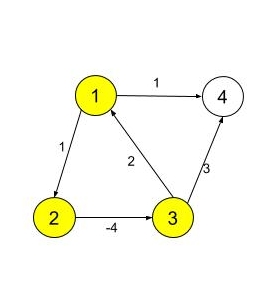
The above graph contains a cycle ( 1 -> 2 -> 3 -> 1 ) and the sum of weights of edges is -1 (1 - 4 + 2 = -1) which is negative. Hence the graph contains a negative cycle.
Note:
It's guaranteed that the graph doesn't contain self-loops and multiple edges.
Problem approach
You have been given a directed weighted graph of ‘N’ vertices labeled from 1 to 'N' and ‘M’ edges. Each edge connecting two nodes 'u' and 'v' has a weight 'w' denoting the distance between them.
Your task is to detect whether the graph contains a negative cycle or not. A negative cycle is a cycle whose edges are such that the sum of their weights is a negative value.
2. OOPS based Questions
Difference between Constructor and Method?
Problem approach
Constructors :
1) A Constructor is a block of code that initializes a newly created object.
2) A Constructor can be used to initialize an object.
3) A Constructor is invoked implicitly by the system
4) A Constructor is invoked when a object is created using the keyword new.
5) A Constructor doesn’t have a return type.
6) A Constructor’s name must be same as the name of the class.
7) A Constructor cannot be inherited by subclasses.
Method :
1) A Method is a collection of statements which returns a value upon its execution.
2) A Method consists of Java/C++ code to be executed.
3) A Method is invoked by the programmer.
4) A Method is invoked through method calls.
5) A Method must have a return type.
6) A Method’s name can be anything.
7) A Method can be inherited by subclasses.


Here's your problem of the day 
Solving this problem will increase your chance to get selected in this company
Skill covered: Programming
How do you remove whitespace from the start of a string?
Choose another skill to practice
Similar interview experiences
SDE - 1
2 rounds | 2 problems
Interviewed by IBM

 Selected
4728 views

0 comments

0 upvotes
SDE - 1
2 rounds | 3 problems
Interviewed by IBM
Rejected
1958 views
0 comments
0 upvotes
SDE - 1
3 rounds | 5 problems
Interviewed by IBM
Selected 2659 views
0 comments
0 upvotes
SDE - 1
2 rounds | 4 problems
Interviewed by IBM
Rejected
1045 views
0 comments
0 upvotes
Companies with similar interview experiences

SDE - 1
5 rounds | 12 problems
Interviewed by Amazon
 Selected
 117552 views
24 comments
0 upvotes

SDE - 1
4 rounds | 5 problems
Interviewed by Microsoft
Selected 60143 views
5 comments
0 upvotes
SDE - 1
3 rounds | 7 problems
Interviewed by Amazon
 Selected
 36138 views
7 comments
0 upvotes