





MakeMyTrip interview experience Real time questions & tips from candidates to crack your interview

Fullstack Developer
MakeMyTrip


4 rounds | 8 Coding
problems

 Selected
 Interview preparation journey

Preparation
Duration: 12 months
Topics: DSA, OOPS, OS, DBMS, Computer Networks, Dynamic Programming, Graphs

Tip 1 : Never lose hope. Just keep working.
Tip 2 : Solve at least 5 problems each day of medium level or 3 questions of hard level with complete understanding.
Tip 3 : Keep at least 3-4 projects in your resume.
Application process
Where: Campus
Eligibility: 8.5 CGPA
Tip 1 : Keep it 1 page.
Tip 2 : Revise it very well before the interview.
Tip 3 : Know your projects in-depth. They might also ask you to show a demo as it is a virtual interview. So, keep them ready before the interview.

Interview rounds
01
Round
Easy
Online Coding Interview
Duration90 minutes
Interview date8 Aug 2021
Coding problem2
2 Coding Questions and 20 MCQ's to be solved in 90 minutes. It was from 6 pm. The camera and screen-recorders were on. The mcq was on web, oops, dbms.
1. Number of Islands II
Hard
45m average time
55% success

0/120
Asked in companies


You have a 2D grid of ‘N’ rows and ‘M’ columns which are initially filled with water. You are given ‘Q’ queries each consisting of two integers ‘X’ and ‘Y’ and in each query operation, you have to turn the water at position (‘X’, ‘Y’) into a land. You are supposed to find the number of islands in the grid after each query.
An island is a group of lands surrounded by water horizontally, vertically, or diagonally.
2. Make Array Elements Equal
Moderate
25m average time
75% success
0/80
Asked in companies


You are given an array of integers of size ‘N’. You have to make the elements of the array equal, and the cost of changing the element ‘x’ to ‘y’ is abs(x -y). Your task is to find the minimum cost to make the elements of the array equal.
For example:
Consider ARR = [3, 4, 5] now suppose if we want to change every element value to 4, then the cost of changing 3 to 4 is |3 - 4| which is 1, and the cost of changing 5 to 4 is |5 - 4| which is 1, so the total cost is 1 + 1 = 2. The value 2 is the minimum cost to make all values in the array equal. Hence, the answer is 2.
02
Round
Medium
Face to Face
Duration70 minutes
Interview date10 Sep 2021
Coding problem5
The interview started with the interviewer asking me about my projects and why and what I have used in them. Be very clear with all the technologies you have used in your project as the interviewer will ask you in-depth about it.
Explain Components, Modules and Services in Angular. What is a Recursive Stored Procedure?
1. Sub Sort
Moderate
15m average time
85% success
0/80
Asked in companies


You are given an integer array ‘ARR’. You have to find the length of the shortest contiguous subarray such that, if you sort this subarray in ascending order, then the whole array will be sorted in ascending order.
An array 'C' is a subarray of array 'D' if it can be obtained by deletion of several elements(possibly zero) from the beginning and the end from array 'D'.
Example:
Let’s say we have an array 'ARR' {10, 12, 20, 30, 25, 40, 32, 31, 35, 50, 60}. Then we have to find the subarray {30 , 25 , 40 , 32 , 31 , 35} and print its length = 5 as our output. Because, when we sort this subarray the whole array will be sorted.
2. Minimum Operations
Easy
20m average time
82% success
0/40
Asked in companies

You are given an array 'ARR' of 'N' positive integers. You need to find the minimum number of operations needed to make all elements of the array equal. You can perform addition, multiplication, subtraction or division with any element on an array element.
Addition, Subtraction, Multiplication or Division on any element of the array will be considered as a single operation.
Example:
If the given array is [1,2,3] then the answer would be 2. One of the ways to make all the elements of the given array equal is by adding 1 to the array element with value 1 and subtracting 1 from the array element with value 3. So that final array would become [2,2,2].
3. Tower of Hanoi
Easy
15m average time
85% success
0/40
Asked in companies


You are given three rods (numbered 1 to 3), and ‘N’ disks initially placed on the first rod, one on top of each other in increasing order of size ( the largest disk is at the bottom). You are supposed to move the ‘N’ disks to another rod(either rod 2 or rod 3) using the following rules and in less than 2 ^ (N) moves.
1. You can only move one disk in one move.
2. You can not place a larger disk on top of a smaller disk.
3. You can only move the disk at the top of any rod.
Note :
You may assume that initially, the size of the ‘i’th disk from the top of the stack is equal to ‘i’, i.e. the disk at the bottom has size ‘N’, the disk above that has size ‘N - 1’, and so on. The disk at the top has size 1.
Example :
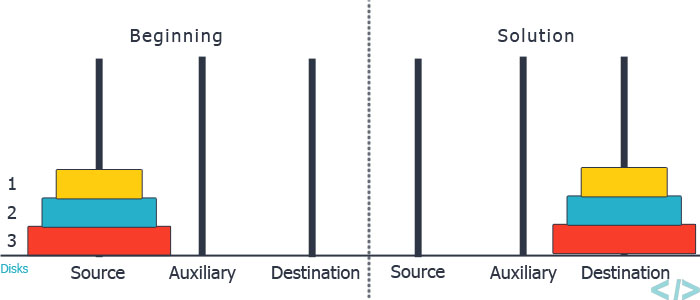
4. Technical Questions
Relationships, Scaling, Load Balancing, and few complex queries on SQL Joins.
5. OS Questions
Multithreading and Semaphore.
03
Round
Easy
Face to Face
Duration30 minutes
Interview date10 Sep 2021
Coding problem1
The interviewer was VP of Engineering at MakeMyTrip with more than 10 years of experience. He asked about the 4 Pillars of OOPS and we had an in-depth discussion with real-life applications for each of them.
1. Square root (decimal)
Easy
10m average time
90% success
0/40
Asked in companies


You have been given two integers 'N' and 'D', Your task is to find the square root of the number 'N' with precision up to 'D' decimal places i.e. the difference between your answer and the correct answer should be less than 10 ^ (-D).
For example if N = 10 and D = 3, then your answer will be 3.162.
04
Round
Easy
HR Round
Duration10 minutes
Interview date10 Sep 2021
Coding problem0
Just a few HR questions and details about my family.


Here's your problem of the day 
Solving this problem will increase your chance to get selected in this company
Skill covered: Programming
How do you remove whitespace from the start of a string?
Choose another skill to practice
Similar interview experiences
Fullstack Developer
4 rounds | 7 problems
Interviewed by MakeMyTrip
 Selected
2437 views

0 comments

0 upvotes
Fullstack Developer
3 rounds | 8 problems
Interviewed by MakeMyTrip
Selected 1164 views
0 comments
0 upvotes
SDE - 1
3 rounds | 3 problems
Interviewed by MakeMyTrip
Selected 1356 views
0 comments
0 upvotes
SDE - 1
3 rounds | 5 problems
Interviewed by MakeMyTrip
Rejected
839 views
0 comments
0 upvotes
Companies with similar interview experiences
Fullstack Developer
6 rounds | 5 problems
Interviewed by Microsoft
Rejected
2527 views
0 comments
0 upvotes

Fullstack Developer
2 rounds | 2 problems
Interviewed by Samsung
Selected 2478 views
0 comments
0 upvotes

Fullstack Developer
2 rounds | 2 problems
Interviewed by Amdocs
Selected 2105 views
0 comments
0 upvotes