





TravClan interview experience Real time questions & tips from candidates to crack your interview

Trainee Technology
TravClan


2 rounds | 5 Coding
problems

 Selected
 Interview preparation journey

Preparation
Duration: 5 months
Topics: Data Structures and Algorithms, Networking, Database Management System, Operating System, Time Complexity, Compiler design, Machine Learning and Artificial intelligence techniques , recursion with backtracking problems and also graph-related algorithms problems

Tip 1 : I practiced a lot of problems related to Data structures on the Coding ninjas platform and other coding platforms.
Tip 2 : If you are stuck somewhere in a problem and want to see reference, first, try to understand the algorithm and then move on to code.
Tip 3 : Just see the algorithm that is how to approach first and don't try to understand from the code right off the bat, code has finer implementation variation that can be done on your own if you are clear with the algorithm. Also for big product companies, prepare enough problems of graphs and trees as these are the most important topics for interviews.
Application process
Where: Campus
Eligibility: No
Tip 1 : Mention a good level of projects in your resume, and also give a brief detail about each and every project.
Tip 2 : Have at least 1 or 2 good projects from which you know everything involved in the project.

Interview rounds
01
Round
Easy
Online Coding Interview
Duration90 minutes
Interview date23 Jan 2021
Coding problem2
This round consist of coding as well as mcq questions
1. Minimum Cost to Destination
Hard
41m average time
30% success

0/120
Asked in companies



You have been given an N*M matrix where there are 'N' rows and 'M' columns filled with '0s' and '1s'.
'1' means you can use the cell, and '0' means the cell is blocked. You can move in the 4 following directions from a particular position (i, j):
1. Left - (i, j-1)
2. Right - (i, j+1)
3. Up - (i-1, j)
4. Down - (i+1, j)
Now, for moving in the up and down directions, it costs you $1, and moving to the left and right directions are free of cost.
You have to calculate the minimum cost to reach (X, Y) from (0, 0) where 'X' is the row number and 'Y' is the column number of the destination cell. If it is impossible to reach the destination, print -1.
2. Maximum Of All Subarrays Of Size k.
Moderate
20m average time
80% success
0/80
Asked in companies


You are given an array consisting of N non-negative integers, and an integer K denoting the length of a subarray, your task is to determine the maximum elements for each subarray of size K.
Note:
A subarray is a contiguous subset of an array.

The array may contain duplicate elements.

The given array follows 0-based indexing.

It is guaranteed that there exists at least one subarray of size K.
02
Round
Easy
Face to Face
Duration36 minutes
Interview date25 Jan 2021
Coding problem3
1. Convert Min Heap To Max Heap
Moderate
25m average time
75% success
0/80
Asked in companies

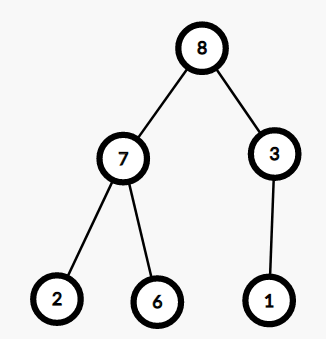
You are given an array of size ‘N’ which is an array representation of min-heap.
You need to convert this min-heap array representation to a max-heap array representation. Return the max-heap array representation.
For Example
Corresponding to given min heap : [1,2,3,6,7,8]
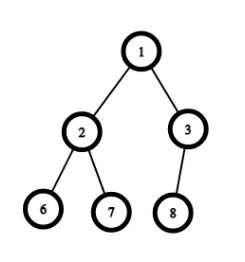
It can be converted to the following max heap: [8,7,3,6,2,1]
2. Sum Between Zeroes
Easy
20m average time
80% success
0/40
Asked in companies


You are given a Singly Linked List which contains a series of integers separated by ‘0’.
Between two zeroes, you have to merge all the nodes lying between them into a single node which contains the sum of all the merged nodes. You have to perform this in place.
Note:
It is guaranteed that there will be no two consecutive zeroes, and there will always be a zero at the beginning and end of the linked list.
3. Snake and Ladder
Moderate
30m average time
60% success
0/80
Asked in companies


You have been given a Snake and Ladder Board with 'N' rows and 'N' columns with the numbers written from 1 to (N*N) starting from the bottom left of the board, and alternating direction each row.
For example
For a (6 x 6) board, the numbers are written as follows:
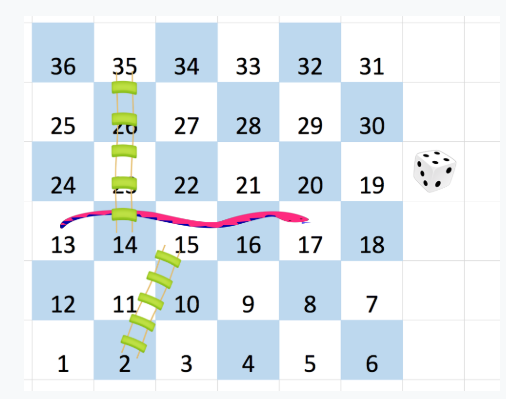
You start from square 1 of the board (which is always in the last row and first column). On each square say 'X', you can throw a dice which can have six outcomes and you have total control over the outcome of dice throw and you want to find out the minimum number of throws required to reach the last cell.
Some of the squares contain Snakes and Ladders, and these are possibilities of a throw at square 'X':
You choose a destination square 'S' with number 'X+1', 'X+2', 'X+3', 'X+4', 'X+5', or 'X+6', provided this number is <= N*N.
If 'S' has a snake or ladder, you move to the destination of that snake or ladder.  Otherwise, you move to S.
A board square on row 'i' and column 'j' has a "Snake or Ladder" if board[i][j] != -1. The destination of that snake or ladder is board[i][j].
Note :
You can only take a snake or ladder at most once per move: if the destination to a snake or ladder is the start of another snake or ladder, you do not continue moving - you have to ignore the snake or ladder present on that square.

For example, if the board is:
-1 1 -1
-1 -1 9
-1 4 -1
Let's say on the first move your destination square is 2  [at row 2, column 1], then you finish your first move at 4 [at row 1, column 2] because you do not continue moving to 9 [at row 0, column 0] by taking the ladder from 4.

A square can also have a Snake or Ladder which will end at the same cell.
For example, if the board is:
-1 3 -1
-1 5 -1
-1 -1 9
Here we can see Snake/Ladder on square 5 [at row 1, column 1] will end on the same square 5.


Here's your problem of the day 
Solving this problem will increase your chance to get selected in this company
Skill covered: Programming
How do you remove whitespace from the start of a string?
Choose another skill to practice
Similar interview experiences
SDE - 1
5 rounds | 6 problems
Interviewed by TravClan

Rejected

0 views

0 comments

0 upvotes
SDE - 1
3 rounds | 4 problems
Interviewed by TravClan
Rejected
935 views
0 comments
0 upvotes
Software Engineer
4 rounds | 7 problems
Interviewed by TravClan
Selected 1197 views
0 comments
0 upvotes

SDE - 1
3 rounds | 9 problems
Interviewed by Salesforce
 Selected
 4552 views
0 comments
0 upvotes
Companies with similar interview experiences

Trainee Technology
2 rounds | 4 problems
Interviewed by HCL Technologies
Rejected
5102 views
0 comments
0 upvotes