Do you think IIT Guwahati certified course can help you in your career?
Introduction
Step Functions is said to be a serverless orchestration service that is used to build business-critical applications by combining AWS Lambda functions and other AWS services. With the help of Step Functions' graphical console, we see our application's workflow as a series of event-driven steps. The Step Functions' built-in controls allow us to examine the state of each step in our workflow and make sure that our application runs in order and as expected. Depending on our use cases, we can have different Step Functions call AWS services, such as AWS Glue or Lambda, to perform tasks.
How AWS Step Functions work?
Here we will describe essential concepts to help you get familiar with AWS Step Functions and understand how it works.
Standard vs. Express Workflows
Step Functions has two workflow types- Standard and Express. Standard workflows have exactly-once workflow execution and can run for up to one year. They are ideal for long-running, auditable workflows. Express workflows have at-least-once workflow execution and can run for up to five minutes, and are ideal for high-event-rate workloads, such as streaming data processing and IoT data ingestion.
States
States are elements in the state machine. They are referred to by their name, which is a string, but it must be unique and within the scope of the whole state machine. It can perform a variety of functions in our state machine, such as:
Complete some work in your state machine (a Task state)
Choose between branches of execution (a Choice state)
Transitions
After executing a state, AWS Step Functions uses the value of the Next field to determine the next state to advance to. For example, the following state includes a transition to NextState.
"SomeState" : {
  ...,
  "Next" : "NextState"
}
State Machine Data
A State machine data takes the following forms: the initial input into a state machine, data passed between states and the output from a state machine to use in AWS Step Functions.
Input and Output Processing
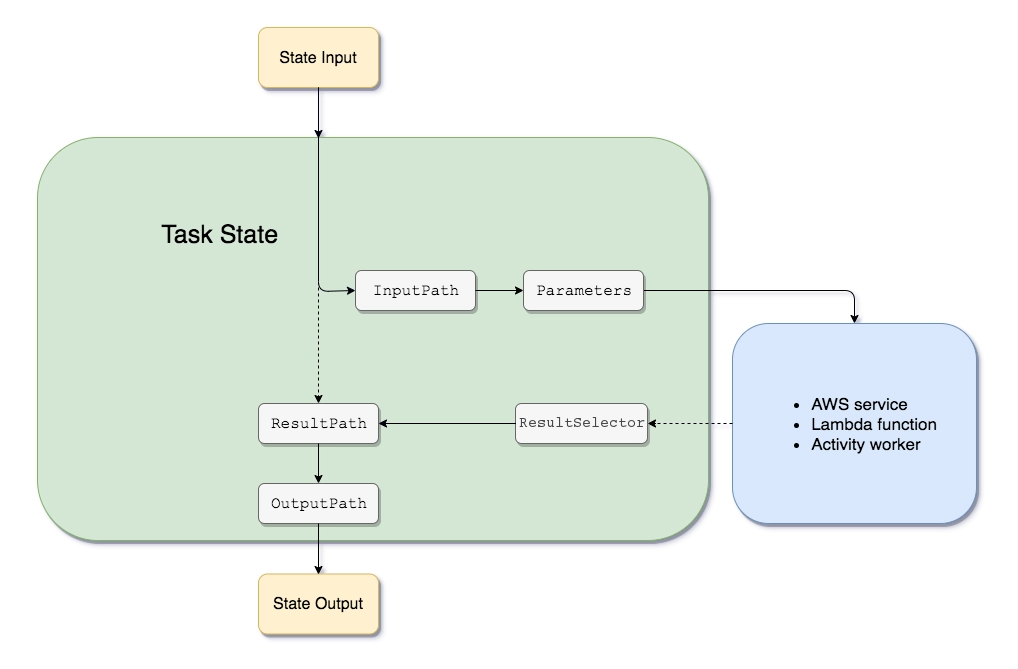
A Step Functions execution receives a JSON text as input and passes that input to the first state in the workflow. Individual states receive JSON as input and usually pass JSON as output to the next state. A general working of processing is shown below.
Any state can encounter runtime errors. It can happen for numerous reasons such as:
Task failures (for example, an exception in a Lambda function)
State machine definition issues (for example, no matching rule in a Choice state)
Transient issues (for example, network partition events)
By default, when a state reports an error, AWS Step Functions causes the execution to fail entirely.
Invoke step functions
We can configure several other services to invoke state machines. We can only invoke state machines asynchronously which returns a response immediately. Some services that can be configured to invoke Step Functions include:
Amazon API Gateway
Amazon EventBridge
AWS CodePipeline
AWS Step Functions
Tagging in Step functions
AWS Step Functions supports tagging of state machines (both Standard and Express) and activities. This can help us manage and track the costs associated with our resources and provide better security in our AWS Identity and Access Management (IAM) policies.
Step Functions manages your application's logic and components, so you can write less code and focus on updating and building your application quickly. Here we will describe typical use cases for working with Step Functions.
Data processing using AWS Step Functions
To make faster and well-informed business decisions, it is essential that organizations quickly process the data they receive from mobile devices, satellites, marketing and sales, applications, operational data stores, infrastructure, and more.
Step Functions provides the reliability, scalability, and availability required to manage your data processing workflows successfully. We can process data faster using parallel executions like Step Functions’ Parallel state type or dynamic parallelism using its Map state type.
Examples of data processing types are:
Converting video files to required formats and resolutions.
Start, create, and terminate an Amazon EMR cluster for big data processing.
Machine learning
Machine learning allows organizations to analyze collected data to identify patterns quickly, then make decisions without any human intervention. This start of the initial data set is known as the training data set. The model is deployed for production only after it is considered accurate enough to meet business needs.
The AWS Step Functions Data Science Software Development Kit (SDK) enables you to create workflows that preprocess data easily, train, and publish your models using Amazon SageMaker and Step Functions.
Some examples of machine learning workflows that use Step Functions include:
Fraud detection
Personalization and Recommendations
Data Enrichment
Microservice orchestration
Microservice architecture disintegrates applications into loosely coupled services. Each microservice is independent, making it easy to scale up a single service or function without needing to scale the entire application. Step Functions enable several ways to manage our microservice workflows. We can use Standard Workflows with the AWS Fargate integration to orchestrate applications running in containers for long-running workflows. Synchronous Express Workflows are ideal for short-duration, high-volume workflows that require an immediate response.
Some examples of some API orchestrations that use Step Functions include:
The changes are immediately visible on the screen in synchronous or real-time workflows, such as changing a value in a record.
Container Orchestration.
IT and security automation
To manage complex and time-consuming operations, such as upgrading and patching software, selecting infrastructure, synchronizing data, and more, Step functions can automatically scale to meet the needs of your business without requiring manual intervention. This helps to complete routine operations quickly and consistently on a large scale and lets us focus on strategic work such as innovation and feature development.
Some examples of the types of automation workflows using Step Functions include:
Automating the deployment of AWS CloudFormation StackSets.
Warning employees of phishing emails within seconds of receipt.
Automating the routing of customer feedback received based on sentiment analysis so that those with negative sentiment are immediately escalated for manual review.
Security in AWS Step Functions
This section will help in providing information about AWS Step Functions authentication and security.
Data protection in AWS Step functions
AWS is in control of protecting the global infrastructure that runs all of the AWS Cloud. It is recommended to protect AWS account credentials and set up individual user accounts with AWS Identity and Access Management (IAM) for data protection purposes.
Identity and Access management in AWS Step Functions
We can use AWS Identity and Access Management (IAM) and Step Functions to help secure our resources by controlling who can access them with the help of user authentication and access controls.
Logging and Monitoring
Logging and monitoring are essential for maintaining Step Functions' availability, reliability, and performance and your AWS solutions. Several tools are available to use with Step Functions, such as logging using CloudWatch Logs, Amazon EventBridge Events, etc.
Resilience in AWS Step Functions
The AWS global infrastructure is built around AWS Regions and Availability Zones. AWS Regions provide multiple physically separated and isolated Availability Zones connected with low-latency, high-throughput, and highly redundant networking. We can operate and design applications and databases that automatically failover between zones without interruption with Availability Zones. Availability Zones are more highly available, fault-tolerant, and scalable than traditional single or multiple data center infrastructures.
Configuration and Vulnerability Analysis in AWS Step Functions
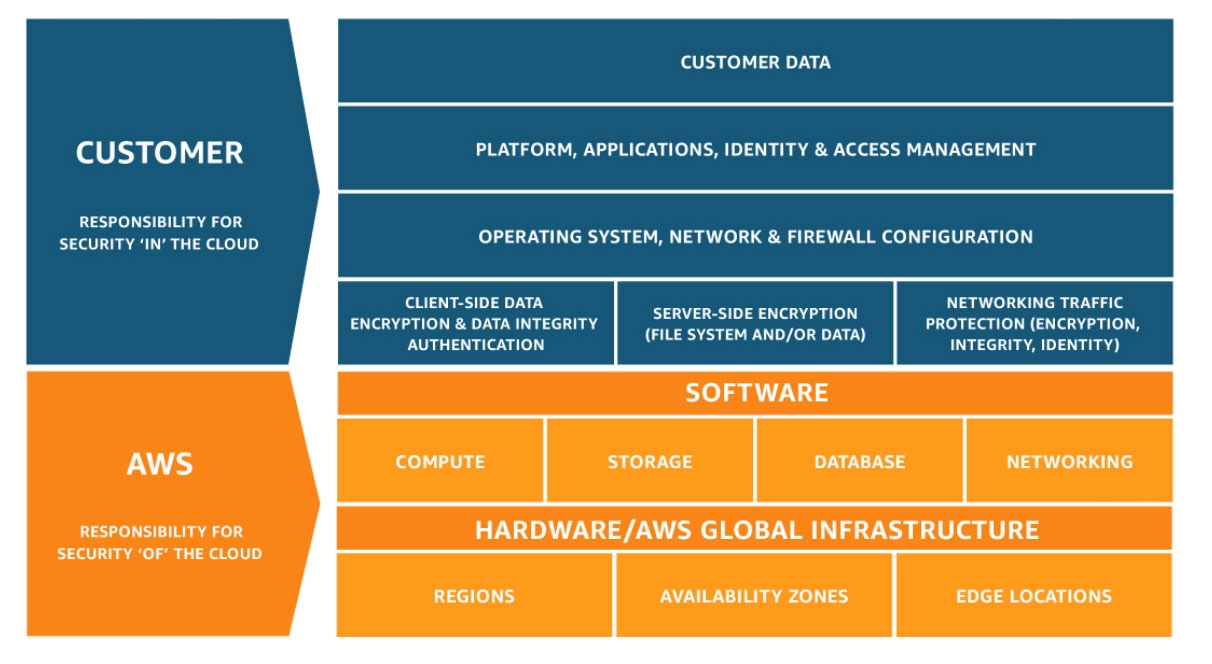
Configuration and IT controls are a shared responsibility between AWS and the customer. . This shared model can help relieve the customer's operational burden. The nature of this shared responsibility also helps provide the customer control and flexibility that allows the deployment. This differentiation of responsibility is commonly referred to as Security "of" the Cloud versus Security "in" the Cloud, as shown in the chart below:
They are fully managed services that makes it effortless to coordinate the components of microservices and distributed applications using visual workflows. It even logs the state of each step, so when things do go wrong, we can diagnose and debug problems quickly. We can change and add steps without even writing code to evolve your application and quickly innovate.
What are some standard AWS Step Functions use cases?
Some Step Functions use cases are:
DevOps and IT automation: build tools for continuous deployment and continuous integration, or create event-driven applications that automatically respond to changes in infrastructure.
E-commerce: automate mission-critical business processes, such as inventory tracking and order fulfillment.
Web applications: implement robust user registration processes and sign-on authentication.
How do AWS Step Functions connect and coordinate other AWS services?
You create workflows with AWS Step Functions that can coordinate and connect over 200 AWS services using Service Integrations. For example,
Invoking an AWS Lambda function
Running an Amazon Elastic Container Service or AWS Fargate task
Publishing a message to an Amazon SNS topic
Submit an AWS Batch job and wait for it to complete
List some of the compliance standards supported by Step Functions?
AWS Step Functions conform to HIPAA, FedRAMP, SOC, GDPR, and other common compliance standards.
What are the languages used by AWS step functions?
AWS Step Functions state machines are defined in JSON using the declarative Amazon States Language. For convenience, we may use an AWS SDK in the language of our choosing. AWS Lambda supports code written in Python, Golang (Go), Node.js (JavaScript), and C# (using the .NET Core runtime and other languages).
Conclusion
I hope this article helps you provide some meaningful insights on AWS Step Functions. We learned about its basic working, use cases, and definition and discussed security in the Step functions.
We hope that this blog has helped you increase your knowledge regarding AWS Step functions, and if you liked this blog, check other links. Do upvote our blog to help other ninjas grow. Happy Coding!"
Live masterclass
Ace 6-Figure GenAI Roles with AI-Engineering tool-kit
by Shantanu Shubham
29 Oct, 2026
11:30 AM
Build Your Own AI Data Analyst Using SQL + GenAI for 20L+ CTC
by Sumit Shukla
26 Oct, 2026
11:30 AM
Beyond Chatbots: Build an AI Support Agent & Prepare for AI Engineer Interviews
by Yogesh
27 Oct, 2026
11:30 AM
Prompt-to-Dashboard: Build Power BI Reports Faster with GenAI
by Abhishek Soni
28 Oct, 2026
11:30 AM
Ace 6-Figure GenAI Roles with AI-Engineering tool-kit
by Shantanu Shubham
29 Oct, 2026
11:30 AM
Build Your Own AI Data Analyst Using SQL + GenAI for 20L+ CTC






 7+ registered

