Get a skill gap analysis, personalised roadmap, and AI-powered resume optimisation.
Introduction
In SQL, the cartesian product is an operation that combines every row from one table to another. It returns a new table that has values of both tables. The Cartesian product is used when you want to generate every possible combination of both tables. Many real-life examples can be represented as cartesian products, like decks of cards, chess boards, computer images, and many more.
This article will be exploring the SQL Cartesian Join in more detail, like their Syntax, usage, and future scope.
What is Cartesian Product SQL?
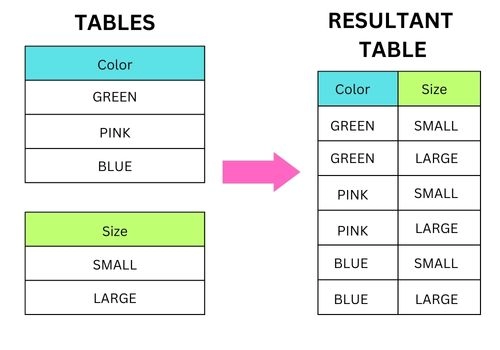
A Cartesian product is a product of two tables whose resultant table consist of all possible and ordered sets. It is useful when you want to combine every row from one table with every row from another table. Order is essential, so we use ordered pairs to obtain a new table from tables A and B.
For example, if there are two tables, A and B, each have 3 and 2 lines, respectively. Then the Cartesian product will have 3 * 2 lines. Each row from the first table joins the second row of the second table. Cartesian products involve a large number of redundant operations. It is always recommended to use qualifier operators for large tables.
The following is the syntax of performing a cartesian product in SQL.
SELECT *
FROM table1
CROSS JOIN table2;
In the next section, you will get a better understanding of using this syntax.
Cartesian Product SQL Implementation
The Cartesian product is implemented using the CROSS JOIN operator. In some cases, a Cartesian Join acts like an INNER JOIN when the WHERE clause has a significant condition. The basic Syntax that is used is:
SYNTAX
SELECT *
FROM table1
CROSS JOIN table2;
This will create a new table that includes all possible and valid combinations of rows from Table 1 and Table 2.
Let's consider two tables. One table has a list of employees, and another has a list of departments. We will find the cartesian product of the two tables by using the below steps.
Example
Let's take an example. Create tables named as ‘employees’ and ‘departments’.
Implementation To Create Table
#create two tables named as employees and departments.
CREATE TABLE employees (
  id INT PRIMARY KEY,
  name VARCHAR(50)
);
CREATE TABLE departments (
  id INT PRIMARY KEY,
  name VARCHAR(50)
);
Output
Now insert the values into these tables using the INSERT function in SQL.
Implementation For Adding Values To The Table
#insert values in employees table
INSERT INTO employees (id, name) VALUES
  (1, 'Ninja_1'),
  (2, 'Ninja_2'),
  (3, 'Ninja_3');

#insert values in departments table
INSERT INTO departments (id, name) VALUES
  (1, 'Writer'),
  (2, 'Reviewer');
Output
Employees table:
Departments table:
Now you can perform cartesian products between ‘employees’ and ‘departments’ using SELECT statement and CROSS JOIN function.
Implementation For Cartesian Product
#now display the whole table using SELECT statement
SELECT * FROM employees CROSS JOIN departments;
Output
Explanation
The first element 'Ninja_1' is taken from Table 1, and the second element, "Writer," is taken from Table 2.
These elements are multiplied to form an ordered pair as "Ninja_1, Writer".
The same step is iterated over other elements of the table. This step is repeated until all the possible combinations are not formed.
The resultant table shows the cartesian product of the elements.
Use Cases Of Cartesian Products in SQL
A Cartesian product in SQL is beneficial when you require all combinations of every row from one table to every row from the other table.
Generate All Possible Combinations
The Cartesian product can generate all possible data combinations from two or more tables. In e-commerce sites, for example, you can generate all viable product and size combinations to create an additional category.
Create Test Data
Cartesian products can be used to generate test data for an application. It will include all possible combinations for testing.
Data Analysis
Cartesian products may be used to determine the link between various types of data.
Limitation of Using Cartesian Product SQL
We are going to discuss some essential limitations regarding Cartesian products in SQL. They are as follows:
Cartesian product operations can be expensive, especially when using large data in table form. When two large data tables are combined, the resultant data table would also be enormous, creating problems in handling or performing any operations.
Cartesian products can create duplicate data, which can cause problems when working with the resulting table.
Cartesian product operations require a lot of memory, especially when working with large tables. The system does contain that much memory to store, which leads to operation failure.
Cartesian products are very complex and challenging to understand.
Alternative ways to achieve the same result as the Cartesian Product
There are many alternative ways to achieve the same result as that of cartesian products in SQL. These ways are:
Let's consider the same table as above and demonstrate alternative ways in which we can achieve the same result as that of a Cartesian product.
Using Implicit Join
You can use Implicit Join to combine two tables without any specific join condition.This is much equivalent to CROSS JOIN.
Implementation
SELECT *
FROM employees, departments;
Output
Using Inner Join:
You can use INNER JOIN to achieve the same result as of the cartesian product. It is only applicable if the condition is true. It is mostly used in cases where there is a need to combine rows with a specific condition.
Implementation
SELECT *
FROM employees
INNER JOIN departments ON 1=1;
Output
Comparison Between Cartesian Product, Implicit Join and Inner Join.
Cartesian Product
Implicit Join
Inner Join
Definition
It returns a resultant set which has the combination for every row from one table to every row from another table.joint
It is a join that is implied by the relationship between the tables
It returns a resultant set that consists of rows that have matching values in both hastables.
Result set
The result set has the cartesian product of all the rows from both the tables.result
The result set hasresult a combination of all the rows from both tables where the join condition is true.
The result set have a combination of only rows from both the tables where the join condition is true.
Performance
Very low performance
Faster than cartesian product but slower than Inner join
What is the difference between Cartesian Product and Inner Join in SQL?
Cartesian Product returns all possible combinations from both tables, whereas INNER JOIN returns only the rows that have the same values in both tables based on the JOIN condition applied.
Can we perform Cartesian Product between a table and itself in SQL?
Yes, we can perform Cartesian Product between a table and itself in SQL. This is known as Self-Join or Self- Cartesian Product. We can do this by using the same for the table for both instances in a CROSS JOIN statement.
How can you handle duplicate rows in a Cartesian product?
You can use the DISTINCT or GROUP BY clause to delete some duplicates present in the resultant table of the Cartesian product.
How can you limit the size of the resultant Cartesian product?
The WHERE clause can filter the result based on a specific condition. You can even use the TOP or LIMIT keyword to limit the number of rows the resultant table returns.
What is the impact of cartesian products in SQL on Query performance?
Cartesian products can significantly impact query performance, especially when used for large tables. To optimize it, you can use filter criteria to limit the number of rows or optimize the performance speed.
Conclusion
Cartesian Product is a powerful tool in SQL. It generates all possible combinations of the data from two or more tables. However, it can create some limitations when large data tables are considered. It is essential to use Cartesian Products to perform well by judging all aspects, like their limitations, challenges, and use cases.
In this article, we learn what a Cartesian Product in SQL is. We even discuss implementing Cartesian Products in SQL using an example. We also discuss some use cases and limitations of the Cartesian Product. We also come across other alternative ways in which we can get the same result as that of the Cartesian Product.
To learn more about such content, check out the link below
You can find more informative articles or blogs on our platform. You can also practice more coding problems and prepare for interview questions from well-known companies on your platform, Coding Ninjas Studio.









 7+ registered

