Do you think IIT Guwahati certified course can help you in your career?
Introduction
Abstraction and data hiding are key principles of object-oriented programming (OOP) that enhance code security, modularity, and simplicity. Data hiding ensures the encapsulation and security of sensitive data, while abstraction allows the modeling of complex systems. Developers can create flexible, modular, and secure codebases by leveraging these concepts effectively, Abstraction and data hiding are some of the main concepts of object-oriented programming(OOPS). Abstraction is a technique for expressing important properties without dealing with the background details. On the other hand, Data Hiding insulates the data by directly accessing it by the application.
Both concepts appear identical in aspect; however, they are not. The abstraction makes it possible to develop real-world objects with similar properties using user-defined data types. On the other hand, data hiding protects the data and function from unauthorized access.
Abstraction is a technique for expressing important properties without dealing with the background details. On the other hand, Data Hiding insulates the data by directly accessing it by the application.
Why Understanding the Difference Matters
In Java programming, understanding the distinction between Abstraction and Data Hiding is more than a theoretical concept—it's a practical necessity. These principles are foundational to writing secure, maintainable, and efficient code. They support better software design and empower developers to build applications that are easier to manage and scale over time.
1. Code Maintainability
Abstraction plays a key role in keeping Java code maintainable. It allows developers to focus on what an object does, not how it does it. When systems grow in complexity, abstraction lets teams make changes to the internal implementation without affecting the external behavior. For instance, consider a PaymentService class with a method processPayment(). The logic for handling credit cards, wallets, or UPI can change internally, but as long as the method signature stays the same, other parts of the application remain untouched.
This level of separation simplifies code upgrades, testing, and bug fixes. In large Java projects, abstracting core behaviors reduces dependencies and avoids ripple effects when modifications are made.
2. Security in Application Design
Data Hiding, implemented using access modifiers like private and protected, ensures that internal object data isn't exposed unnecessarily. It protects sensitive data from external manipulation and restricts direct access to variables. For example, a BankAccount class should not allow other classes to access or change the balance directly. Instead, controlled access via deposit() or withdraw() methods enforces business rules.
This approach reduces vulnerabilities, prevents inconsistent object states, and aligns with Java's emphasis on encapsulation. Especially in applications dealing with personal or financial data, data hiding acts as a first line of defense against accidental misuse or malicious access.
3. Efficient Collaboration in Teams
In collaborative Java projects, clear use of abstraction and data hiding enables modular development. When developers design classes with well-defined interfaces (abstraction) and hide internal details (data hiding), different team members can work independently on separate modules. For instance, a developer working on the UI layer only needs to know what methods a service exposes—not how those methods fetch or process data.
This promotes clean architecture and readable, well-structured code. Misunderstandings are minimized because the contract between classes is clear, and unauthorized access to internals is prevented. It ensures better code reviews, reusability, and fewer integration issues during development.
What is Data Hiding in Java?
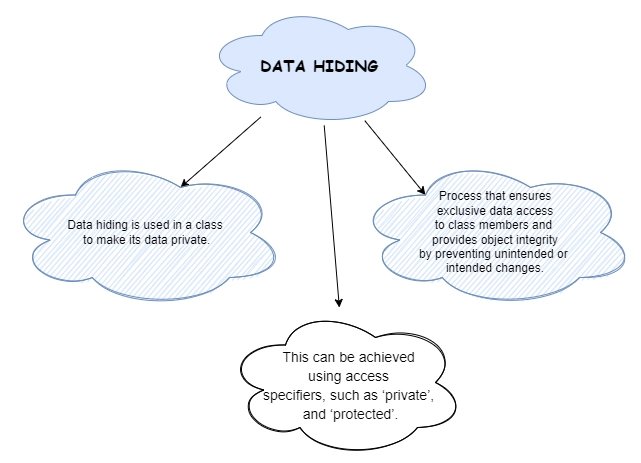
Data hiding in Java is a programming technique used to encapsulate information within a class or module, it restricts access to the data from outside the class or module using access modifiers. It is important to enhance code security, reduce unintended interference, and promote modular design by hiding the implementation details of a class. The term "data hiding" refers to concealing data from program components that don't need to be retrieved. Data hiding helps in the protection of a class's members. Access modifiers such as public, private, and protected are available in programming languages such as Java. Data hiding or information hiding is the process of hiding data from direct access by the program. Encapsulation is used to implement data hiding, which protects a class's data and functions from unauthorized access. On the other hand, Encapsulation occurs when data and functions are encased into a single unit. As a result, data hiding helps in achieving encapsulation.
The data and functions in a class are made private using data hiding so that they cannot be accessed falsely by functions outside the class and are protected from accidental modification. The functional details of an object can be handled through access specifiers.
Implementation of Data Hiding in Java
Java
Java
// Java Program to demonstrate data hiding import java.io.*;
// Class Bank public class Bank {
// Private data (data hiding) private long currBalance = 0;
// Bank_id is checked for authentication long bank_id; String name;
// function to modify private data public long getBalance(long Id) {
// Checking whether the user is // valid or not
// Compare bank_id of user and the give Id // then only it will get access
if (this.bank_id == Id) {
// Return current balance return currBalance; }
// Unauthorised user return -1 return -1; } // Setter function to update the balance public void setBalance(long balance, long Id) { // Compare bank_id of user and the give Id // then only it will get access
if (this.bank_id == Id) { // Update balance in current ID currBalance = currBalance + balance; } } }
// Another class created- Employee public class Emp { public static void main(String[] args) { // Creating employee object of Bank class Bank employee = new Bank();
// employee.getBalance(123456) employee.setBalance(90000, 1909009); // This will not get access as bank_id is given wrong // unauthorised user is not getting access. This is data hiding
long emp_balance = employee.getBalance(12345); // As this time it is valid user it will get access
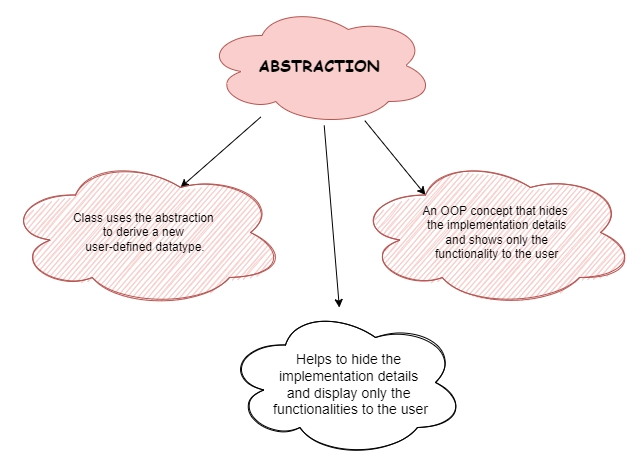
Abstraction hides the internal details and simply displays the user's functionality. It indicates an object's necessary characteristics that distinguish it from other items. To put it in another way, it hides the implementation details while presenting the functionality to the rest of the world. An abstraction concentrates on the external aspect of an object. It establishes a mental barrier in relation to the viewer's perspective. A proper abstraction emphasizes crucial aspects to the reader or user while suppressing irrelevant and deviant characteristics.
Abstraction may be implemented using abstract classes and interfaces in OOP-supporting programming languages like Java. Abstract and non-abstract methods can be found in an abstract class.
The definitions for the abstract class should be provided by a class that extends an abstract class. Furthermore, an interface's methods are all abstract methods. As a result, a class that implements an interface should have definitions for all of the abstract methods. Data abstraction is implemented as a class representing the essential properties without the accompanying explanations.
Types of Abstraction
Procedural abstraction – It includes a series of instructions with specified functions.
Control abstraction – It is a program control mechanism where interior details are not specified.
Data abstraction – It is a set of data that specifies and describes a data object.
Implementation of Abstraction in Java
Java
Java
package oopsconcept;
public abstract class VehicleAbstract {
    public abstract void start();
    public void stop() {
        System.out.println("Stopping Vehicle in abstract class");
    }
}
class TwoWheeler extends VehicleAbstract {
    @Override
    public void start() {
    System.out.println("Starting Two Wheeler");
    }
}
class FourWheeler extends VehicleAbstract {
    @Override
    public void start() {
    System.out.println("Starting Four Wheeler");
    }
}
package oopsconcept;
public class VehicleTesting {
    public static void main(String[] args) {
        VehicleAbstract my2Wheeler = new TwoWheeler();
        VehicleAbstract my4Wheeler = new FourWheeler();
        my2Wheeler.start();
        my2Wheeler.stop();
        my4Wheeler.start();
        my4Wheeler.stop();
    }
}
You can also try this code with Online Java Compiler
The primary advantage of using an Abstraction in programming is that it allows you to group similar classes together as siblings.
Abstraction in Oops(Object-Oriented Programming) helps to reduce the complexity of the design and implementation process.
Difference Between Data Hiding and Abstraction
Abstraction is the process of displaying only essential information to the user. But, in Data Hiding, we simply hide data from some components by ensuring access to only limited members.
The purpose of having abstraction is to hide the complex implementation details of the software. But data hiding is implemented to have encapsulation in the program.
To achieve abstraction, we use abstract classes and interfaces. While for data hiding, we implement getters and setters.
Perameters
Data Hiding
Abstraction
Definition
A concept of concealing the internal implementation details from the user.
A concept of showing only the essential features while hiding unnecessary details.
Usage
Used to ensure controlled access and safeguard the data.
Used to design a system with minimal complexity while showing only relevant details.
Visibility
Details are hidden but can still exist in the program.
Irrelevant details are not even defined in the interface presented to the user.
Purpose
Data hiding protects the data from unauthorized access or modification
Abstraction simplifies the usage and design by focusing on what an object does, not how it does it.
Why Use Abstraction in Real-World Projects
1. Large-scale Software Architecture
In complex Java applications, abstraction is essential to managing large codebases. It hides implementation details and exposes only essential behaviors through abstract classes or interfaces. For example, a PaymentProcessor interface may define a method processPayment(), while different classes (CreditCardProcessor, UPIProcessor) implement the specifics. This approach allows developers to focus on high-level design without worrying about how each payment type is handled internally. It also helps avoid tight coupling between modules. In large enterprise systems like banking or e-commerce, this separation ensures that teams can work on different parts independently, making the system more scalable and easier to maintain.
2. API and Framework Design
Abstraction is the foundation of clean and reusable API design. Java frameworks like Spring expose simplified interfaces (JpaRepository, RestController) that developers use without knowing the internal workings. This consistent abstraction layer allows users to interact with the framework in a predictable way while the complex logic is handled behind the scenes. For example, when calling save() on a repository interface, the actual database logic is abstracted away. This promotes ease of use, reduces learning curves, and encourages code reusability. Frameworks built with abstraction can be extended and adapted for different applications with minimal changes.
3. Code Scalability and Maintenance
Abstraction makes Java code easier to scale and maintain over time. By encapsulating behavior in abstract methods and separating concerns, developers can make enhancements without affecting the rest of the system. For instance, if a NotificationService interface defines sendNotification(), it can be implemented using SMS, email, or push notifications. Adding a new channel doesn’t require modifying existing code, just creating a new implementation. This plug-and-play design encourages modularity and supports agile development practices, where change is constant. It also allows new developers to quickly understand and contribute to specific modules without needing full knowledge of the entire codebase.
Importance of Data Hiding for Security and Maintainability
1. Preventing Direct Access to Sensitive Data
Data hiding in Java ensures that sensitive fields are not directly accessible from outside the class. This is typically done using the private access modifier. For instance, in a BankAccount class, the balance variable should be private to prevent unauthorized modification:
private double balance;
This protects critical data and enforces security rules through controlled access methods like deposit() and withdraw(). By shielding internal variables, developers can prevent unintentional errors and potential security breaches, especially in applications dealing with financial or personal data.
2. Avoiding Inconsistent States
By using getters and setters instead of direct access, developers can control how data is modified. For example, in a User class, the setter method for age might include validation:
public void setAge(int age) {
    if (age > 0) this.age = age;
}
This ensures the object is always in a valid state. Without data hiding, external code could assign negative values or invalid data, leading to logical errors. Encapsulation via data hiding provides a safety net to preserve data integrity, which is vital for building reliable and bug-free applications.
3. Enhancing Security in Distributed Applications
In client-server or web-based Java applications, exposing internal logic or data fields can open up vulnerabilities. By hiding data and exposing only the necessary methods, developers reduce the risk of misuse. For example, REST APIs should never expose internal object structures directly. Instead, use DTOs (Data Transfer Objects) that hide internal data and only expose what’s needed. This minimizes attack surfaces and enforces boundaries between client and server logic. In secure Java environments like Spring Boot or enterprise Java applications, data hiding is a critical step in protecting both application logic and user data.
Frequently Asked Questions
How can we hide the data in Java?
In Java, data hiding can be achieved through encapsulation. Encapsulation involves declaring data members of a class as private and providing public methods (getters and setters) to manipulate and access these data members. By restricting direct access to the data and controlling it through methods, encapsulation effectively hides the data implementation details from outside classes.
Why encapsulation is called data hiding?
Encapsulation is often referred to as data hiding because it conceals the internal state and implementation details of an object from the outside world. By declaring data members as private and providing controlled access through public methods, encapsulation restricts direct access to the data, thus hiding it and protecting it from unauthorized manipulation.
What is encapsulation and data hiding in Java?
Data hiding focuses on restricting access to an object member within a particular class, while encapsulation concentrates on how the data is accessed and how various objects behave. Data encapsulation is achieved by hiding information and not just concealing the information.
Why do we hide data in Java?
Data hiding is important to make sure that the important data is changed/updated by the members with the correct access levels only. You wouldn't want other classes or objects changing the value of the important parameters of some other class. That could lead to a big issue. Hence not advised.
Conclusion
In this blog, we have discussed the Difference Between Abstraction and Data Hiding in Java. Knowing the difference between abstraction and data hiding in Java helps in writing better and more organized code. Abstraction means focusing on the important parts of a problem and hiding unnecessary details. It helps to create clear and easy-to-understand code by defining clear rules and structures.









 7+ registered

