Do you think IIT Guwahati certified course can help you in your career?
Introduction
Hello Ninjas! Do you know what LAN, MAN, or WAN are? What is the difference between LAN, MAN, and WAN? If all these terms are new to you, don't worry. We Coding Ninjas, will help you clear all your doubts.
This blog will give you detailed information about LAN, MAN, and WAN. We will show the difference between LAN, MAN, and WAN on different parameters. These terminologies are essential to know if you are interested in Computer Networking. Before the comparison, we first discuss LAN, MAN, and WAN in detail.
What is LAN?
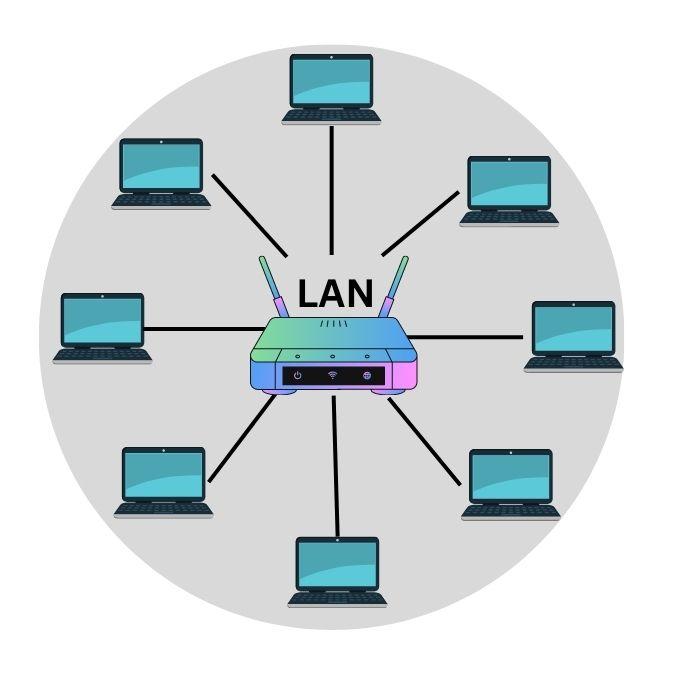
A LAN, short for Local Area Network, connects computers and devices in small areas like schools, colleges, universities, or offices. It allows them to communicate and share resources like files and Internet access, providing a fast and efficient way to transfer data.
LANs can be of two types based on connections:-
Wired: We generally use Ethernet and switches to connect the endpoints in wired LANs.
Wireless: In wireless LANs, we use devices like WiFi.
LANs are more secure than the Internet since they cover only small areas and can be managed easily.
What is MAN?
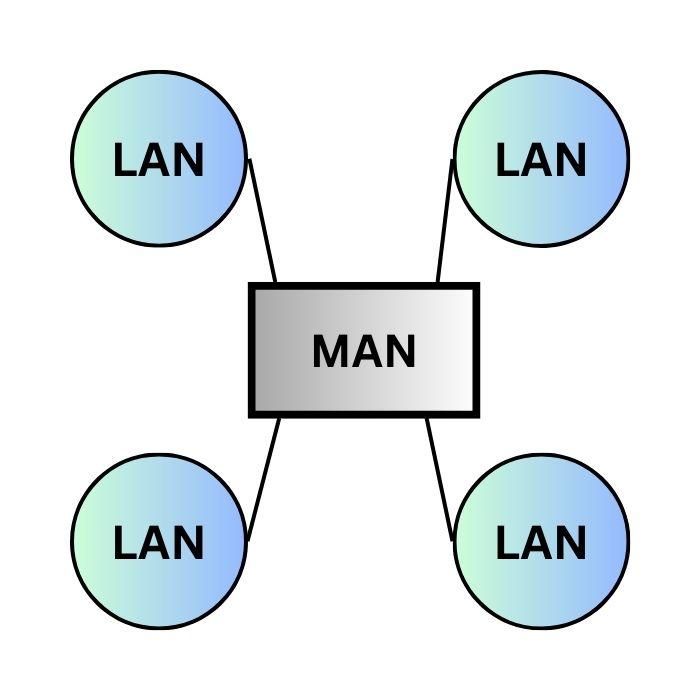
A MAN, short for Metropolitan Area Network, connects computers and different devices in a large area than LANs since it is generally made using two or more LANs. So MANs can cover a small town or a city.
MAN covers more area than LANs but less than WANs. MANs are expansive, so multiple organizations or companies might own them.
A good example of a MAN is a cable TV network in a city.
What is WAN?
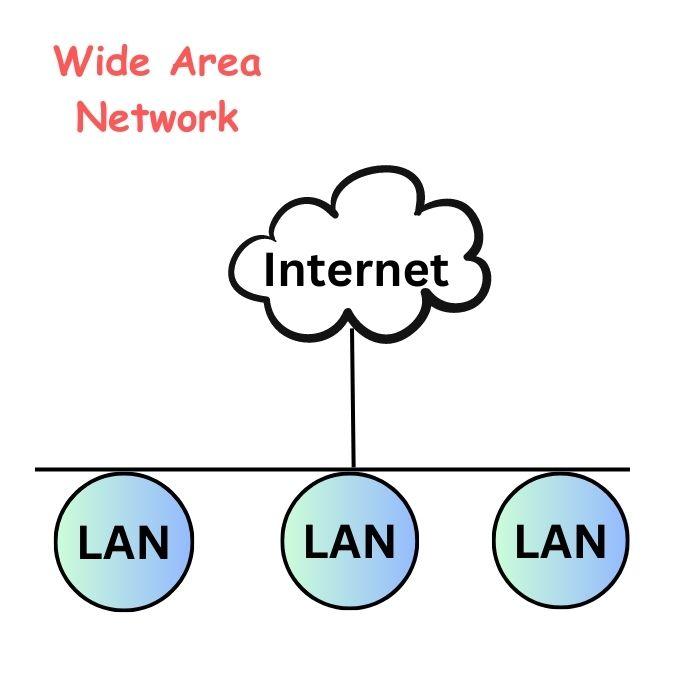
A WAN, short for Wide Area Network, connects telecommunication networks in a much larger area. It covers a vast area than LANs and MANs since it is generally made using multiple LANs. WANs can cover a state or a whole country. WAN includes Internet and corporate networks that connect different organizations and companies over the globe.
WANs can be vulnerable to security threats. Therefore we should use security measures like firewalls and encryption to protect the data flowing into the networks from hackers.
High Data Transfer Rates: LANs provide fast data transfer speeds, allowing quick communication between connected devices.
Private Ownership: LANs are usually owned, set up, and maintained by a single organization or individual, ensuring privacy and control over the network.
Connectivity: LANs enable devices like computers, printers, and servers to connect and share resources, such as files, printers, and internet access.
Low Error Rates: LANs have low error rates, thanks to their small geographic size, which reduces the chances of data transmission errors.
Reliability: LANs are reliable and provide consistent connectivity for local devices.
Scalability: LANs can be easily expanded by adding more devices or extending network infrastructure to accommodate growing needs.
Features of MAN
High Data Transfer Rates: MANs offer fast data transfer speeds, suitable for connecting various organizations and institutions within a city.
Multiple Ownerships: MANs can be owned and operated by multiple organizations, businesses, or service providers, fostering collaboration and resource sharing.
Interconnectivity: MANs connect LANs from different locations, enabling communication and data sharing between offices, campuses, or branches.
Fiber Optic Based: MANs often use fiber optic cables as the backbone for data transmission, ensuring high-speed and reliable connectivity.
Scalability: MANs can grow to accommodate expanding network needs by adding more interconnected locations or increasing bandwidth.
Features of WAN
Vast Geographic Coverage: WANs span extensive distances, enabling communication between remote locations worldwide.
Global Connectivity: WANs connect LANs and MANs across different regions, facilitating global data exchange.
Diverse Technologies: WANs use various technologies like leased lines, satellites, and the internet to link distant locations.
Public and Private Networks: WANs include both public networks (like the internet) and private networks (company-owned or leased lines).
High Data Transfer Rates: WANs offer variable data transfer speeds, from relatively slow connections (e.g., dial-up) to high-speed fiber optics, depending on the infrastructure used.
Interoperability: WANs allow different types of devices and networks to communicate with each other, promoting compatibility.
Frequently Asked Questions
What are the 4 types of networks?
The four types of networks are Local Area Network (Covers a small area like a home or office), Metropolitan Area Network (Connects multiple LANs within a city), Wide Area Network (Spans large geographic areas, like countries), Wireless Local Area Network (Connects devices wirelessly within a limited area, often using Wi-Fi ).
What is a TCP IP network?
A TCP/IP network is a type of computer network that uses the TCP (Transmission Control Protocol) and IP (Internet Protocol) to facilitate data communication and ensure reliable data delivery across interconnected devices.
What is the difference between MAN and WAN?
MAN is the network that covers smaller geographical areas compared to WAN. MAN typically lies within a single city or town, whereas WAN covers a state or a country.
MAN uses a high transmission speed compared to WAN.
What are the advantages of WAN over MAN?
Advantages of WAN over MAN include higher Geographical area coverage and higher scalable capability. WANs have more flexibility than MAN. WAN can also provide users with direct access to the cloud, such as IaaS, SaaS, and PaaS.
Conclusion
LAN, MAN, and WAN are the different types of networks. All these have their advantages and disadvantages, and we can choose among them according to our use.
Congratulations, You have learned about LAN, MAN, and WAN in a brief and the difference between LAN, MAN, and WAN in detail. Also, read some FAQs related to them.
You can learn more about algorithms and related concepts from these articles.
I hope you enjoyed the “Differences between LAN, MAN, and WAN” article. You can refer to Guided Path to learn about DSA, computer science subjects, system design, etc.
Please upvote if you liked the article. Thanks for reading.







 1+ registered

