Do you think IIT Guwahati certified course can help you in your career?
Introduction
In Java, both List and Set are interfaces used to store collections of elements, but they serve different purposes. A List allows duplicate elements and maintains insertion order, while a Set does not allow duplicates and may not preserve order. Understanding the key differences between these two can help in choosing the right one based on specific use cases.
In this article, we will check the difference between list and set and look at the properties, implementation and performance of each. First, we will go through the definition of list and set.
What is List Interface in Java?
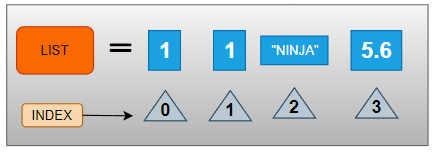
A list is a collection of elements, where each element has an index that starts from 0. See the image below for a better understanding. In Java, a List is an interface that is part of the Java Collections Framework. It represents an ordered collection of elements, allowing for the storage and manipulation of data. The List interface extends the Collection interface and provides several methods for working with lists of objects.
It is also mutable, so you can change the elements whenever you require. And it can also have duplicate elements with different data types. One important thing to remember is to initialise the list with the square bracket. See the below code for a better understanding.
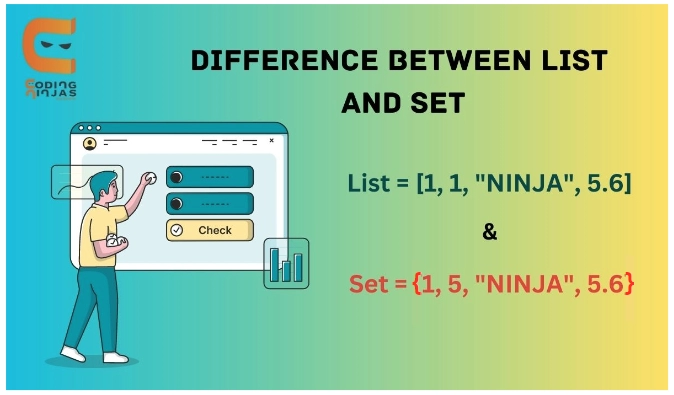
List = [1, 1, "NINJA", 5.6]
We will move to the Set definition to better understand the difference between list and set.
Syntax of list in Java
List<Type> listName = new ArrayList<>();
Properties of List Interface
Lists are a data structure that stores an ordered collection of elements.
Each element in a list has an index for addressing.
It is mutable, so you can change its elements any time you want.
You can add new elements to a list using the append() method or insert() method.
You can remove elements from a list using the remove() method or pop() method.
Here it is easy to access individual elements in a list using their index.
Here we can also concatenate two lists using this ( + ) operator or the extend () method.
Here you can sort lists also using the sort() method.
public class Solution { public static void main(String[] args) {
// New list List<String> coders = new ArrayList<String>();
// Adding at the end of the list coders.add("Master Coder"); coders.add("Master Coder"); coders.add("Experienced Coder");
System.out.println("Initial list of coders: " + coders);
// Updating at level coders.set(1, "Intermediate Coder");
// Removing coders.remove(2); System.out.println("Removed coder at index 2");
// Removing and returning the last coder in the list String lastCoder = coders.remove(coders.size() - 1); System.out.println("Removed last coder: " + lastCoder);
// Getting the first coder String firstCoder = coders.get(0); System.out.println("First coder in the list: " + firstCoder);
// Printing final list System.out.println("Updated list of coders: " + coders); } }
You can also try this code with Online Java Compiler
Initial list of coders: [Master Coder, Master Coder, Experienced Coder]
Removed coder at index 2
Removed last coder: Intermediate Coder
First coder in the list: Master Coder
Updated list of coders: [Master Coder]
What is Set Interface in Java?
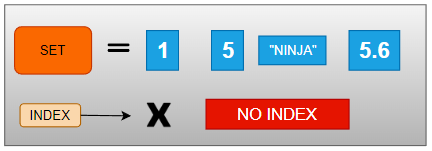
A set is a collection of unique elements. It is unordered, so there is no indexing as in the list from 0 to n. See image below for a better understanding.
It is also mutable, so you can change the elements whenever required. But it can not have duplicate elements. It can have elements with different data types. One important thing to remember here is to initialise a set with the curly bracket. See the below code for a better understanding.
Set = {1, 5, "NINJA", 5.6}
We will move to the properties and implementation of each set and list to better understand the difference between list and set.
Syntax of Set in Java
Set<Type> setName = new HashSet<>();
Properties of Set Interface
The Set is also similar to the List, but it is unordered.
It is also mutable, so you can change its elements anytime.
It is important to note that, as a list, it cannot store duplicate elements.
Here, the elements in a set are not assigned an index.
It is implemented using curly braces {} or the set() constructor.
You can add elements to a set using the add() method or the union() method to combine two sets.
You can remove elements from a set using the remove() method or discard() method.
Code Implementation of Set in Java
Java
Java
import java.util.HashSet;
import java.util.Set;

public class Solution {
	public static void main(String[] args) {

		Set<Integer> ninjaLuckyNumbers = new HashSet<>();
		ninjaLuckyNumbers.add(7);
		ninjaLuckyNumbers.add(42);

        System.out.println("Initial set: " + ninjaLuckyNumbers);
		// This element is a duplicate and will not be added
		ninjaLuckyNumbers.add(42);
		ninjaLuckyNumbers.add(17);

		// Check if an element is present in the set
		System.out.println(ninjaLuckyNumbers.contains(42)); // prints true
		System.out.println(ninjaLuckyNumbers.contains(10)); // prints false

		// Remove an element from the set
		ninjaLuckyNumbers.remove(42);
		System.out.println(ninjaLuckyNumbers); // prints [17, 7]

		// Clear all elements from the set
		ninjaLuckyNumbers.clear();
		System.out.println("Updated set: " + ninjaLuckyNumbers);
	}
}
You can also try this code with Online Java Compiler
List is a vital part of the Java Collections Framework. It represents an ordered collection of elements, allowing duplicate values and maintaining insertion order. This makes it ideal when the position of elements matters—like storing a sequence of user inputs or processing ordered data.
Lists are widely used in real-world applications such as maintaining a to-do list, handling rows in a database result, or managing playlists in media apps. Common implementations like ArrayList and LinkedList offer flexibility in choosing performance-based structures (e.g., fast access vs. fast insertion/deletion).
The ability to access elements by index and preserve order makes Lists essential for scenarios where the order and repetition of elements are important.
Importance of Set in Java
Set in Java is designed to store unique elements, eliminating duplicates automatically. It does not maintain insertion order (unless using LinkedHashSet) and provides faster lookup and search operations due to internal hashing.
Sets are crucial in applications where data uniqueness is mandatory—such as managing user IDs, filtering duplicate inputs, or checking unique visitors to a website.
For example:
Set<String> emails = new HashSet<>();
emails.add("a@example.com");
emails.add("b@example.com");
emails.add("a@example.com"); // ignored as duplicate
You can also try this code with Online Java Compiler
Popular types like HashSet, LinkedHashSet, and TreeSet provide options for performance, order preservation, and sorting. Sets help developers write cleaner, more efficient code when ensuring uniqueness is a priority.
Difference Between List and Set in Java
Below is the difference between list and set. In the tabular form, it will be easy for you to understand.
Parameters
List
Set
Definition
Objects are minimally dependent on each other.
Objects are heavily dependent on each other.
Order of Elements
Maintains the insertion order of elements.
Does not guarantee any specific order of elements.
Index Access
An index can access elements.
No Indexing is available.
Mutability
Allows both mutable and immutable implementations.
Allows both mutable and immutable implementations, but mutation may require uniqueness enforcement.
Duplicates
Lists allow duplicate elements
Sets do not allow duplicate elements.
Syntax
Uses square brackets to define [ ].
Uses curly braces { }.
When to Use List and When to Use Set
When to Use List
Use a List when the order of elements matters, and you may need to store duplicate values. Lists maintain insertion order, support index-based access, and allow retrieval of elements by position. If your application requires repeating items or accessing elements by index (e.g., list.get(0)), List is the right choice.
Key considerations:
Order matters (e.g., task queue, user input sequence)
Duplicates are acceptable or needed
Frequent read/write operations at specific positions
Example use cases:
Displaying items in a shopping cart
Managing steps in a workflow
Storing responses from a survey
When to Use Set
Use a Set when you need to store unique elements and avoid duplicates. Sets are ideal for checking membership, filtering repeated data, and ensuring data integrity. Some Set implementations (HashSet) offer fast performance for add, remove, and search operations, while others (LinkedHashSet, TreeSet) preserve order or sort elements.
Key considerations:
Uniqueness is essential (e.g., user IDs, emails)
Performance is important for lookups
No need for duplicate values or index-based access
Example use cases:
Removing duplicate words from a document
Tracking unique visitors to a website
Validating entries in a form
Practical Use Cases and Scenarios
Use List When:
You want to display items in the order they were entered (e.g., chat messages).
Duplicates are part of the data model (e.g., order history where the same item may appear multiple times).
You need to insert or update items at specific positions.
Use Set When:
You need to avoid storing the same value more than once (e.g., usernames).
You want quick search and insertion with no concern for duplicates.
You’re filtering repeated inputs or validating unique records.
Example Scenario: In an online quiz app:
Use a List to store the order of questions or submitted answers.
Use a Set to store the correct answer keys or list of participants (ensuring no duplicates).
Choosing between List and Set depends on whether your data needs order, duplication, or uniqueness. Understanding these differences leads to more efficient and reliable Java applications.
Frequently Asked Questions
Why is set better than list in Java?
A Set is better than a List in Java when you need to ensure unique elements and don't require index-based access. Sets eliminate duplicates automatically and can provide more efficient operations for checking presence and removing elements.
When to use set instead of list?
Use a Set instead of a List when you need to ensure all elements are unique and don't require ordering or indexing. Sets are ideal for operations involving uniqueness checks, such as eliminating duplicates or fast membership testing.
What is the difference between data set and list?
A dataset is a collection of related data, while a list is an ordered collection of elements. A dataset is broader, encompassing various data types and structures.
What is the difference between set and list duplicates?
Sets do not allow duplicates; each element must be unique. Lists, however, permit duplicate elements, allowing multiple instances of the same value.
Conclusion
In this article, we learned about the difference between list and set. Understanding the distinctions between Lists and Sets in Java is pivotal for effective data management and algorithm design. Lists, including implementations like ArrayList and LinkedList, maintain the order of elements and allow duplicates, making them suitable for scenarios where the sequence matters. On the other hand, Sets, exemplified by HashSet and TreeSet, prioritize uniqueness and do not guarantee any specific order. If you want to learn more, follow these articles below to build fundamentals:








 5+ registered

