




Introduction
The fibonacci series is the number sequence in which the given number results from adding the two previous numbers. The terms in the Fibonacci sequence are as follows:

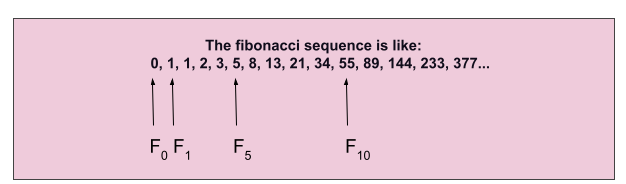
The individual numbers in this sequence are called Fibonacci numbers. The Fibonacci sequence is a fantastic mathematical concept found in various places, including seashell patterns and the Parthenon.
Properties of Fibonacci Numbers
- The ADDITION Rule
FN + K = FK . FN + 1 + FK - 1 . FN
- Applying Addition Rule to the case, K = N
FN + N = FN . FN + 1 + FN - 1 . FN
F2N = FN ( FN + 1 + FN - 1)
- From the above property, we can prove that for any positive integer K, FNK is the multiple of FN (By the Induction Hypothesis).
- The inverse of the above property is true since, if FM is multiple of FN, then M is also the multiple of N.
- Cassini’s Identity
FN - 1 . FN + 1 - FN2 = (-1)N
This identity was given by Giovanni Domenico Cassini, an Italian mathematician. In the mathematical expression, N is the variable and it can have values from 1…..N.
For eg., if ‘N’ is an odd number, i.e. 1, 3, 5,... then (-1)N+1 = +1 in every case. But if we take even value here, we will get the result as -1.
- GCD Identity
For M, N >= 1
GCD(FM , FN) = FGCD (M, N) , where M, N are integers
Recommended topic, kth largest element in an array and Euclid GCD Algorithm
The Golden Ratio Approach
The golden ratio is defined as the limit of the ratio of successive terms in the Fibonacci sequence.
|
Now, if we divide F2 with F1, we get, F2 / F1 = 1 / 1 = 1 F3 / F2 = 2 / 1 = 2 F4 / F3 = 3 / 2 = 1.5 F5 / F4 = 5 / 3 = 1.667 F6 / F5 = 8 / 5 = 1.6 F7 / F6 = 13 / 8 = 1.625 F8 / F7 = 21 / 13 = 1.61538 F9 / F8 = 34 / 21 = 1.619047 F10 / F9 = 55 / 34 = 1.61765 F11 / F10 = 89 / 55 = 1.61818 F12 / F11 = 144 / 89 = 1.617975 F13 / F12 = 233 / 144 = 1.61805 . . . and so on. |
The golden ratio is coming about 1.618, as it means that as ‘N’ becomes sufficiently large, the fibonacci sequence approaches or approximates a geometric sequence. So, starting at number 144, and if we multiply 144 by 1.618, we get 233 (Approx.), the next element in the sequence. If we now multiply 233 with 1.618, we get approximately 377. Hence this golden ratio helps to approximate the next number in the series easily.
The formula for golden ratio is,
|
(1 + √5)N - (1 - √5)N FN = ------------------------------ 2N . √5 |
For example, let us find out the 8th element in the sequence using the formula,
(1 + √5)8 - (1 - √5)8
F8 = ------------------------------ = 21
28 . √5

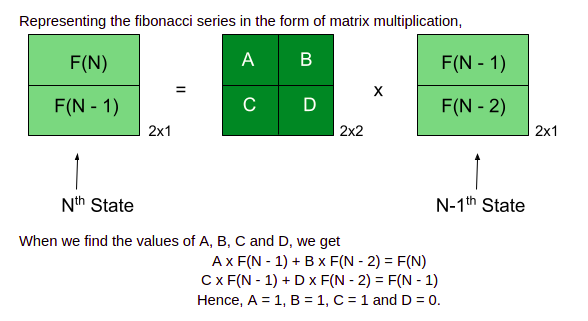





 1+ registered

