Do you think IIT Guwahati certified course can help you in your career?
Introduction
Computers, unlike humans, are designed to be perfect and cannot tolerate errors. Suppose the correct syntax for printing Hello Ninja is print("Hello Ninja"), but the programmer accidentally omits one of the parentheses. The program will be terminated due to a syntax error.
Dealing with coding errors is an essential part of any programmer's life.
Anyone who writes and manipulates computer code may encounter coding errors from time to time, regardless of their level of knowledge or experience.
In this article, we will discuss different types of Exceptions in Java. We will focus on java util nosuchelementexception and how to fix it.
To err is human. It implies that mistakes are common among people.
For machines, the above statement is not applicable. Computers cannot ignore errors.
So, Exceptions in Java are "unwanted interruptions in the normal course of the program's execution." They indicate that something went wrong while running the program. In Java, there are two types of exceptions: Checked and unchecked, based on the time of occurrence, i.e., compile-time or run-time.
Checked Exceptions
These are the exceptions that are notified to the user by the compiler at the time of the runtime.
For example, if you are accessing a file using the FileReader class and the file passed to the object does not exist, it will give a FileNotFoundException exception.
Unchecked Exceptions
These are the exceptions that occur only when the program runs. This is the reason why they are also called Runtime exceptions.
They are ignored at the compile time. For example, if we are accessing the out-of-bound index of an array, then we would get an ArrayIndexOutOfBoundsException.
As the name suggests, in this article, we will discuss java util nosuchelementexception and how to fix it. Since we have already discussed exceptions in java, you must wonder under which category java util NoSuchElementException fall and how to fix it.
Don’t worry; Ninja, Coding Ninjas is here to guide you.
Constructors of NoSuchElementException
The constructors for the NoSuchElementException in Java:
Constructor
Description
NoSuchElementException()
Constructs a NoSuchElementException with no detail message.
NoSuchElementException(String message)
Constructs a NoSuchElementException with the specified detail message.
These constructors allow you to create instances of NoSuchElementException with or without a custom error message.
Java util NoSuchElementException
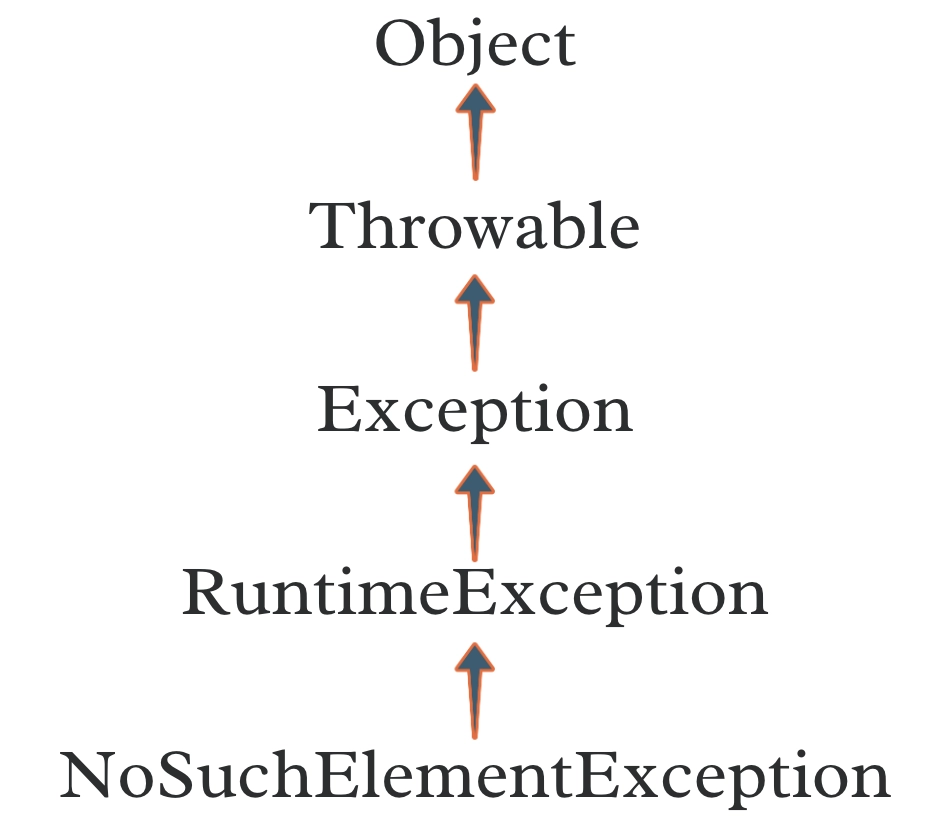
NoSuchElementException as the name implies, is an exception that occurs when the intended element does not found. Numerous accessor methods in Java throw NoSuchElementException to indicate that the requested element does not exist. It is an Unchecked exception which means it occurs during run time.
Let us see its hierarchy:
Causes of java util NoSuchElementException
In Java, the java util NoSuchElementException is raised when an iterable's maximum limit gets exceeded or when there are no more enumeration elements to iterate over. The following causes the java util NoSuchElementException to be thrown:
iterator::next()
Enumeration::nextElement()
StringTokenizer::nextElement()
NoSuchElementException Example
Below code shows the occurrence of java util NoSuchElementException in java while using the above methods:
Java
Java
import java.util.*; public class main { public static void main(String[] arguments) { HashMap<Integer, String> map = new HashMap<Integer, String>();
To fix a NoSuchElementException, ensure proper handling, like checking for existence before accessing elements in collections or using try-catch blocks.
How do I return a no such element exception?
To return a NoSuchElementException, throw it explicitly when encountering scenarios where elements are expected but not found.
What is the use of the Java util package?
It contains the classes needed to make an applet that can communicate with its applet context. It includes all the classes needed to create user interfaces and paint graphics and pictures.
Why do we use import Java util.*?
It means importing all the classes and interfaces within java.util package and making them available within the current class or interface. This is shorthand wild card annotation for importing all classes within a particular package.
Conclusion
To wrap up the article, we have extensively discussed java util NoSuchElementException and how to fix it. At last, we have discussed about some faqs based on the same.









 1+ registered

