




Introduction
Let's say we have the requirement to test a web server and check how many concurrent users it can handle. For that, we need a performance testing tool that generates and simulates many concurrent user loads on the web server.
So are you also thinking that Apache Jmeter will be the suitable tool? Then yes, this is where Apache Jmeter comes to the rescue!

It is an open-source load and performance testing software based on Java Language. It was primarily written to load and test the performance of Apache JServ (also called the Apache Tomcat project). Later on, to add more features and functional testing capabilities, the Apache community redesigned it to enhance the GUI.
Let's now discuss the method of performance testing using JMeter.
JMeter Performance Testing
It is a testing method performed using Apache JMeter to verify and validate the performance of a web application and other products' performance. It refers to testing software or a program under some specific workload and monitoring, which calculates whether its results are according to the expectations.
JMeter performance testing consists of load tests and stress tests of web applications.
Advantages of Performance Testing
In Jmeter, performance testing is done to test the software product's speed, response time, reliability, and resource usage.
- It identifies and eliminates any potential resistances to the software application.
- JMeter can test the performance of static resources such as JavaScript, CSS, and HTML.
- JMeter is also used to test dynamic resources like- JSP, AJAX, JPA, Servlets, etc.
- JMeter can determine the maximum number of user loads your website can handle.
Types of Performance Testing
JMeter performance tests are of several types. Some of them are mentioned below:
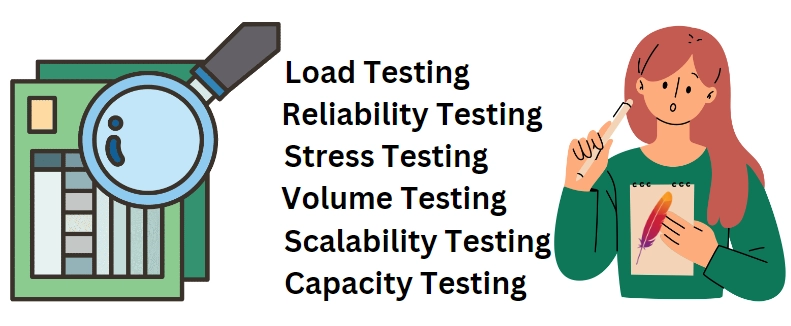
Load Testing
This testing tests the applications for their performance at normal and peak usage. This performance may depend on response time and consistency on different user loads.
Reliability Testing
Testing a system's reliability involves determining whether the web application will become normal again after an abnormal state. It calculates how long the system would take to return to its original state.
Stress Testing
There is a maximum load each web server can handle. The web server responds slowly and starts making faults when the load exceeds the limit. Hence stress testing is used to determine the maximum load that a web server can support.
Volume Testing
In this testing, the system's performance is checked concerning the volume of data. It enters a large amount of data into the database to perform the test.
Apart from these performance testing, scalability testing, and capacity testing are two other types of testing.
Let's now move to the simple process of creating a performance test plan.


 1+ registered

