Do you think IIT Guwahati certified course can help you in your career?
Introducion
No, Java is not a fully object-oriented language as it supports primitive data types like int, byte, long, short, etc., which are not objects. Hence these data types like int, float, double, etc., are not object-oriented. That's why Java is not 100% object-oriented.
In this blog, we will discuss whether Java qualifies as a full-fledged object-oriented language. We'll explore the core principles of object-oriented programming (OOP) and see how Java stacks up.
Pure Object-Oriented Languages, also known as Complete Object-Oriented Languages are Fully Object-Oriented Languages that support or have strict features such that they treat everything inside the source code as objects. Such languages do not support primitive data types, for example, int, char, float, bool, and so on.
Although, most of the programming languages are based on object-oriented programming system concepts, yet only a handful of them are considered to be a pure Object-oriented programming language. Only Smalltalk and Self are recognised as purely object-oriented languages. Furthermore, Self relies on object prototypes, while Smalltalk is conventionally considered to be object-oriented with classes and implementation inheritance. Hence specifically, there is only a single pure object-oriented programming language, which is Smalltalk.
Smalltalk/Squeak/Pharo, Erlang, Eiffel, Self, and CLOS (Common Lisp Object System) are a few languages that are pure object-oriented programming languages or very close to being one of them.
Smalltalk is remarkably recognized as the purest form of an object-oriented programming language.
When it comes to system requirements, Smalltalk variants run on many different platforms, so does CLOS (on any platform where you can run the Common Lisp).
Is Java Really an Object-Oriented Language?
Java is widely known as an object-oriented programming (OOP) language, but it’s important to explore how it applies core OOP principles and where it deviates from pure object-oriented design. Let’s look at both sides to answer the question clearly.
Java as an Object-Oriented Language Java supports all major object-oriented programming features:
Classes and Objects are the foundation of Java programs.
Inheritance allows code reuse through class hierarchies.
Polymorphism enables dynamic method behavior.
Encapsulation hides internal data using access modifiers.
Abstraction allows defining essential behaviors while hiding complexity.
In Java, everything except primitive types is an object, and the language encourages developers to follow OOP practices. Features like method overriding, constructors, and interfaces further promote Java OOP features that support modular, maintainable code.
Why Java Is Not Fully Object-Oriented Despite its strong object-oriented foundation, Java is not 100% object-oriented. One key reason is the use of primitive data types such as int, float, boolean, etc., which are not objects and don’t support object behaviors like methods or inheritance. While wrapper classes (Integer, Float) exist, they are optional.
Java also supports static methods, which belong to classes rather than instances, enabling procedural programming styles. This is another reason why Java is not 100% object-oriented, especially when compared to languages like Smalltalk, where everything—including numbers and control structures—is treated as an object.
Seven object-oriented-based features need to be satisfied with, for considering any programming language to be a pure Object-Oriented language.
1. Encapsulation & Data Hiding
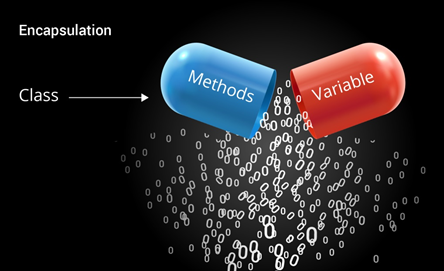
Apart from inheritance, polymorphism, and abstraction, encapsulation is one of the four fundamental OOP concepts. Encapsulation can be defined as the wrapping up or combining of data into a single unit, the word comes from a capsule that holds different compositions together.
In OOPs Encapsulation is the mechanism that links together the source code and the data it manipulates.
Encapsulation binds the data and covers it with an imaginary shield, any function or code outside the shield (class) cannot access the encapsulated data members, code, and functions.
The class needs to be declared as a private class for being encapsulated; by default, all the classes are private only.
The class can be used by the end-user or the world without providing any details behind implementation using the abstraction concept, so technically encapsulation is a combination of data-hiding and abstraction.
Steps for achieving encapsulation in Java
Declare the member variables of a class as private.
Create public setter and getter methods to modify or view the values of the variables.
Image Source: Edureka
Advantages of using Encapsulation
The fields of a class can be set as read-only or write-only using getters and setters.
A class can provide selective access to the data contained in its fields. Encapsulation makes the code concise and modularised for unit testing.
Encapsulation increases the reusability of the code and makes it easily adaptable to new requirements.
The user has no idea about the inner implementation of the class because of data hiding.
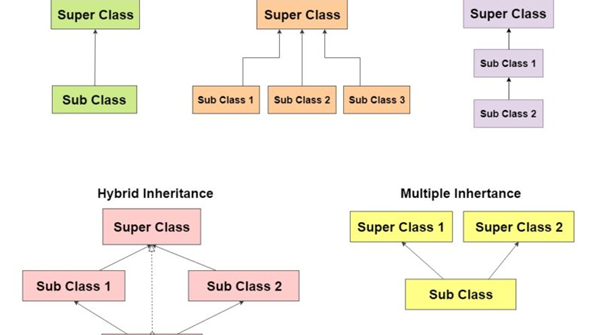
The mechanism through which an object can acquire all the behaviours and properties of its parent object is known as Inheritance. It is one of the most essential features of OOPs (Object Oriented programming system). The main object of Inheritance is to increase code reusability and reduce code redundancy.
This can be done by creating new classes by building upon the pre-existing classes.
During inheritance, you inherit from a pre-existing class, so that you can re-use its methods and fields to avoid boilerplate code.
Furthermore, you can even add new methods and fields in the new class.
Image Source: Simple Snippet
A subclass is a class that inherits other classes, which is also known as a derived class, extended class, or child class, whereas a superclass is a class from where a subclass inherits the features. Commonly also known as a base class or a parent class. Inheritance demonstrates the IS-A relationship which is popularly also known as a parent-child relationship.
Advantages of Inheritance in Java
It facilitates runtime polymorphism by Method Overriding.
For facilitating Code Reusability.
3. Polymorphism
Polymorphism is one of the seven essential object-oriented programming concepts, by which we can perform a single task in multiple ways. It is the combination of two Greek words : poly and morphs.
The word “poly” signifies many, while “morphs” signifies forms. Therefore, polymorphism refers to many forms.
There are two variants of polymorphism in Java known as compile-time polymorphism and runtime polymorphism.
Method overloading and method overriding are the two ways of carrying out polymorphism in Java. Overloading a static method in Java is considered as an example of compile-time polymorphism
Runtime polymorphism or Dynamic Method Dispatch is the process that allows a call to an overridden method to be resolved at runtime instead of the compile-time.
In runtime polymorphism, an overridden method is called via the reference variable of any of its superclass.
In Java, abstraction is the process of Data hiding, such that only the essential information is displayed to the user. The trivial or the non-essentials sections are not visible to the user. The properties and behaviors of an object are used to differentiate it from other objects of a similar kind and also assist in classifying/grouping the objects.
Abstraction can be achieved by adding abstract classes; almost 100% abstraction can be achieved with the help of interfaces. The abstract keyword is a non-access modifier, used for declaring classes and methods as abstract ones. Abstract methods are used only in abstract classes, and they do not have a body. They depend on the subclass for providing the body, this makes overloading mandatory in abstract classes.
An abstract class is a restricted class, which cannot be used directly for creating an object; you must inherit it from another class in order to create objects. A few methods of an abstract class can be concrete/pre-defined; all the methods should not be abstract. An abstract class is allowed to have parameterised constructors and the default constructor is necessarily present in an abstract class. For Example, A car is viewed as a car rather than its individual internal components, which are not visible to the user.
Image Source: Java67
5. All pre-defined types should be objects
Java fails the fifth necessary condition of being an object-oriented programming language as the primitive Data Type such as int, long, bool, float, char, and so on are predefined in it.
The predefined data types are not treated as objects in Java. While in a “pure” object-oriented programming language like Smalltalk both objects and primitive types are treated similarly.
int s = 50;
System.out.print(s);
6. All user-defined types should be objects
User-defined data types are defined by the programmers/users themselves by availing of efficient features of the language. They are related variables that store multiple values of the same or different kind. If you want a variable to hold dissimilar values user-defined data types must be used. For example, classes and interfaces are the user-defined data types of Java.
7. Methods invoked by the objects
Operations performed on any object should be carried out strictly through methods invoked by the objects.
The static keyword in Java
In Java, we can use a class declared as static without creating an object. If you are using a static variable or a static class, you cannot call that function or variable using a dot(.) or class object, this leads to Java defying the seventh necessary object-oriented feature.
Wrapper Class in Java
Java wrapper class allows us to convert primitives into objects and vice-versa. Furthermore, you can also use Integer, Float, etc. rather than int, float, etc.
You can even communicate with objects without calling their methods. For example: via arithmetic operators.
A fully object-oriented language should include all the basic seven programming concepts, which are mentioned above.
And along with that, it is compulsory to be pre-defined and user-defined types, it should be treated as objects while writing the source code and, the entire range of operations should be performed strictly by invoking the methods of a class, post creating their objects.
Java supports most of the above-mentioned properties 1, 2, 3, 4, and 6 but it disagrees with properties 5 and 7.
Why is Java not a pure Object-Oriented Programming Language?
Java is considered a very object-oriented language, but it falls short of being purely object-oriented due to a few key characteristics:
Primitive Data Types: Unlike pure object-oriented languages (like Smalltalk), Java has built-in primitive data types like int, float, char, etc. These aren't objects and don't share the same behavior as objects created from classes. They are fundamental data types handled differently by the language.
Static Members: Java allows static methods and variables within classes. These static members exist outside the concept of objects and can be accessed without creating an instance of the class. This deviates from the core object-oriented principle, where everything revolves around objects and their interactions.
Inheritance Limitations: While Java supports inheritance, it doesn't allow multiple inheritance (inheriting from more than one parent class directly). This can limit code flexibility and reusability in some scenarios.
Object-Oriented vs Procedural Code in Java
Java supports both procedural and object-oriented programming styles, but each has different strengths. Understanding their differences helps in choosing the right approach based on your project.
Example – Procedural vs OOP Style in Java
Let’s compare a simple task: printing employee details.
Procedural Style:
String name = "John";
int age = 30;
System.out.println("Employee: " + name + ", Age: " + age);
Object-Oriented Style:
class Employee {
    String name;
    int age;
    void printDetails() {
        System.out.println("Employee: " + name + ", Age: " + age);
    }
}
Employee emp = new Employee();
emp.name = "John";
emp.age = 30;
emp.printDetails();
The OOP approach offers better structure, modularity, and scalability. It becomes easier to manage as your codebase grows, especially when working with complex real-world entities like employees, products, or users.
When to Use Object-Oriented Design in Java
OOP design is ideal for large applications that demand code reuse, modularity, and maintainability, like web platforms, desktop apps, or enterprise software. It’s also perfect when working with real-world entities such as users, accounts, or orders, allowing you to model their properties and behaviors as objects.
On the other hand, procedural programming is acceptable for simple, short-lived scripts or quick utilities where creating classes would be overkill. For example, a quick file reader or a calculator tool can be written procedurally for simplicity.
Real-World Use Cases of Object-Oriented Programming in Java
Object-oriented programming is the foundation of real-world Java development, helping teams build clean, efficient, and scalable software systems.
Java in Web Applications
Frameworks like Spring and JavaServer Faces (JSF) leverage Java’s OOP model to structure web applications. Components such as controllers, services, and entities are modeled as objects. Concepts like encapsulation keep data safe, while inheritance helps reuse logic across layers, making the system modular and testable.
OOP in Android Development
Android apps are built on Java and follow strict object-oriented principles. Components like Activities, Fragments, and Adapters are objects that interact using inheritance and polymorphism. For example, all Activities extend the base Activity class, allowing consistent lifecycle handling and flexible UI behavior.
OOP in Enterprise Software Using Java
Enterprise systems in sectors like banking, inventory, and customer management rely on Java's OOP model. Platforms like Java EE or Jakarta EE promote the use of objects and interfaces for scalable, secure, and maintainable code. Services, DAOs, and business objects work together to represent complex real-world workflows.
By understanding both procedural vs object-oriented Java styles and seeing real-world Java OOP examples, developers can make informed design choices that scale with application complexity.
Frequently Asked Questions
In Java, define the term enumeration.
Enumeration, or enum, is a Java interface. Enum allows for sequential access to elements stored in a collection in Java.
Can a Java class have multiple constructors
Yes, a Java class can have multiple constructors, which is known as constructor overloading. Each constructor must have a different parameter list.
How does Java handle access control for object properties?
Java uses access modifiers like public, private, protected, and default to control the visibility and accessibility of object properties and methods.
What are the advantages of object-oriented programming in Java?
OOP in Java promotes code reuse, modularity, maintainability, and scalability. It makes programs easier to debug, enhance, and extend.
Conclusion
Java is not considered a pure object-oriented language, mainly because it includes primitive data types and static members. These features differentiate it from purely object-oriented languages like Smalltalk, but Java remains highly object-oriented and widely used for OOP-based development. In conclusion, Java's lack of complete adherence to object-oriented principles, mainly due to primitive data types and static members, prevents it from being classified as a fully object-oriented language. However, it still offers strong object-oriented features, making it a versatile and widely-used programming language.







 1+ registered

