




Introduction
In Linear Algebra, linear transformation is widely used for matrix transformation. In vector algebra, we also apply the concept of the linear transformation in vector space. Transformation means nothing but a function 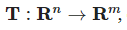 where
where 
is the domain of the function and  is codomain. In this article, we will limit our discussion within matrix transformation.
Definition
Linear transformation is a function that satisfies the following properties :
- T(X + Y) = T(X) + T(Y)
- T(aX) = aT(X)
Where  and
and 
In case of matrix transformation, X and Y are nothing but matrices.
In another way, the function is linear transformation if we can associate some matrix with T(x) and each term of each component of T(x) is a number times one of the variables.
For example,
The function f(x,y) = (2x, 3y) and g(x,y,z) = (z, 3+y, 0.5x) are linear transformation but f(x,y) = (2x, y^2) not a linear transformation.
f(x,y) = (2x+1, y, x+y) is a linear transformation from 
It can be also expressed as f(x,y)= 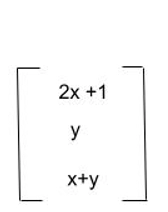 (in matrix form)
Checking if linear transformation or not
Let’s check if f(x,y)=(2x+1, y, x+y)= is a linear transformation or not.
Proof
let……
X=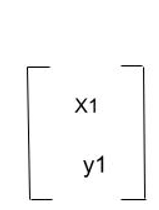 , Y=
, Y=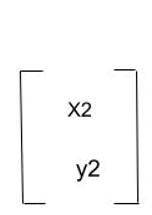
f(x1,y1) =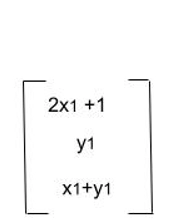 f(x2,y2) =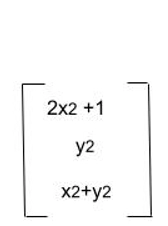
f(X+Y) = 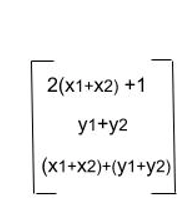 = f(X) + f(Y)
So, it satisfies the property of linear transformation.
Hence, f(x,y) = (2x+1, y, x+y) is a linear transformation associated with matrices.


 1+ registered

