


Introduction 📝
In this article, we will discuss what Network Service Tiers are in google cloud and the types of Network Service Tiers. We will also discuss the regions supporting the standard tier and more about Network Service Tiers.

Google Cloud is the first large public cloud to offer a tiered network with Network Service Tiers. Choose the best network service tier for your needs and budget. Let's Understand the Network Service Tiers in detail:
Network Service Tiers overview 🌐
Network Service Tiers allow you to improve the connection between internet-connected equipment and Google Cloud instances. Premium Tier traffic is routed over Google's premium backbone, whilst Standard Tier traffic is routed through standard ISP networks.
Premium Tier should be used to optimize for performance, while Standard Tier should be used to optimize for cost. Let's compare both the tier:
Premium Tier |
Standard Tier |
Highest performance: Traffic between the internet and VM instances in your VPC network is routed as much as feasible within Google's network. |
Cost-effective: Traffic between the internet and VM instances in your VPC network is often routed through the internet. |
For services that require worldwide accessibility. |
For services hosted entirely within a region. |
Unless you make configuration changes. Premium Tier is the default. |
Performance is comparable to those of other cloud service providers.
|
Each Network Service Tier has its own egress cost. See Network Service Tiers Pricing for further details.

The suggested use cases for the Standard Tier and Premium Tier are shown in this figure.
🔖Network Service Tiers and Google Cloud resources
Google Cloud has two sorts of external IP addresses: global and regional.
| External IP address type | Premium Tier | Standard Tier |
|
Global external IPv4 and IPv6 addresses
Anycast IP addresses that are publicly routable. |
✅Supported |
❌ Not supported |
|
Regional external IPv4 addresses
IPv4 addresses that are publicly routable and assigned to a single Google Cloud area for usage by resources. |
✅Supported |
When IP addresses are utilized with approved resources, support is provided. IP addresses imported to Google Cloud utilizing bring your own IP are not supported (BYOIP).
|
|
Regional external IPv6 addresses
IPv6 addresses that are publicly routable and assigned to a single Google Cloud region for usage by resources. |
✅Supported |
❌ Not supported |
The network is built to maintain traffic between virtual machine (VM) instances in the same area on Google's network, regardless of the tier you use, even if a load balancer is in the way. This is true irrespective of whether the transmission utilizes openly or secretly routable IP addresses.
🔖Regions supporting Standard Tier
Only resources that use local external IP addresses in the following Google Cloud regions are eligible for Standard Tier. The external HTTP(S) load balancer must utilize a regional external IP address and choose Standard Tier if Cloud Storage buckets are being used as the backends for HTTP(S) Load Balancing.
- asia-east1
- asia-east2
- asia-northeast1
- asia-northeast3
- asia-south1
- asia-southeast1
- asia-southeast2
- australia-southeast1
- europe-north1
- europe-west1
- europe-west2
- europe-west3
- europe-west4
- Europe-west6
- Northamerica-northeast1
- southamerica-east1
- us-west1
- us-west2
- us-west3
- us-west4
- us-central1
- us-east1
- Us-east4
🔖Traffic routing
The routing variations for each of the Network Service Tiers are listed in this table.
Traffic |
Premium Tier |
Standard Tier |
Ingress to Google Cloud |
Google's network receives traffic from your users at a node that is close to them. |
In the location where you have installed your Google Cloud services, traffic from your users enters Google's network through peering, ISP, or transit networks. |
Egress from Google Cloud |
Egress traffic is routed over Google's backbone network and exits at the global edge point of presence (PoP) that is most convenient for your consumers. |
A peering or transit network located in the Google Cloud area from whence it originates is used to send egress traffic to the internet. |
🔖Premium Tier
The Premium Tier routes traffic from external systems to Google Cloud services across Google's low-latency, high-reliability worldwide network. This network is made up of a large private fiber network with over 100 points of presence (PoPs) throughout the world. This network is intended to withstand several failures and disturbances while continuing to distribute traffic.
For VM instances and load balancers, Premium Tier supports both regional and global external IP addresses. Premium Tier must be used for all global external IP addresses.
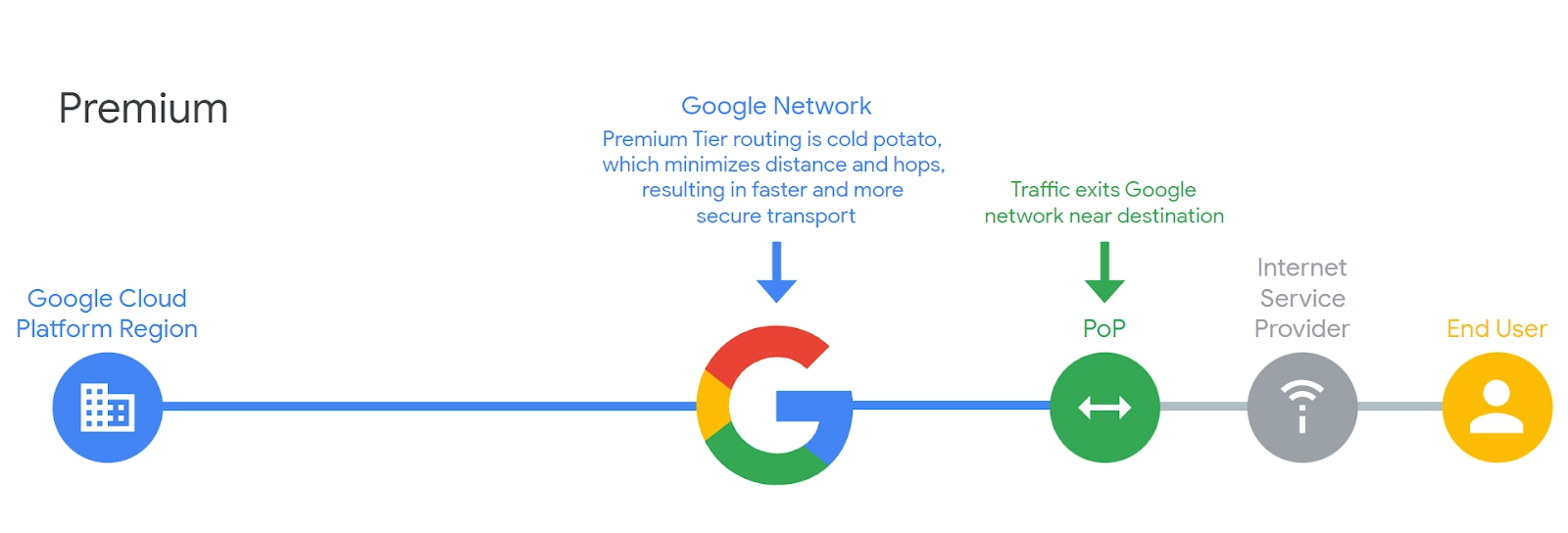
Routing path for Premium Tier
Incoming traffic from internet-connected systems enters Google's high-performance network at the PoP nearest to the sending system with Premium Tier. Traffic is directed from that PoP within Google's network to the VM in your Virtual Private Cloud (VPC) network or the nearest Cloud Storage bucket. Outbound traffic is routed through Google's network and terminates at the nearest PoP to its destination. By decreasing the number of hops between end users and the PoPs nearest to them, this routing strategy reduces congestion and maximizes performance.
🔖Standard Tier
The Standard Tier routes traffic from external systems to Google Cloud services over the internet. It only uses Google's network's double redundancy up to the point when Google's data center links to a peering PoP. Packets leaving Google's network are delivered over the public internet, which is subject to the dependability of intermediary transit providers and ISPs. Standard Tier network quality and dependability are comparable to other cloud providers. Premium Tier or Standard Tier can be used for regional external IP addresses.
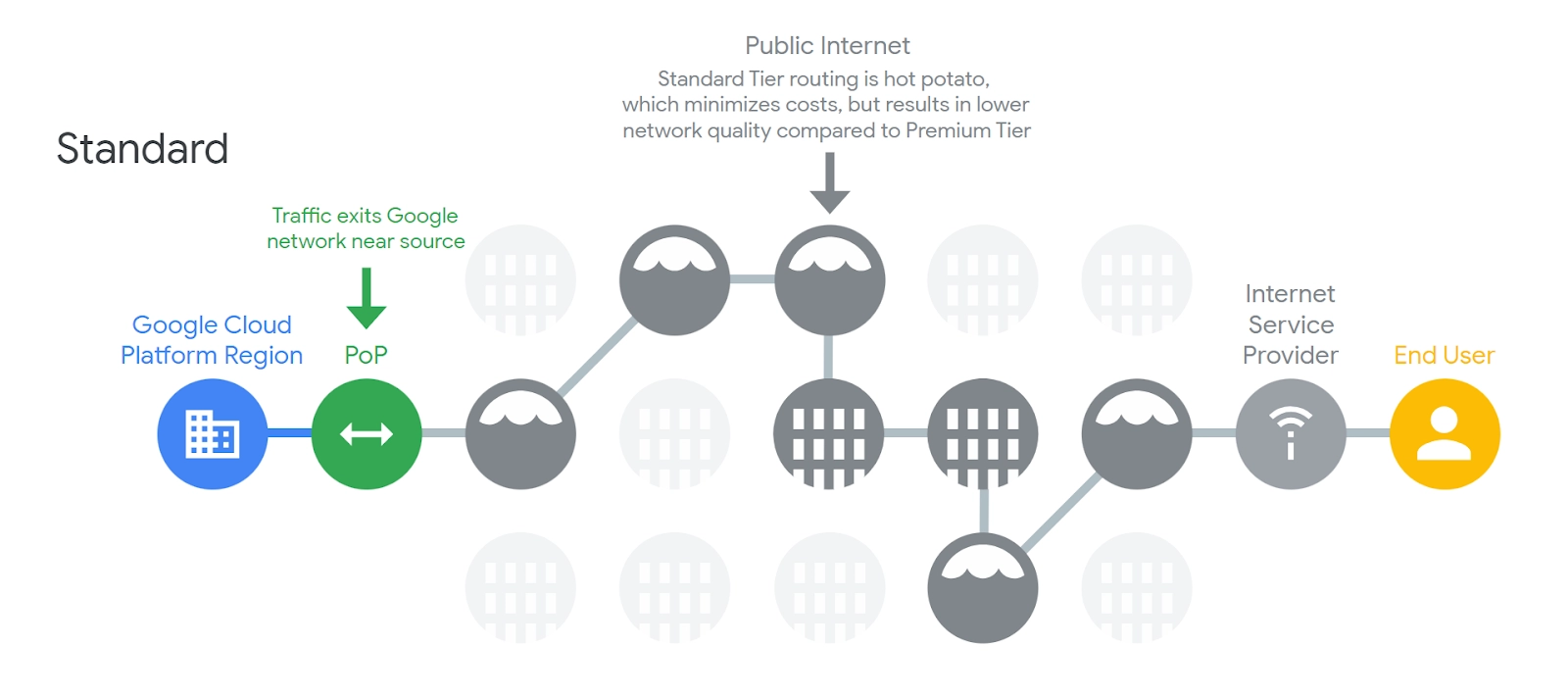
The routing path for Standard Tier
Standard Tier is less expensive than Premium Tier because traffic from internet-connected devices is routed through transit (ISP) networks before reaching VMs in your VPC network or regional Cloud Storage buckets. Regardless of the destination, standard Tier outbound traffic generally leaves Google's network from the same location as the sending VM or Cloud Storage bucket. In exceptional instances, such as during a networking event, traffic may be unable to escape through the nearest exit and may be routed through another exit, maybe in another area.
You can con visit the official documents of the Network Service Tiers overview for more information.



 6+ registered