Types of Logic OR Gates
There are a few different kinds of OR gates used in electronics. Each type does the same basic job but in its own way. Think of it like different kinds of cars. All cars get you from point A to point B, but they might look different and work a bit differently.
Basic OR Gate
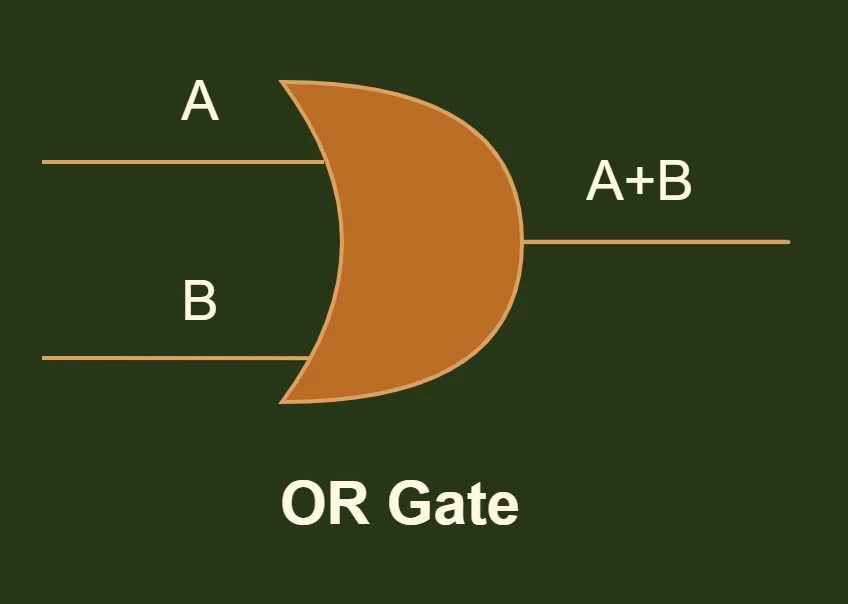
This is the most simple type. It just follows the basic rule: if any input is on, the output is on.
NOR Gate
This is like an OR gate, but it does the opposite at the end. If the OR gate says the output should be on, the NOR gate makes it off, and if the OR gate says off, the NOR makes it on.
Exclusive OR (XOR) Gate
This one is a bit special. It only turns on the output when the inputs are different. If both inputs are the same, whether off or on, the output is off.
Each type is used for different needs in gadgets and machines. Knowing which one to use helps make better electronics.
OR Gate Circuit Diagram Using Transistors
To make an OR gate, you can use things called transistors. These are tiny parts that act like switches. For an OR gate, you need two transistors. When you give them a signal, they can let electricity pass or stop it, just like a gate.
Here's how you can make an OR gate with transistors:
Components Needed
-
Two transistors (think of them as tiny switches)
-
Resistors (these are like brakes that slow down the electricity)
-
A power source (like a small battery)
-
Wires to connect everything
- A light or something to show the output
Working of the Circuit
-
Connect the first part of each transistor to the power source.
-
Connect the second part of each transistor to the inputs. These are like the triggers.
-
Join the third parts of the transistors together and connect a resistor, then connect this to the light.
-
The light is your output. If any input is "on," the light will turn on.
- This setup is like having two switches for one light. If you turn on any switch, the light comes on. That's how the OR gate works with transistors.
Advantages of OR Gate
Simple to Understand
OR gates are easy to get. They work like regular switches. If any switch is on, the light is on.
Widely Used
You find OR gates in many gadgets. They help in making decisions, like whether your phone screen should light up or not.
Easy to Make
You can make an OR gate with basic parts like transistors and resistors. It's like a simple DIY project.
Low Cost
The parts for an OR gate don't cost much. It's like buying a small toy instead of a big one.
Fast
OR gates work quickly. They can make decisions in a tiny fraction of a second.
Reliable
OR gates are trustworthy. They do their job well and don't break down easily.
Versatile
You can use OR gates in many ways. They're like the Swiss Army knife of electronics.
Energy Efficient
OR gates don't use a lot of power. It's like a light bulb that uses less electricity but still gives enough light.
Disadvantages of OR Gate
Limited Function
OR gates can only do one type of decision. It's like having a tool that can only do one job.
Not for Complex Tasks
For big decisions, OR gates alone aren't enough. You need more complex setups.
Noise Sensitivity
OR gates can get confused by electrical noise, like a person misunderstanding in a noisy room.
Voltage Limits
They need the right amount of power. Too little or too much can make them not work right.
Wear & Tear
Over time, physical OR gates can wear out, especially if they're used a lot.
Heat Generation
When used a lot, they can get warm, like a phone after a long call.
Space
In big circuits, using many OR gates can take up a lot of room, like having too many tools in a small box.
Integration Challenges
Sometimes it's hard to fit OR gates into complex circuits, like trying to add a new piece to a puzzle.
Frequently Asked Questions
Can OR gates be used in everyday gadgets?
Yes, OR gates are in many gadgets like phones, computers, & even kitchen appliances. They help these devices make simple decisions, like turning on a light or sending a signal.
What happens if both inputs of an OR gate are off?
If both inputs are off, the OR gate's output will also be off. It needs at least one input to be on for the output to turn on.
Are OR gates hard to make?
Making an OR gate is not very hard. You need basic parts like transistors and resistors, and a little know-how of how to connect them.
Conclusion
OR gates are like the simple decision-makers in the world of electronics. They help our gadgets do the basic task of choosing between "this or that" by using simple rules. Understanding OR gates gives us a peek into how electronics make decisions, making it easier to grasp the bigger picture of how complex devices work. Whether you're just curious or diving into electronics, knowing about OR gates is a great starting point.
You can refer to our guided paths on the Coding Ninjas. You can check our course to learn more about DSA, DBMS, Competitive Programming, Python, Java, JavaScript, etc. Also, check out some of the Guided Paths on topics such as Data Structure and Algorithms, Competitive Programming, Operating Systems, Computer Networks, DBMS, System Design, etc., as well as some Contests, Test Series, and Interview Experiences curated by top Industry Experts.







 32+ registered