

Table of contents
1.
Introduction
2.
The Need for RANSAC Algorithm?
3.
RANSAC Algorithm
4.
Frequently Asked Questions
4.1.
What is the RANSAC plane algorithm?
4.2.
What is the RANSAC-based method?
4.3.
What is the RANSAC algorithm for feature matching?
5.
Conclusion
Last Updated: Aug 13, 2025
Easy

RANSAC Algorithm

Author ANJU JAISWAL
0 upvote
Career growth poll
Do you think IIT Guwahati certified course can help you in your career?

Introduction

Fischler and Bolles created the RANdom SAmple Consensus (RANSAC) algorithm, a general parameter estimation approach designed to deal with a high proportion of outliers in the input data. By removing outliers in the training dataset, the RANSAC (RANdom SAmple Consensus) technique takes the linear regression process to the next level. Outliers in the training dataset impact the coefficients/parameters learned during training. 

RANSAC Algorithm

As a result, outliers should be discovered and deleted during the exploratory data analysis phase. Outliers from the training data set should be removed, use Statistical approaches such as Z-scores, Box plots, other types of plots, hypothesis tests, and many others.

The Need for RANSAC Algorithm?

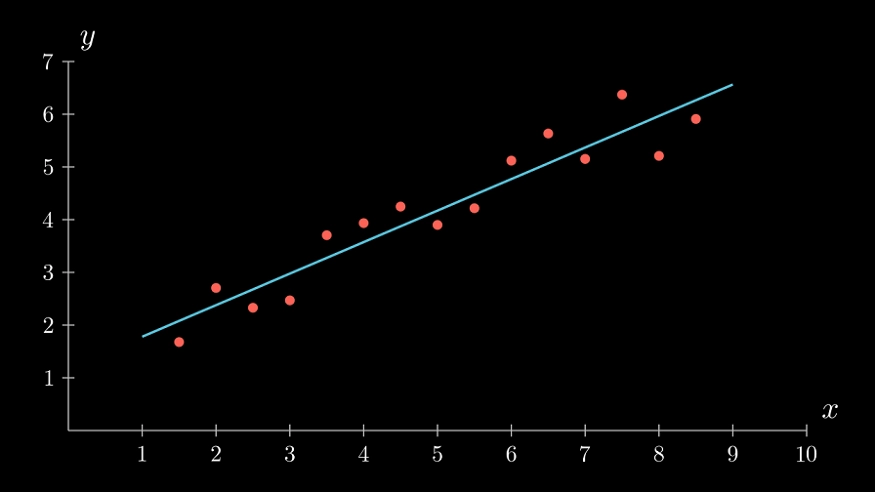
The concept underlying traditional linear regression is straightforward: create a "best-fit" line across the data points that minimizes mean squared errors. It appears to be in good condition. However, we do not often obtain such clean, well-behaved data.
Need for RANSAC Algorithm

The Classic example of linear regression

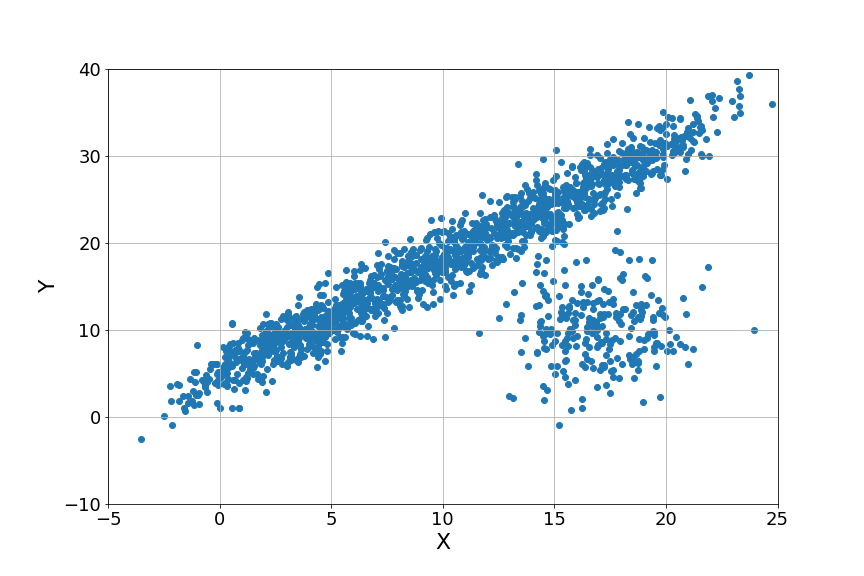
You have been given a dataset and want to use it to fit a mathematical model. We can now presume that there are some inliers and outliers in this data. Outliers are data points that any plausible mathematical model cannot describe. Inliers are data points that a mathematical model can explain. 
Need for RANSAC Algorithm

Data points

The quality of the mathematical model we can fit the data is usually harmed by their presence in the dataset. While estimating the parameters of our mathematical model, we should disregard these outliers for optimum outcomes. RANSAC assists us in finding these locations in order to provide a better fit for the inliers.

Even the inliers may not completely match the mathematical model owing to noise. However, the outliers either have an unusually significant quantity of noise or are produced due to measurement errors or sensor difficulties.

Let us discuss the algorithm now.

RANSAC Algorithm

Basic idea: Try on a few different fits and choose the best one!

The following stages will be followed. The method will be terminated if the model performance passes a user-defined threshold or a set number of iterations has been achieved.

for n in range(numTrials): # num of trials we opt for or iterations
Pick a random set of points
Solve the model using those parameters
Divide the original dataset into inliers and outliers based on the fit.
The model-fitting points become part of the consensus set. The model is good if a certain number of points have been classified as part of the consensus set.
count number of inliers,
pick the model with the most inliers
RANSAC Algorithm

Trying different fits

So, what appears to be a reasonable compromise? We must define a maximum distance threshold possible inlier can have while using RANSAC. The absolute value for each activity must be chosen separately based on the problem we attempt to solve.

Another critical question is how many times we must perform this process to discover a solution. We must admit that RANSAC does not always provide a decent answer. It is a non-deterministic system. To develop a model for our data, we choose points at random. That implies that depending on how data is distributed, and we can develop a decent model with a certain probability.

Also read, Sampling and Quantization

Frequently Asked Questions

What is the RANSAC plane algorithm?

The RANSAC plane algorithm estimates the best-fitting plane in 3D data by iteratively selecting inliers while ignoring outliers using random sampling.

What is the RANSAC-based method?

A RANSAC-based method identifies model parameters by iteratively selecting random subsets of data, fitting a model, and maximizing the number of inliers.

What is the RANSAC algorithm for feature matching?

The RANSAC algorithm for feature matching identifies consistent correspondences between keypoints by iteratively fitting a geometric transformation and rejecting mismatched outliers.

Conclusion

In this blog we got an overview of the RANSAC's algorithm. We saw that even when the data set contains many outliers, it can estimate the parameters with high accuracy. We learnt about why we need the algorithm and where it can be used. Finally we looked at the pseudocode of the Algorithm. To get a complete understanding of various machine learning and computer vision algorithms, check out our Machine learning course.

Live masterclass


