

Table of contents
1.
Introduction 
2.
What is a Real-Time Operating System?
2.1.
Components of Real-Time Operating System (RTOS)
3.
Types of Real-Time Operating System (RTOS) 
3.1.
Hard Real-Time operating system
3.2.
Soft Real-Time operating system
3.3.
Firm Real-time
4.
What is the Purpose of RTOS?
4.1.
Common Uses of RTOS
5.
GPOS vs RTOS
6.
Advantages of Real-time operating system
7.
Disadvantages of the Real-time operating system
8.
Frequently Asked Questions
8.1.
What is the importance of RTOS?
8.2.
Write the main features of  RTOS.
8.3.
What is the difference between real-time OS and normal OS?
8.4.
Write the difference between time-sharing and real-time operating systems.
8.5.
Give some examples of Real-time operating systems.
9.
Conclusion
Last Updated: Apr 24, 2025
Easy

Real-Time Operating System (RTOS)

Career growth poll
Do you think IIT Guwahati certified course can help you in your career?

Introduction 

Operating system software handles computer operations such as editing, input/output operation, resource allocation, file system manipulation, etc., and acts as a visual interface between user and hardware. There are different types of operating systems which are-

In this article, we are going to discuss about the Real Time Operating System in detail.
Operating System

So, let’s get started: 
 

Also see: Multiprogramming vs Multitasking and Open Source Operating System

What is a Real-Time Operating System?

A real-time operating system (RTOS) is a specially designed operating system used in computers with strict time limits for any work to be done. It is widely used in those systems where calculation results influence the process while executing.

In RTOS, the processing time required is calculated by ten incremental seconds. It is a time-limited system defined as fixed time constraints. In this type of system, processing should be done within the specified parameters. Otherwise, this will lead to system failure. 

Examples of real-time operating systemsFlight traffic control systems, Command Control Systems, Heart pacemakers, Airlines Booking systems, Multimedia Network Systems, Medical Imaging Systems, Cell phone switching gadgets, Robots, etc.

What is a Real-Time Operating System

Source:Intel

Next, let us discuss the components of an RTOS:

Also Read About, FCFS Scheduling Algorithm and Difference Between Bit and Byte

Components of Real-Time Operating System (RTOS)

RTOS is system software that controls computer hardware and software resources and provides essential services to computer programs. It acts as a link between the computer user and the computer hardware like any other operating system. We can perform computer programs efficiently and easily using the operating system. There are several different tasks performed within the system, and it responds appropriately to every task in short intervals. This makes real-time systems compatible with systems. 

There are various components of Real-time operating systems which are given below-
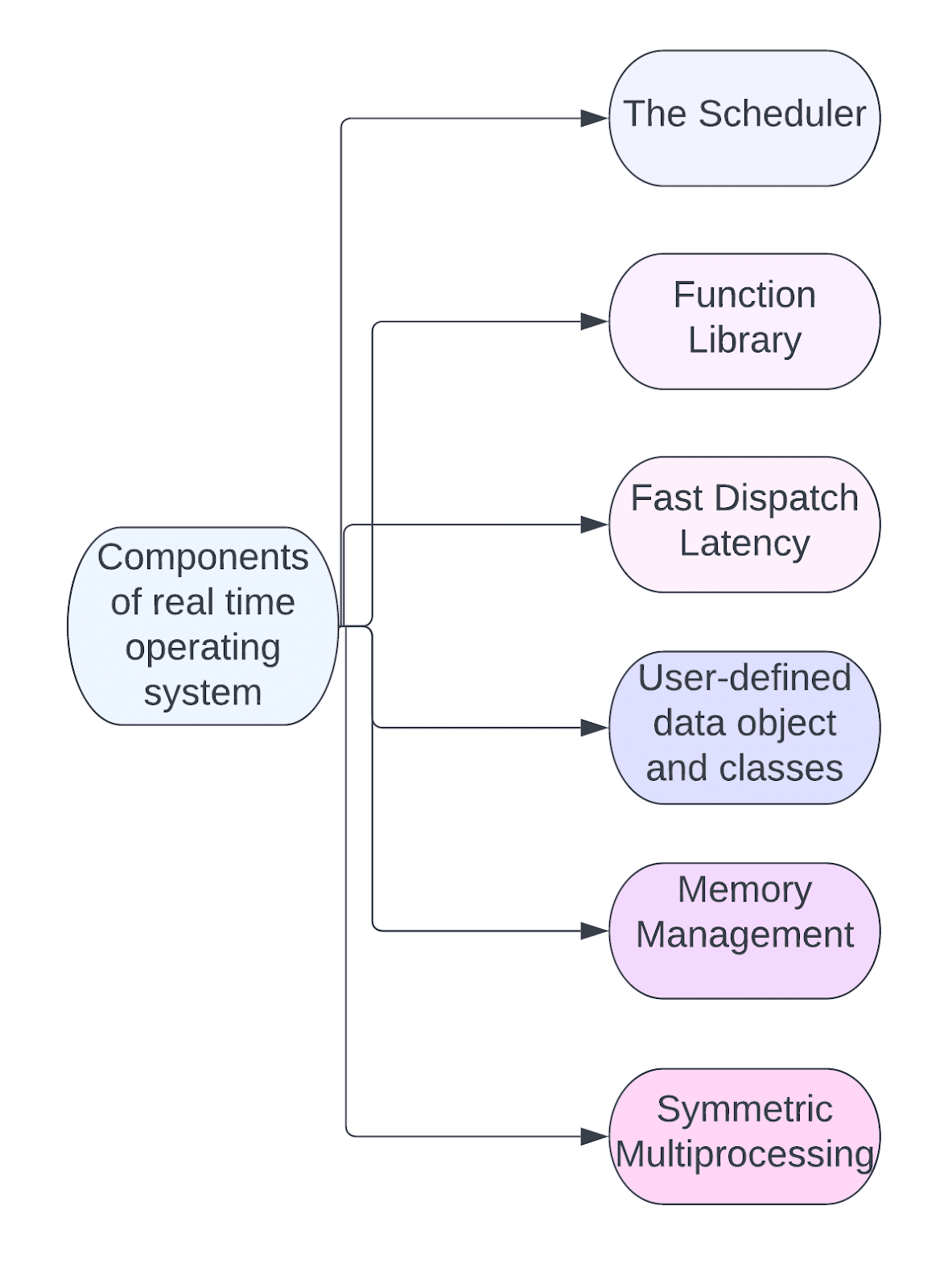
Components of Real-Time Operating System (RTOS)

The Scheduler: This component of RTOS tells the order of the tasks in which it can be executed which are usually based on priorities.

Function Library: It is an important RTOS feature that serves as a visual connector that helps you to connect the kernel and application code. This application allows you to send requests to Kernel using the library so that the app can provide the results you want.

Fast dispatch latency: It is an interval between the termination of the task that can be identified by the OS and the actual time taken by the thread, which is in the ready queue, that has started processing.

User-defined data objects and classes: The RTOS system uses programming languages ​​such as C or C ++, which must be configured according to their functionality or operation.

Memory Management: this feature is required in the system to allocate memory to every program, which is a very important part of RTOS.

Symmetric Multiprocessing (SMP): It is a number of different functions that can be managed by RTOS so that parallel processing can be done.

Must Read Multiprocessing Operating System

Types of Real-Time Operating System (RTOS) 

Now it’s time to discuss the types of RTOS which are generally of three types as discussed below-

Types of Real-Time Operating System (RTOS)

Hard Real-Time operating system

In Hard RTOS, all important tasks must be completed within the allotted time, that is, within the given deadline. Failure to meet the deadline could result in serious failures such as mechanical damage or even loss of human life.


For Example- Autopilot travel simulators, Medical critical care systems, Aircraft systems, etc.

Soft Real-Time operating system

Soft RTOS accepts a few delays while using the Operating System. In this type of RTOS, there may be a closing date assigned to a specific task, but a short delay is acceptable. Therefore, cut-off dates are treated softly via means of this kind of RTOS.


For Example- Online Transaction systems and Livestock price quotation Systems.

Firm Real-time

These types of RTOS also need to follow a deadline. However, bypassing the deadline may not have the greatest impact but may result in unwanted impacts, such as a significant reduction in product quality.


For Example- Different types of Multimedia applications.
 

Must Read Process Management in OS

What is the Purpose of RTOS?

A Real-Time Operating System (RTOS) is designed to manage hardware resources, execute tasks, and provide services within strict timing constraints. Unlike general-purpose operating systems (GPOS) such as Windows or standard Linux distributions, RTOS focuses on determinism, low latency, and predictability, ensuring that critical tasks are completed within defined time limits.

The primary purpose of an RTOS is to support real-time applications where delayed processing can lead to system failures or undesirable outcomes. It ensures that tasks are executed precisely when needed—especially in scenarios involving automation, embedded systems, or mission-critical control.

Key characteristics of RTOS include:

  1. Real-Time Task Scheduling: Uses preemptive or cooperative scheduling to prioritize critical tasks.
  2. Low Latency and High Responsiveness: Responds quickly to external events and interrupts.
  3. Deterministic Behavior: Guarantees consistent response times, crucial for safety and time-sensitive operations.
  4. Efficient Resource Management: Minimizes memory usage and maximizes CPU cycles to suit embedded systems.
  5. Minimal Overhead: Strips down features to reduce delays and improve reliability.

Common Uses of RTOS

  • Defense Systems (e.g., RADAR, missile guidance)
  • Air Traffic Control Systems
  • Medical Devices (e.g., pacemakers, infusion pumps)
  • Stock Trading Platforms (high-frequency trading)
  • Networked Multimedia Systems (VoIP, video streaming devices)

GPOS vs RTOS

ParameterGeneral-Purpose OS (GPOS)Real-Time OS (RTOS)
ComplexityHigh, supports diverse applicationsLow, focused on specific tasks
TimingBest-effort schedulingTime-bound, deterministic scheduling
Resource GuaranteesNo hard guarantees on CPU or memoryGuaranteed resource allocation for real-time tasks
Behavior PredictabilityVariable, depends on system loadConsistent, even under heavy load
UpgradeabilityEasy and frequent with broad supportOften customized and rarely updated

Advantages of Real-time operating system

The benefits of the real-time operating system are as follows-:

  • It is easy to plan, develop and use real-time applications under a real-time operating system.
  • Real-time performance structures are highly compact, so those structures require very little memory space.
  • In a Real-time operating system, there is high usage of devices and systems.
  • Memory sharing is best controlled on these types of systems.

Disadvantages of the Real-time operating system

Following are the cons of a Real-time operating system-

  • Real-time operating systems have complex architecture and are very expensive to upgrade.
  • Real-time applications are extremely complex and can consume significant CPU cycles.


You can also read about layered structure of operating system.

Must Read Threads in Operating System

Frequently Asked Questions

What is the importance of RTOS?

  • It provides pre-programmed editing, which allows you to separate analytical processing and non-critical processing.
  • Real-time OS provides API functions that allow for clean and minimal application code.
  • Short-term dependence and work-based design create interdependence between modules.

Write the main features of  RTOS.

  • Take very little memory
  • Use very few resources
  • Response times are highly predictable
  • Unexpected location.
  • Kernel saves the ad status of the interrupted activity and decides which task to launch next.
  • Kernel restores function status and shifts CPU control to that task.

What is the difference between real-time OS and normal OS?

The difference between standard and real-time applications is a time factor. Time is not an important factor in normal operating systems like Windows, Linux, Unix, etc. Time is a very important factor in real-time applications used in the launch of rockets, ATMs, etc. 

Write the difference between time-sharing and real-time operating systems.

Many users can interact with computer systems simultaneously using time-sharing operating systems, which switch the CPU between them. On the other hand, a real-time operating system may be able to complete one task at a time and deliver resources on time.

Give some examples of Real-time operating systems.

Some examples of Real-time systems are-

  • MTS
  • Lynx
  • QNX
  • VxWorks etc.

Conclusion

To summarize this blog, we learned about real-time operating systems, different types of operating systems, and components. Further, we also discussed the three types of real-time operating systems which are soft, firm, and hard RTOS. And then we learned about the advantages and disadvantages of Operating System.

Recommended Readings: 

Live masterclass


