Do you think IIT Guwahati certified course can help you in your career?
Introduction
Operators are an integral part of any programming language. They help us work with data and variables to perform a particular task. Every data stored within a variable exists as bits or bytes in the computer. This allows the programmer to perform bit manipulation operations to solve a variety of problems in an optimised manner. The Shift operator in Java focuses on shifting the bit patterns of an operand in a particular direction. Moving the bits of a value tends to change the existing value to a new one.
What Are Shift Operators?
Shift operators in Java are used to move the bits of a number left or right, which is useful for low-level programming tasks such as bit manipulation, optimization, and cryptography. These operators work on the binary representation of integers and directly affect their value by shifting bits in a specific direction.
<< (Left Shift)
The left shift operator (<<) shifts all bits in a number to the left by a specified number of positions. It fills the empty bits on the right with zeros.
int a = 5;        // Binary: 00000101
int result = a << 1; // Result: 00001010 (10)
You can also try this code with Online Java Compiler
This is equivalent to multiplying the number by 2^n. Commonly used in performance-sensitive code for fast multiplications.
>> (Signed Right Shift)
The signed right shift operator (>>) shifts bits to the right, preserving the sign bit (leftmost bit). It divides the number by 2^n, maintaining the number's sign.
int a = -8;       // Binary: 11111000
int result = a >> 2; // Result: 11111110 (-2)
You can also try this code with Online Java Compiler
Used when arithmetic division with sign preservation is required.
>>> (Unsigned Right Shift)
The unsigned right shift operator (>>>) also shifts bits to the right, but it does not preserve the sign bit. It fills the leftmost bits with zeros, making it suitable for unsigned binary operations.
int a = -8;
int result = a >>> 2; // Binary result is positive
You can also try this code with Online Java Compiler
Typically used for low-level data processing or converting negative binary values into their unsigned form.
Why Are Shift Operators Important in Java?
Shift operators play a vital role in Java programming beyond basic syntax. They’re widely used for performance optimization, binary data manipulation, and low-level programming tasks where direct control over bits is required.
1. Performance Efficiency Shift operations are much faster than multiplication or division by powers of two. For instance, x << 1 is equivalent to x * 2 but with significantly lower CPU cycles. This makes them ideal in performance-critical code like game engines, financial systems, or real-time applications.
2. Memory-Level Bit Manipulation Developers often use shift operators to set, clear, or mask specific bits within an integer. This is useful when dealing with flags, compact data formats, or hardware registers. For example, setting the third bit of a byte can be done using value |= (1 << 2).
3. System-Level Programming Use Shift operators are essential in embedded systems, cryptographic functions, and data compression algorithms. They help encode, decode, or pack data efficiently. For instance, right shifts can be used to extract specific byte segments from a binary number.
Types of Shift Operators in Java
Name
Operator
Syntax
Description
Signed Left Shift
<<
Operand << number
It moves all the bits of the operand towards the left by a given number.
Signed Right Shift
>>
Operand >> number
It moves all the bits of the operand towards the right by a given number.
Unsigned Right Shift
>>>
Operand >>> number
It moves all the bits of the operand towards the right by a given number, and the vacant leftmost position is filled with 0 instead of the sign bit.
Signed Left Shift Operator in Java
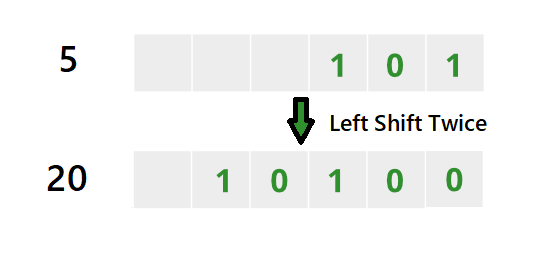
The left shift operator shifts the bits of the binary representation of a number to the left. It is equivalent to multiplying the operand with 2 raised to the number of shifting bits i.e., if n is the number of positions to be shifted, then the resulting number will be x * 2^n, where x is the operand.
public class Main
{
    public static void main (String[] args)
  {
      int x = 5;
      int n = 2;
      int answer = x << n;
      System.out.println("Left shift " + x + " by " + n + " positions : " + answer);
    }
}
Output
Left shift 5 by 2 positions : 20
5 in binary form is 101. By the formula, on applying left shift, the number will be 5 * 2^2 = 20. After shifting the bits towards the left, the right-most vacant spaces are filled with 0. This works similar to an unsigned shift operator, and hence, unsigned left shift operator is not specially defined.
Signed Right Shift Operator in Java
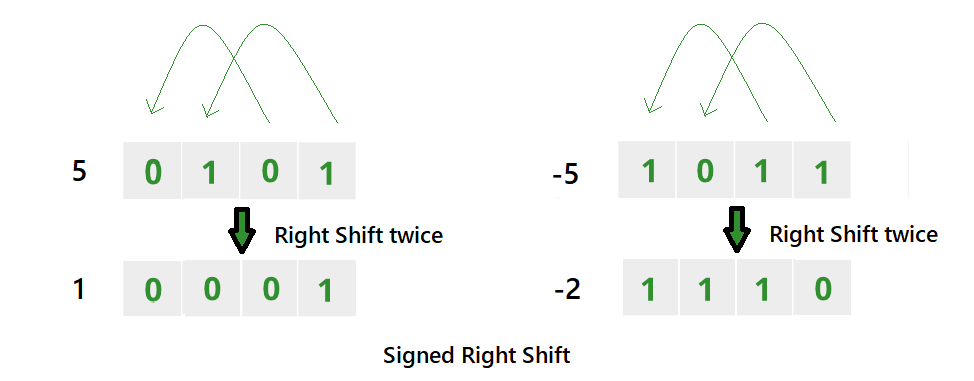
The right shift operator shifts the bits of the binary representation of a number to the right. It is equivalent to the floor division of the operand and 2 raised to the number of shifting bits, i.e. if n is the number of positions to be shifted, then the resulting number will be floor(x / 2^n), where x is the operand. (Note: floor division gives the quotient of a division rounded off to the nearest small integer.)
public class Main
{
    public static void main (String[] args)
  {
      int x = 5, y = -5;
      int n = 2;
      int answer1 = x >> n;
      int answer2 = y >> n;
      System.out.println("Right shift " + x + " by " + n + " positions : " + answer1);
      System.out.println("Right shift " + y + " by " + n + " positions : " + answer2);
    }
}
Output
Right shift 5 by 2 positions : 1
Right shift -5 by 2 positions : -2
5 in binary form is 101. On applying right shift, the number will be 5 / 2^2 = 1. After shifting the bits towards the right, the leftmost vacant spaces are filled with the sign bit, which in the first case is 0.
-5 in binary form is 1010. On applying right shift, the number will be -5 / 2^2 = -2. After shifting the bits towards the right, the leftmost vacant spaces are filled with the signed bit 1.
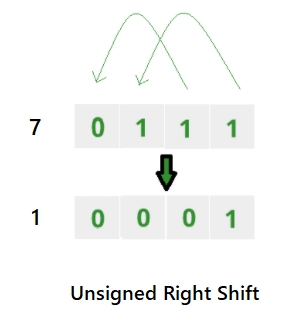
In unsigned right shift, all bits are shifted to the right and the vacant spots on the left are filled with 0.
public class Main
{
    public static void main (String[] args)
  {
      int x = 7, y = -7;
      int n = 2;
      int answer1 = x >>> n;
      int answer2 = y >>> n;
      System.out.println("Right shift " + x + " by " + n + " positions : " + answer1);
      System.out.println("Right shift " + y + " by " + n + " positions : " + answer2);
    }
}
Output
Right shift 7 by 2 positions : 1
Right shift -7 by 2 positions : 1073741822
Signed right shift operator. Shifts bits to the right, preserving the sign of the number (sign-extension).
x = -8; x >> 1; // Result: -4
>>>
Unsigned right shift operator. Shifts bits to the right, filling with zeros from the left.
x = -8; x >>> 1; // Result: 2147483644
The >> operator preserves the sign of the number during shifting (sign-extension), while the >>> operator fills with zeros from the left, effectively treating the number as unsigned.
Shift Operators vs Arithmetic Operators
While shift operators and arithmetic operators serve different purposes in Java, they sometimes perform similar tasks. Understanding where they overlap—and where they differ—is important for writing efficient code.
a. How Shift Operators Mimic Multiplication or Division
Shift operators can replicate certain arithmetic operations more efficiently. For example:
The left shift (<<) operator shifts bits to the left, multiplying the number by 2 for each shift.
int x = 4;            // Binary: 00000100
int result = x << 1;  // Binary: 00001000 → result = 8
You can also try this code with Online Java Compiler
These operations avoid the overhead of arithmetic calculations and are ideal for fast mathematical computations with powers of 2.
b. Performance Benefits in Some Scenarios
Shift operators provide performance benefits in low-level or real-time applications like gaming, signal processing, or embedded systems. Since they work directly at the bit level, they're faster than arithmetic operators, especially in tight loops or hardware-bound code.
For example, multiplying by 8 using shifts:
int value = 5;
int result = value << 3;  // 5 * 8 = 40
You can also try this code with Online Java Compiler
This approach is quicker than using value * 8, particularly on systems where multiplication is slower than bitwise operations.
Shift Operators vs Arithmetic Operators
Feature
Shift Operators
Arithmetic Operators
Purpose
Bit-level manipulation
Mathematical computation
Symbol
<<, >>, >>>
+, -, *, /, %
Example
x << 2 → x * 4
x * 4
Performance
Faster in specific cases
Standard speed
Frequently Asked Questions
What is bit manipulation?
Bit manipulation techniques allow us to solve different problems using the bit representation of an operand. Data encryption and data compression use these operations to encode, decode or compress a given data. They are also used in computer networking applications that involve the framing and transfer of packets across a network.
What is >> and >>> in Java?
In Java, >> and >>> are bitwise right shift operators. >> is the signed right shift operator, which shifts the bits of a number to the right by a specified number of positions, preserving the sign bit. >>> is the unsigned right shift operator, which shifts the bits of a number to the right by a specified number of positions, filling the leftmost bits with zeros.
What is the use of shift operator?
Shift operators are used in Java for bitwise manipulation of integers. They allow you to efficiently perform operations such as division or multiplication by powers of 2, extraction or insertion of specific bits, and compact representation of data. Additionally, they are commonly used in low-level programming, cryptography, and optimization tasks.
Conclusion
Shift operators in Java, including the signed left shift operator in Java (<<), signed right shift (>>), and unsigned right shift (>>>), offer powerful tools for bitwise manipulation. They are essential for efficient data handling, particularly in low-level operations like cryptography and data compression. Understanding these operators is crucial for optimizing performance and solving problems involving bitwise operations.









 1+ registered

