Do you think IIT Guwahati certified course can help you in your career?
Introduction
We all want to write an easy-to-understand code that is readable and lightweight. Therefore, in this blog, we will understand the concept of Aspect-Oriented Programming(AOP). Spring boot AOP enables Aspect-Oriented Programming in Spring Applications. The AOP concept is very easy to implement, and with this, we can add modularity to our code.
There is no need to recompile the complete code if we have made any manipulations. Instead, we just need to change the configuration files to make it done. So, let's read and understand the concept of AOP with the help of this blog.
Definition of Spring Boot AOP
AOP is known as Aspect-Oriented Programming. It adds modularity to the program without modifications in the original code itself. Instead, we can achieve modularity with the separation of the cross-cutting concerns. The central unit of modularity is an aspect.
The extra functionality can be added before or after the method execution whenever a method gets executed.
Why AOP
By simply using simple pluggable configurations, we can dynamically add the cross-cutting concern before, after, or around the actual logic. Moreover, maintainability is achieved for the present as well as the future. Therefore, AOP plays a very crucial role.
Cross-Cutting Concerns
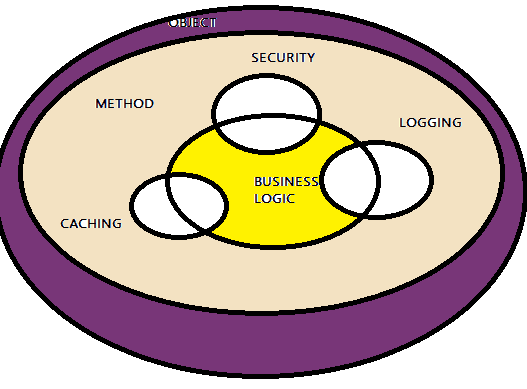
A cross-cutting platform is something that we can implement over the code core without any modification. We can add this concern at multiple places in the application. For example, security is a cross-cutting concern that must be implemented over various platforms. So, despite repeatedly adding the code at every method, we can define the functionality in a standard class and control where we need to apply that functionality in the whole application. Some common cross-cutting concerns are logging, validation, and caching.
Benefits of Spring Boot AOP
It's like plug-and-play. There is no need to touch core code or business logic.
As regular spring beans, we can configure the aspects.
The cross-cutting concerns are stored in one place only.
The logic of each concern is at one place rather than being scattered.
Aspect
Like in Object-Oriented Programming, there is a class in the same in Aspect-Oriented Programming, there is an aspect. Aspect is a special kind of class where the cross-cutting concern can also be modularized.
We need to implement a cross-cutting concern with the help of aspects.
Benefits of Aspect
In one place, we can store the logic of concern. Therefore, the readability of the code is maintained.
The primary concerns are held in the business logic. At the same time, the secondary problem is stored in aspect. Therefore, clarity is optimized.
AOP Terminology
Let's have more clarity about AOP with the help of the following terminologies:
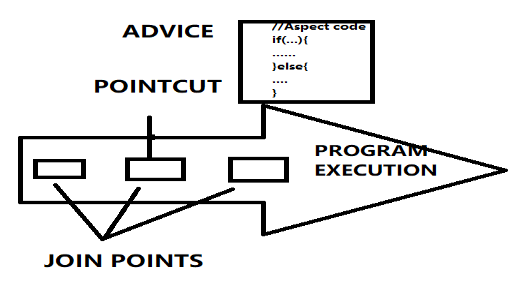
ASPECT: It is a module with a set of APIs(Application Programming Interface) that provide all cross-cutting requirements. For example, a security module would be called the AOP aspect for security alignment. There can be any number of aspects depending upon the need.
JOIN POINT: It is the actual place in the application where an action will be taken using the Spring AOP framework.
POINT CUT: It is the expression language of the AOP. A pointcut combines two or more joinpoints where advice needs to be executed. It can be implemented using expressions or patterns. ADVICE: Advice is nothing but an action that we will take before or after implementing the method. Basically, they are the method that gets executed when a certain join point needs a matching point cut in the application. The five types of advice are as follows: before, after, after-returning, after-throwing, and around advice.
Example: The following diagram shows the execution of advice.
Execution of advice
Remember, advice can't be for every join point. It changes with the join point.
TARGET OBJECT: Target objects are those over whom the advice is implemented.
WEAVING: Weaving is the process that links aspects with other application types or objects to create an advised object. It can be implemented anytime during runtime, load time, or compile time. Specifically, spring AOP executes the weaving process during runtime.
AOP Vs. OOP
AOP can't replace OOP; instead, it just extends it.
Let's understand the difference between AOPs and OOP's.
Factors
AOP
OOP
Definition
AOP stands for Aspect-Oriented Programming.
OOP stands for Object-Oriented Programming.
Code Creation
Code creation is apparent and evident.
Code creation is not that clear; instead, there is functionality within the class.
Modularity
The basis of modularity is functionalities or processes.
The basis of modularity is real-world objects.
Reusability
Reusability of code is to a greater extent.
Reusability of code is to a lesser extent.
Let's take a look at the diagrams:
AOP
OOP
Spring AOP vs. AspectJ
Spring AOP and AspectJ are two popular frameworks for implementing aspect-oriented programming (AOP) in Java. The table below highlights their differences:
Feature
Spring AOP
AspectJ
Integration
Part of the Spring Framework, works seamlessly with Spring.
A standalone AOP framework that can be used independently.
Complexity
Simple and easy to use for most AOP scenarios.
More complex and powerful, suitable for advanced use cases.
Weaving Type
Runtime-based (proxy creation).
Supports compile-time, load-time, and runtime weaving.
Performance
Slower than AspectJ due to runtime weaving.
Faster as it can perform compile-time or load-time weaving.
Dependency
Requires Spring Framework.
Does not require Spring; works with any Java application.
Use Cases
Best for Spring-specific projects with simple AOP needs.
Ideal for complex and cross-cutting concerns.
Annotations
Limited annotations for defining aspects.
Provides extensive annotations and flexibility.
Types of Spring Boot AOP Advice
Below is the detail of five kinds of advice:
Before Advice: This gets implemented before the joining point.
After Returning Advice: It gets executed once the joining end gets completed typically.
After Throwing Advice: It runs if the method exits by throwing an exception.
After Advice: It confirms it gets executed whether the joining point usually leaves or exceptionally gets returned.
Around Advice: It runs after and before a join point.
Frequently Asked Questions
1. Which problems are solved with the help of Spring Boot AOP?
Ans: Spring Boot AOP solves the problem of code tangling and eliminates code scattering.
Code is accumulated in a particular module which can be implemented anytime in the code that’s how the code becomes clean and readable.
2. Name three types of cross-cutting concerns.
Ans: The three cross-cutting concerns are:-
Logging
Security
Transaction
3. Differentiate concern and cross-cutting concern
Ans: The following shows the difference between concern and cross-cutting concern.
Concern: It is the behavior that we want in the module of the application
Cross-cutting concerns: It is applicable throughout the application.
Conclusion
This was all about AOP. When we face interview questions, this basis of knowledge of Spring Boot AOP will be helpful. Please make sure that you correctly understand the basics over which the whole Spring Boot AOP is based and the terminologies associated with it. Since it is user-friendly and it becomes easier to understand, that's why this model is preferable.









 7+ registered

