Do you think IIT Guwahati certified course can help you in your career?
Introduction
While preparing for the job interview, it is important to be ready to tackle all the basic to medium to advanced questions that an interviewer might ask. If you are preparing for a Test lead/ QA manager interview, It is very important to go through all the frequently asked Test lead interview questions.
In this blog, we have curated a list of the 27 most frequently asked Test lead interview questions that may be asked in your next Test lead/ QA manager interview. But before discussing the questions, let’s learn what a QA manager or test lead is.
What is a QA Manager or Test Lead?
A Quality Assurance(QA) manager is responsible for checking the quality of products, services, and reliability testing for the company's products and development processes. As a QA manager, you should have expertise in Software Testing, API Testing, Automation Testing, Java, etc.
A Test lead is responsible for monitoring, planning, and controlling a company's testing activities and tasks. As a test lead, you should be proficient in the technical aspects of work.
Now we are familiar with the QA manager/ Test lead. Let’s discuss the top 27 most frequently asked Test lead interview questions and answers.
We have divided the test lead interview questions into three levels, i.e., Easy Test Lead Interview Questions, Medium Test Lead Interview Questions, and Hard Test Lead Interview Questions.
Easy Test Lead Interview Questions and Answers
1. What are the responsibilities of a Test lead?
The major roles/responsibilities of a Test lead are:-
Management of product from scratch to the completion of the product.
Test the planning.
Mentoring and coaching the other team members.
Submit the weekly test reports.
Obtain customer acceptance of the deliverables.
2. What is a bug?
A bug is a flaw, mistake, error, or failure in the software code that makes the software produce unexpected results.
3. What are bug leakage and bug release?
Bug Leakage: When the bug is detected by the end-user while using the product and not by the testing team.
Bug Release: When the software is released with a set of known bugs is known as a bug release. The bugs that are released in the product have very less priority and do not cause any severity to the application.
4. What is Design Management?
The processes used to organize, manage, and track test artifacts are referred to as design management. The test relics may include the mechanization code, requirements, documentation, problems, plans, change demands, etc.
5. What is test estimation?
Test estimation provides an estimate of how much time, effort, and resources will be necessary to test the product. Most projects will benefit from test estimation in terms of cost, time, and feasibility.
6. What is a test plan?
A test plan is a document used to communicate the approach and methods utilized during the QA testing process. It is beneficial for setting goals, clarifying expectations, and identifying testing needs. The test plan will outline the testing's parameters and provide details on any project-related issues. It will be decided on the pass/fail, suspension, and exit criteria, as well as the tasks that will be carried out and the roles and responsibilities of each team member.
7. What are the types of test plans?
There are three main types of test plans:-
Master Test Plan
Testing type-specific Test Plan
Testing level-specific Test Plan
8. What is the Requirement Traceability Matrix?
Requirement Traceability Matrix, often abbreviated as RTM, is a document that helps to link the requirements to test cases.
Some of the uses of the Requirement Traceability Matrix are as follows:-
It is used to make sure that all the application requirements are tested in the verification process.
It is used to verify test coverage.
9. Differentiate between Assert and Verify commands in test automation.
Both commands are almost similar; they are used to check if the code's conditions are true.
The difference between both commands is given below.
10. What is the difference between Static and Dynamic Testing?
Static Testing: Done without executing the software (e.g., reviews, walkthroughs, inspections).
Dynamic Testing: Involves executing the software and checking the actual output against expected results.
11. What is Test Case Prioritization?
Test case prioritization is the process of ordering test cases based on business impact, critical functionalities, defect-prone areas, and risk factors to ensure that high-priority tests are executed first.
12. What is the Role of a Test Lead in Agile Testing?
A test lead in Agile ensures quality throughout the sprint cycle, collaborates with developers, prioritizes test automation, and adapts to changing requirements while managing the testing team.
13. What is the difference between Positive and Negative Testing?
Positive Testing: Validates expected functionalities with correct inputs.
Negative Testing: Tests invalid inputs to check system behavior under failure conditions.
14. What are Entry Criteria in Software Testing?
Entry criteria define the prerequisites before testing starts, such as availability of test data, approved test plan, and a stable build.
Medium-Level Test Lead Interview Questions
15. Suppose you have to choose a tool for testing tool for your project. What is your approach to selecting that testing tool?
Some of the factors that you should consider before selecting the testing tool for your project are:-
Identify the different features required in an automation testing tool as per the needs of your project.
Check for all the commercial as well as noncommercial tools that meet the requirements of your project.
Estimate the cost and benefits of the tool.
The final decision to buy the tool is to be taken after consultation with team members.
16. What is Exploratory Testing?
Also known as simultaneous learning, test execution, and test design. Exploratory testing is a methodology that involves testing software without any predetermined timetables or plans. It is used when an early iteration is required. It involves the least amount of planning and the most amount of testing. During software testing, the tester makes new discoveries and learns innovative things that, when combined with knowledge and imagination, lead to the creation of new, effective tests.
17. Explain Bug Triage.
The method of categorizing each bug according to its frequency, severity, and risk is known as bug triage. The QA team verifies the severity of the bug, makes the necessary adjustments, completes the bug resolution, and allocates resources.
There are three processes involved in Bug Triage:-
Bug Review
Assessment
Assignment
18. What is the difference between functional and non-functional testing?
Functional Testing: Functional testing helps to test the application against its functional specifications and requirements. The functionalities are tested by giving the input and getting an expected output. Then the actual output is compared with the expected output.
Non-Functional Testing: Non-Functional testing helps to test the non-functional requirements of the application. It will test all the functionalities that cannot be tested using functional testing. It tests whether the system is fulfilling the requirements or not.
The major differences between functional and non-functional testing are:-
Functional Testing
Non-Functional Testing
Tests if the software meets functional requirements.
Tests non-functional aspects like performance, usability, and security.
Validates features and functionalities of the application.
Evaluates system behavior under various conditions.
Based on business requirements and user scenarios.
Based on technical specifications and system characteristics.
Unit Testing, Integration Testing, System Testing, UAT.
PDCAstands for Plan Do Check Act. It is a four-step problem-solving technique used for quality assurance.
Plan: In this stage, the problem is identified, and a target is set to solve those problems.
Do: In this stage, the improvements are implemented.
Check: In this stage, the result of improvements is checked.
Act: In this stage, we learn from the result obtained.
20. What is a three-point estimation?
In the three-point estimation technique, based on past experience, three values are initially produced for every task.
For example, to complete a particular task, the different possibilities are:-
Best Case Estimate: It takes 12 days to complete the task with experienced team members.
Most Likely Estimate: It takes 18 days to complete the task with enough resources and moderate team members.
Worst Case Estimate: It takes 24 days to complete the task with the team having very less work experience.
21. What is the difference between beta and pilot testing?
Beta Testing:Beta testing is done when the application is just about to release. The beta version application is given to a limited number of end-user to check whether the application is running as per the requirements or not. If some bugs/defects are found, the application is again tested, and the quality of the application will be improved before being released into production.
Pilot Testing:Pilot testing is real-world testing, which is done by a certain group of end-users before launching the application to production. The group of users will use the application fully in order to find any bugs in it. The main purpose of pilot testing is to check the cost, feasibility, risk, and performance of the application.
The major differences between beta and pilot testing are:-
Beta Testing
Pilot Testing
Testing conducted by end-users before final release.
Testing conducted by a selected group of users before full deployment.
To gather feedback from real users and identify last-minute issues.
To evaluate system performance and feasibility before a full rollout.
External users or customers in a real environment.
Internal team or selected users within a controlled setup.
Real-world production environment.
Limited deployment within a specific region or group.
Focuses on usability, reliability, and user acceptance.
Focuses on technical feasibility, system performance, and risk assessment.
Collected from real users experiencing the full product.
Collected from test users within a planned deployment scenario.
Lower risk as software is almost ready for release.
Medium risk as it helps identify critical issues before a full-scale launch.
- A gaming company releases a beta version for user feedback before official launch. - A software company provides beta access to a new app feature.
- A hospital pilot-tests new patient management software in one department before organization-wide implementation. - A bank pilot-tests an online payment system with selected customers.
22. What are exit criteria, and how are they determined?
We cannot continue testing indefinitely at some point in time, we need to stop testing. To stop the testing at a certain point in time, we need some Exit criteria. Exit criteria are the prerequisites that must be satisfied before a particular task or process can be executed successfully. The exit criteria are determined on the basis of the quality standards and tasks set prior to beginning the project.
23. How the quality of test execution is determined?
The quality of test execution can be determined by calculating the Defect Rejection Ratio (DRR)and Defect Leakage Ratio (DLR). The smaller value of DRR and DLR indicates a good quality of test execution.
Defect Rejection Ratio = (No. of defects rejected/ Total no. of defects raised) X 100
Defect Leakage Ratio = (No. of defects missed/ Total defects of software) X 100
24. What is the difference between Functional and Structural Testing?
Functional Testing: Focuses on what the system does, based on requirements.
Structural Testing: Tests how the system is built, focusing on internal structures (e.g., white-box testing).
25. How do you handle defect rejection from developers?
A test lead should analyze logs, provide detailed evidence, replicate the issue consistently, and communicate effectively with developers to validate and resolve defect reports.
26. Explain Risk-Based Testing and its Importance.
Risk-based testing prioritizes test cases based on business impact, likelihood of failure, and critical functionalities, ensuring high-risk areas are tested first to optimize time and resources.
27. How do you measure the effectiveness of a Test Automation Strategy?
Test automation effectiveness is measured by test execution speed, defect detection rate, automation coverage, maintenance cost, and reduction in manual efforts.
28. What is Shift-Left Testing?
Shift-left testing involves starting testing activities earlier in the software development lifecycle (SDLC) to identify defects sooner and reduce bug-fixing costs.
29. What is Parallel Testing, and Why is it Important?
Parallel testing executes multiple test cases simultaneously on different browsers, environments, or devices to reduce execution time and improve coverage.
30. What is the purpose of a Test Data Management Strategy?
A test data management strategy ensures high-quality, secure, and reusable test data for efficient and consistent testing across different scenarios.
Hard Level Test Lead Interview Questions
31.What are how you can manage/mitigate risks in a test project?
There are mainly four ways to manage/mitigate risks in a test project:-
Avoidance: In this method, we avoid the risk factors that are involved in the project.
Acceptance & Sharing: In this method, we accept the risks that are involved in the project and try to develop a planned budget for the risk involved and collaborate with others to share responsibility.
Reduction:In this method, we develop a management plan to reduce the impact of risk.
Risk Transfer:In this method, we transfer the risk to another resource/party.
32. What are the major differences between Smoke testing and Sanity testing?
Smoke Testing:Smoke testing is done to check whether the important functionalities of the application are working properly. This testing is performed on initial builds and is a part of basic testing.
Sanity Testing:Sanity testing is done to verify the conformity of new functionalities in the previously written code. This testing is performed on stable builds and is a part of regression testing.
The major differences between Smoke testing and Sanity testing are:-
Smoke Testing
Sanity Testing
A broad test to check if the basic functionalities of the application work.
A focused test to verify that specific changes or bug fixes work correctly.
To determine whether the build is stable enough for further testing.
To check if new changes or bug fixes have not affected existing functionality.
Covers major functionalities without deep testing.
Focuses on a specific area or module of the application.
Covers critical test cases across the application.
Covers detailed test cases related to the recent changes.
Done on new builds before in-depth testing begins.
Done after bug fixes or minor updates to check if they work properly.
Can be automated or manual.
Usually performed manually.
Fast, as it focuses on basic functionality.
Quicker than regression testing but more detailed than smoke testing.
If smoke testing fails, the build is rejected.
If sanity testing fails, the build is sent back for fixes but may not be rejected outright.
Testing if the login page loads, the dashboard opens, and major buttons work.
Checking if a recently fixed login issue is now resolved without breaking the dashboard.
33. What are the key challenges of Software testing?
Some of the key challenges of software testing are:-
Testing Entire Application: There are several test combinations, making it challenging to test the entire application. If you try every combination, the product delivery will be delayed.
Regression Testing: It could be challenging to manage changes to existing functionality and past working functionality checks.
Communication with Developers: Developers/Testers may not always agree with each other on some points.
Time Constraint: There could be multiple tasks that you need to complete in a specific time.
Priority: When there is a time constraint, it becomes difficult for testers to choose whom to test first.
34. What are the types of Risks in a testing project?
The types of risks in a testing project are:-
Project Definition Risks: This type of risk includes Project target, Scope, and requirements risks.
Human Resources Risks: This type of risk includes Team members, skills, and organization risks.
Strategy Risks: This type of risk includes Communication,Budget, and Management risks.
Project Schedule Risks: This type of risk includes not being able to complete projects on the scheduled date and time.
35. Mention some best practices for test estimation.
Some of the best practices for test estimation are:-
Add Reasonable Buffer Time: Adding some buffer time will help you to deal with the delay in the project caused due to some unavoidable factors.
Use Past Experience Reference: Using past experience references will help you to make a good estimation and avoid all possible errors that may occur.
Add Resource Planning in Estimation: Adding resource planning will help you to make a realistic estimation after considering all the factors.
Stick to Estimate:Sometimes, the estimation may go wrong. It is important to re-check the estimation and make changes when required.
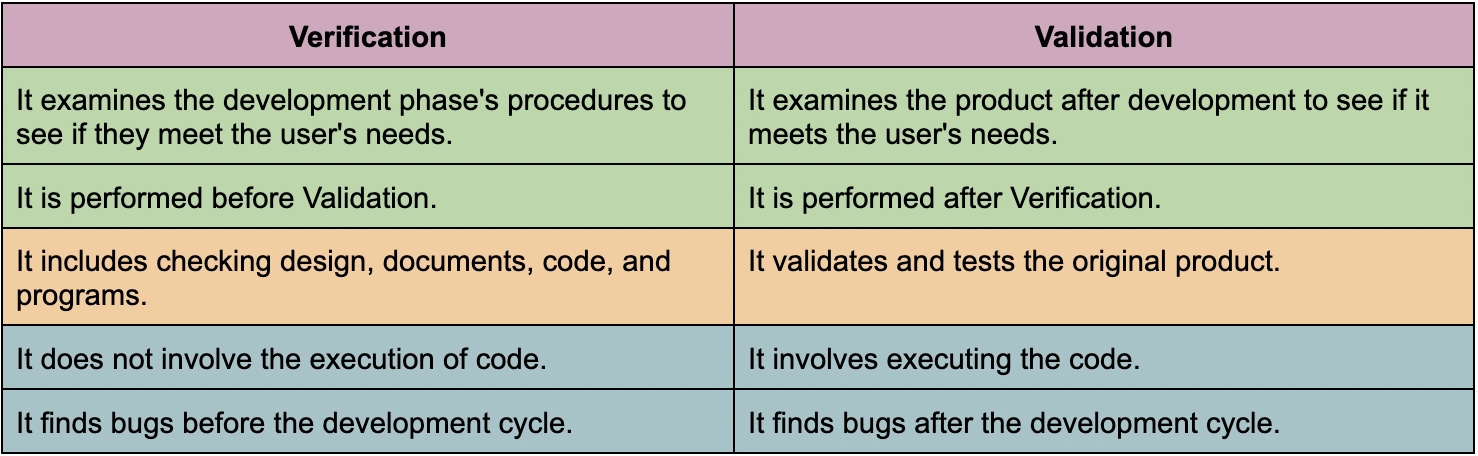
36. Differentiate between Verification and Validation.
Verification:Verification checks whether the application is working properly without having any bugs. Verification confirms the requirements that are mentioned in the SRS document. It includes methods such as desk checking, inspections, reviews, and walkthroughs.
Validation: Validation checks whether the developed product is up to the mark. It checks whether the application that is created is meeting the user’s requirements or not. It includes methods such as white-box testing, black-box testing, and non-functional testing.
The major difference between Verification and Validation is given in the following table:-
37. What are the severity and priority of a bug?
Bug Severity:Bug severity refers to how adversely the bug has impacted the features of the application.
Bug Priority:Bug priority refers to the order in which the bugs can be fixed. The bug that has more priority will be fixed first.
The bugs can have different severity and priority combinations, such as:-
High Priority and Low Severity
High Priority and High Severity
Low Priority and High Severity
Low Priority and Low Severity
38. What are the things that need to be added to a bug report?
The bug report should have the following things:-
Title of the report.
Mentioned Bug name/number.
Steps to reproduce the bug.
Summary that describes the bug.
Description that contains the steps to reproduce the bug and the expected results.
Date and Time when the bug was reported.
Bug Priority/Severity.
Version & Platform.
Evidence of failure that helps the user to understand the bug easily.
39. What is the difference between Retesting and Regression Testing?
Retesting:Retesting is well-planned testing done to check a feature of the application. The test cases written to test a specific feature cannot be automated. Retesting has a higher priority than regression testing.
Regression Testing:Regression testing is generic testing done to check a general area of the application. The test cases written to test a specific feature can be automated. Regression testing has a lower priority than retesting and is done after retesting.
The major differences between beta and pilot testing are:-
Retesting
Regression Testing
Testing a specific defect after it has been fixed.
Testing the entire application to ensure new changes haven’t affected existing functionality.
To verify that a previously failed test case now passes after the defect is fixed.
To check if recent code changes have introduced new defects in the system.
Focuses only on the fixed defect and related test cases.
Covers multiple functionalities across the application.
Uses the same test cases that previously failed.
Uses existing test cases and automated scripts for broader testing.
Faster, as it targets specific defects.
Time-consuming, as it involves comprehensive testing.
Not usually automated, as it focuses on a specific defect fix.
Often automated to speed up the testing process.
Higher priority as it ensures the defect is fixed.
Lower priority compared to retesting but essential for overall stability.
Performed before regression testing.
Performed after retesting to ensure stability.
A login page had a password validation issue, which was fixed and needs to be retested.
After fixing the password issue, regression testing checks if other features like signup, account recovery, and dashboard access are still working correctly.
40. How would you implement Continuous Testing in DevOps?
Continuous Testing in DevOps involves integrating automated tests into CI/CD pipelines, running tests frequently, using infrastructure as code, and leveraging real-time monitoring for quick feedback.
41. How do you handle flaky test cases in automation?
Flaky test cases should be analyzed for intermittent failures, unstable dependencies, network issues, and environment inconsistencies. Solutions include stabilizing waits, improving synchronization, and refactoring scripts.
42. Explain the impact of AI and Machine Learning in Test Automation.
AI-powered test automation enhances self-healing scripts, predictive analytics, intelligent test case generation, and defect pattern identification, significantly improving testing speed and accuracy.
Conclusion
In this article, we have extensively discussed the top 27 most frequently asked test lead interview questions and answers that will help you to crack your next Test lead/QA manager interview. I hope you enjoyed this blog on Top Test Lead Interview Questions and Answers.








 7+ registered

