

Table of contents
1.
Introduction
2.
What is ZigBee?
2.1.
ZigBee Devices
2.2.
ZigBee Architecture
3.
ZigBee protocol
4.
ZigBee applications
5.
Frequently Asked Questions
5.1.
What is ZigBee?
5.2.
Where is ZigBee used?
5.3.
Is ZigBee a Bluetooth?
5.4.
What is the range of ZigBee?
5.5.
Can ZigBee connect to Wifi?
6.
Conclusion
Last Updated: Aug 13, 2025

ZigBee

Author Prakriti
0 upvote
Career growth poll
Do you think IIT Guwahati certified course can help you in your career?

Introduction

In today’s fast, data-driven world, effective data communication is necessary. Multiple high data rate communication standards are available, but hardly any of them pass the sensor and control devices standards. These standards require low power consumption and low latency at low bandwidths. ZigBee technology has low power consumption and cost to the rescue, well suited for multiple home and industrial applications. Let us dive deeper into what ZigBee is!
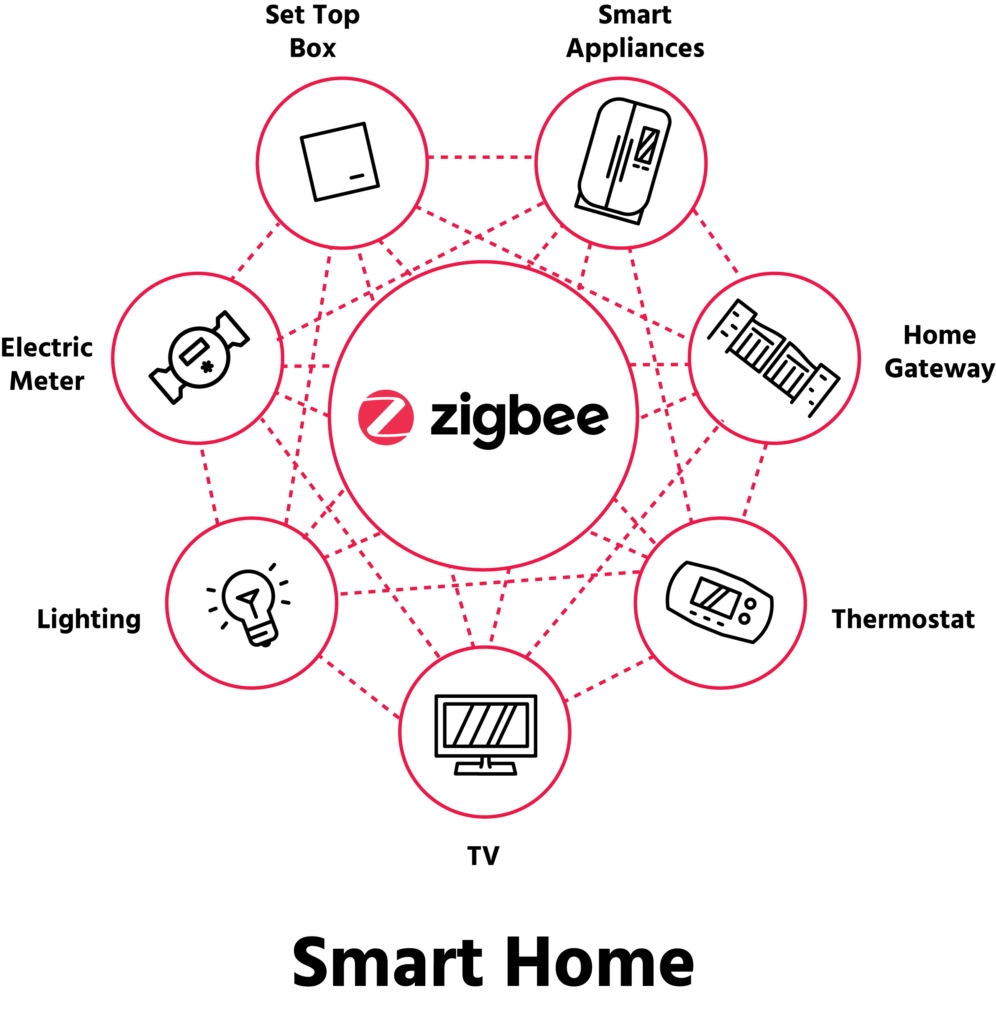
ZigBee

What is ZigBee?

ZigBee is built on IEEE 802.15.4 standards for wireless personal area networks. It covers a range of 10 to 100 m and is known for its low cost and low power consumption. It uses a mesh network to control and monitor devices in its range. It is simpler and less expensive than Wifi and Bluetooth.

ZigBee can be in different modes, and it supports different node configurations for the master to slave or master to master communication. ZigBee is also extendable with the help of routers, and it allows the interconnection of nodes resulting in a broader area network.

Must read - Clean Architecture

ZigBee Devices

There are three types of ZigBee devices, namely.

  • ZigBee Coordinator Device
    It communicates with the router and helps in connecting the devices.
  • ZigBee Router
    It is used for sharing data between devices.
  • ZigBee End Device
    The device is going to be controlled.

ZigBee Architecture

ZigBee architecture includes six layers, namely

  • Application Layer
  • Application Interface Layer
  • Security Layer
  • Network Layer
  • Medium Access Control Layer (MAC)
  • Physical Layer

ZigBee protocol

ZigBee protocol was carefully designed to provide wireless, secure, easy to use, and cheap data communication. The features of ZigBee protocol include

  • Low latency
  • Long battery life
  • Secure connection
  • It supports various network topologies like mesh, point to point, etc.
  • Up to 65K nodes per network!

ZigBee applications

ZigBee has multiple applications, including - 

  • Home automation
    ZigBee can be used to remotely control home appliances like light devices, heating, cooling devices, safety devices, etc. 
  • Industrial automation
    ZigBee can be used for cost reduction in monitoring the parameters and critical equipments for more excellent reliability.
  • Smart grid monitoring
    ZigBee can be used for smart grid monitoring by remotely monitoring the temperature, reactive power management, etc., to name a few.
  • Smart metering
    In smart metering, ZigBee helps in power consumption response, security over power theft, etc.

Also see, Difference Between Verilog and Vhdl

Frequently Asked Questions

What is ZigBee?

ZigBee is a specification for a high-level communication protocol. It is used to create personal networks like radios for low power consumption, home automation, etc.

Where is ZigBee used?

ZigBee is used where we require long battery life with low data rate applications.

Is ZigBee a Bluetooth?

No, ZigBee is not a bluetooth. ZigBee is a LAN, and unlike Bluetooth, its purpose is not to connect to nearby devices.

What is the range of ZigBee?

The range of ZigBee is 10 to 100 m.

Can ZigBee connect to Wifi?

No, ZigBee cannot directly connect to Wifi since ZigBee and Wifi are two different protocols.

Conclusion

This article discussed ZigBee, ZigBee protocol, its features, and applications.

Hoping this blog has helped you enhance your knowledge regarding ZigBee. To learn more about IoT, view our blog, curated by experts.

Check out our fantastic interview preparation course for your dream companies and a complete preparation guide.

Upvote our blog to help other ninjas grow! 

Happy Learning!!

Live masterclass


