










Input:
4 5
0 1 5
0 2 8
1 2 9
1 3 2
2 3 6
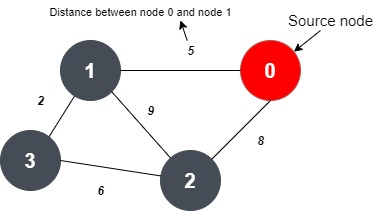
In the given input, the number of vertices is 4, and the number of edges is 5.

In the input, following the number of vertices and edges, three numbers are given. The first number denotes node ‘X’, the second number denotes node ‘Y’ and the third number denotes the distance between node ‘X’ and ‘Y’.

As per the input, there is an edge between node 0 and node 1 and the distance between them is 5.

The vertices 0 and 2 have an edge between them and the distance between them is 8.
The vertices 1 and 2 have an edge between them and the distance between them is 9.
The vertices 1 and 3 have an edge between them and the distance between them is 2.
The vertices 2 and 3 have an edge between them and the distance between them is 6.
1. There are no self-loops(an edge connecting the vertex to itself) in the given graph.

2. There can be parallel edges i.e. two vertices can be directly connected by more than 1 edge.
The first line contains an Integer 'T' which denotes the number of test cases or queries to be run. Then the test cases follow.

The first line of each test case contains two integers ‘V’ and ‘E', denoting the number of vertices in the undirected graph and the number of edges in the undirected graph respectively.

The next ‘E’ lines contain three space-separated integers ‘X’, ‘Y’, and ‘DISTANCE’, denoting a node ‘X’, a node ‘Y’, and the distance between nodes ‘X’ and ‘Y’ respectively.
For each test case, print a single line containing ‘V’ space-separated integers that denote the shortest distance for each node from 0 to ‘V’-1, considering that we need the shortest distance from source node 0.

Print the maximum positive integer value, i.e 2147483647, for the disconnected graph.

Output for each test case will be printed in a separate line.
You are not required to print the output, it has already been taken care of. Just implement the function.
1 <= T <= 50
1 <= V <= 1000
1 <= E <= 3000
0 <= X, Y < V
1 <= DISTANCE[X][Y] <= 10^5


Time limit: 1 sec
The idea is to maintain two arrays, one stores the visited nodes, and the other array stores the distance (element at index ‘i’ denotes the distance from node 0 to node ‘i’). We pick an unvisited minimum distance vertex, then update the distance of all its adjacent vertices considering the path from source to an adjacent vertex to pass through the picked minimum distance vertex. Repeat the process till all nodes are visited.
The Steps are as follows:
5. Return the ‘DISTANCE’ vector, which is our required solution.
The idea is to use a priority queue which creates a min-heap for us. The priority queue sets a priority for every element added to it based on the size of the added element. In the priority queue, we will be storing the ‘DISTANCE’ and node ‘Y’ which will give us the minimum distance vertex.
In our case, priority will be set based on the distance. We will pick an unvisited minimum distance vertex which will be the first element of the priority queue, then update the distance of all its adjacent vertices (using adjacency list) considering the path from source to an adjacent vertex to pass through the picked minimum distance vertex.
Repeat the process till the priority queue is empty.
The Steps are as follows:
5. Return the ‘DISTANCE’ vector, which is our required solution.

