








1. A rooted tree is a directed graph such that, there is exactly one node (the root) for which all other nodes are descendants of this node, plus every node has exactly one parent, except for the root node which has no parents.
2. If there are multiple answers, return the answer that occurs last in the given 2D-array. The answer edge [u, v] should be in the same format, with u < v.
Let’s say we have 3 edges that are {1 , 2} , {1 , 3} and {2 , 3}. So the resulting graph from these edges will be :
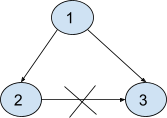
If we remove the edge {2, 3} then the resulting graph will be a tree
with 'N' nodes.
The very first line of input contains an integer ‘T’ denoting the number of test cases.

The first line of every test case contains an integer ‘N’ denoting the number of nodes of the graph.

The second line of every test case contains a 2D array of 'N' X 2 size which contains 'N' edges of the graph.
For each test case, return that single edge that if removed, the resulting graph will be a tree of 'N' nodes.

Output for each test case is printed on a separate line.
1. You do not need to print anything, it has already been taken care of. Just return an edge that can be removed so that the resulting graph is a tree of N nodes.
1 <= T <= 10
3 <= N <= 1000
1 <= 'ARR[i]' <= N

Where ‘ARR[i]’ represents the edges of the graph.

Time Limit: 1 sec
In this approach, we have two cases to handle. The first one is that if a node has two parents then there are two answers and then we have to remove one edge from these two selected answers such that there is no cycle. The other case is that each node has one parent but the graph contains a cycle. So simply remove the edge that causes the cycle to form. Only ‘ANS1’ or ‘ANS2’ can be part of the cycle(if there is a cycle). So, if ‘ANS1’ is empty and cycle found (no 2 parent case, each node has 1 parent), return that edge since it's the last edge found which is part of the cycle. If ‘ANS1’ makes a cycle, return that. Otherwise, return ‘ANS2’ if it makes a cycle. If no cycle is found, then we can simply return ‘ANS2’ as we need to return the last edge in the edges list.
Refer to this doc for disjoint set union https://cp-algorithms.com/data_structures/disjoint_set_union.html
The steps are as follows:

