




Problem
Submissions
Hints & solutions
Discuss
Deletion In Circular Linked List
Easy

0/40
Average time to solve is 30m

Contributed by
30 upvotes
Asked in companies



Problem statement
You are given a Circular Linked List of integers, and an integer, 'key'.
You have to write a function that finds the given key in the list and deletes it. If no such key is present, then the list remains unchanged.
For Example :This is a visualization of the Circular Linked List, represented by:
1 2 3 4 5 -1
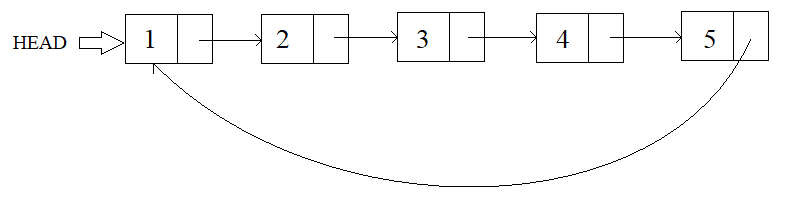
The Circular Linked List before/after deletion may happen to be empty. In that case, only print -1.

All integers in the list are unique.
Detailed explanation ( Input/output format, Notes, Images )
Input format :
The first input line contains the integers present in the circular linked list in order.

The second input line contains a single integer 'key', the key to be deleted.
-1 marks the end of the linked list however, the tail of the linked list would be pointing to the head making it circular in nature.
The only output line contains the updated circular linked list post deletion.
Constraints :
0 <= N <= 10 ^ 5
1 <= key <= 10 ^ 5

Where 'N' is the length of the Circular Linked List.

Time limit: 1 sec
Sample Input 1 :
1 2 3 4 5 -1
3
Sample Output 1 :
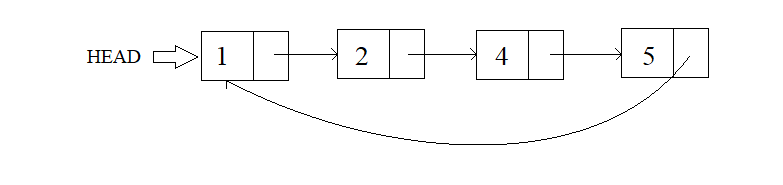
1 2 4 5 -1
Explanation for Sample 1 :
The given linked list, before deletion:
After deletion :
Sample Input 2 :
1 2 3 4 5 -1
1
Sample Output 2 :
2 3 4 5 -1
Hint
Hint 1
Hint 2
Try to think of a recursive approach to solve the problem.
Approaches (2)
Approach 1
Approach 2
Recursion
The idea is to use a recursive approach to find the given key and then remove that node. The recursive idea is very clear that we will traverse through the circular linked list, and we will check if the value of the node is equal to the given key.
We will define a function deleteNodeHelper(root, key, head) to remove the key in which the head is the starting node of the linked list, and we will send root as the next node of the head node.
Working of the Recursive function:
- If the root is equal to head, then we have traversed the whole linked list and have not found the given key. So, we will return head. This will act as the base case of the recursive function.
- We will check if the value of the node is equal to the key. We have found the node with the given key, and we have to remove this node. So, we will return the next node of the root.
- Now, we have to make a recursive call to check all nodes of the remaining linked list. We will set the next node of the root as deleteNodehelper(next, key, head), where next is equal to the next node of root.
- In the end, we will return the current node root.
Time Complexity
O(N), where N is the size of the circular linked list.
We are traversing through the linked list to check if the value of the node is equal to the given key that takes O(N) time. Hence, the overall Time Complexity is O(N).
Space Complexity
O(N), where N is the size of the circular linked list
In the worst case, we are making N recursive calls that take O(N) Space Complexity. Hence, the overall Space Complexity is O(N).
Code Solution
(100% EXP penalty)
Deletion In Circular Linked List
Javascript (node v10.20.0)

Console