




Problem
Submissions
Hints & solutions
Discuss
Floyd Warshall
Moderate

0/80
Average time to solve is 40m
Contributed by
47 upvotes
Asked in companies



Problem statement
You have been given a directed weighted graph of ‘N’ vertices labeled from 1 to 'N' and ‘M’ edges. Each edge connecting two nodes 'u' and 'v' has a weight 'w' denoting the distance between them.
Your task is to find the length of the shortest path between the ‘src’ and ‘dest’ vertex given to you in the graph using Flloyd warshall’s algorithm. The graph may contain negatively weighted edges.
Example :
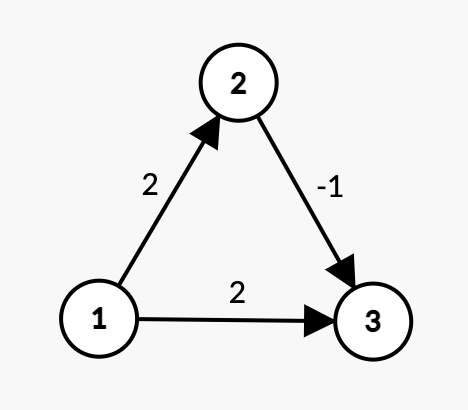
3 3 1 3
1 2 2
1 3 2
2 3 -1
In the above graph, the length of the shortest path between vertex 1 and vertex 3 is 1->2->3 with a cost of 2 - 1 = 1.
Note :
It's guaranteed that the graph doesn't contain self-loops and multiple edges. Also the graph does not contain negative weight cycles.
Detailed explanation ( Input/output format, Notes, Images )
Input Format :
The first line of input contains an integer ‘T’ denoting the number of test cases. Then each test case follows.

The first line of each test case contains four single space-separated integers ‘N’,  ‘M’ , ‘src’ and ‘dest’ denoting the number of vertices, the number of edges in the directed graph the source vertex and the destination vertex respectively.

The next ‘M’ lines each contain three single space-separated integers ‘u’, ‘v’, and ‘w’, denoting an edge from vertex ‘u’ to vertex ‘v’, having weight ‘w’.
Output Format:
For each test case, return an integer denoting the length of the shortest path from ‘src’ to ‘dest’. If no path is possible return 10^9.
You do not need to print anything, it has already been taken care of. Just implement the given function.
Constraints :
1 <= T <= 10
1 <= N <= 50
1 <= M <= 300
1 <= src, dest <= N
1 <= u,v <= N
-10^5 <= w <= 10^5

Time Limit: 1 sec
Sample Input 1 :
1
4 4 1 4
1 2 4
1 3 3
2 4 7
3 4 -2
Sample Output 1 :
1
Explanation For Sample Output 1 :
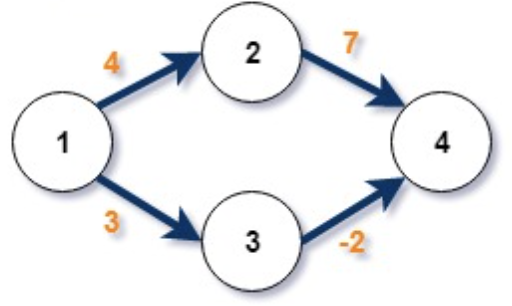
The optimal path from source vertex 1 to destination vertex 4 is 1->3->4 with a cost of 3 - 2 = 1.
Sample Input 2 :
1
2 1 1 2
2 1 3
Sample Output 2 :
1000000000
Hint
Hint 1
Think of negative edges and see which algorithm works on negative edges.
Approaches (1)
Approach 1
Floyd-Warshall's Algorithm
- We will create a 2D array ‘D[][]’, where ‘D[i][j]’ stores the shortest distance from vertex ‘i’ to vertex ‘j’.
- Initialize the 2D array with an infinite value.
- Iterate on the vertices 1 to ‘N’, initialize ‘D[i][i]’ with 0.
- Iterate on the edges of the graph, and each edge (‘u’,’v’,’w’) update ‘D[u][v]’, i.e., ‘D[u][v]’ = ‘w’.
- Now we will use Dynamic Programming to find the minimum distance between every pair of vertices.
- For(k: 1 to ‘N’){
- For(i: 1 to ‘N’){
- For(j: 1 to ‘N’){
- ‘D[i][j]’ = min(‘D[i][j]’, ‘D[i][k]’ + ‘D[k][j]’)
- }
- }
- }
Time Complexity
O(N^3), where ‘N’ is the number of vertices in a graph
We are iterating on the edges of the graph which will take O(M) time. We are iterating on the vertices and for each vertex, we are considering every possible pair of vertices, so it will take O(N^3) time. Thus, the final time complexity will be O(N * N * N + M + N) = O(N^3 + M) = O(N^3) [Since, the maximum value of M can be N^2].
Space Complexity
O(N^2), where ‘N’ is the number of vertices in a graph.
We are making a 2D array ‘D’ which will take O(N^2) extra space.
Video Solution
Unlock at level 3
(75% EXP penalty)
Code Solution
(100% EXP penalty)
Floyd Warshall
Javascript (node v10.20.0)

Console