Key highlights:
● Job postings usually mention whether the employer wants a CV or a resume.
● If a recruiter mentions “CV/resume” you can submit either document.
● Some countries commonly ask for a CV while others prefer a resume.
● Using the correct CV or resume format can improve your chances of getting an interview.
What is the difference between a CV and a resume?
Employers may ask for a CV or a resume based on the role, industry, or country. Some job postings clearly mention which document is required, while others use the terms interchangeably. This often creates confusion for job seekers, especially when applying across different regions or career fields.
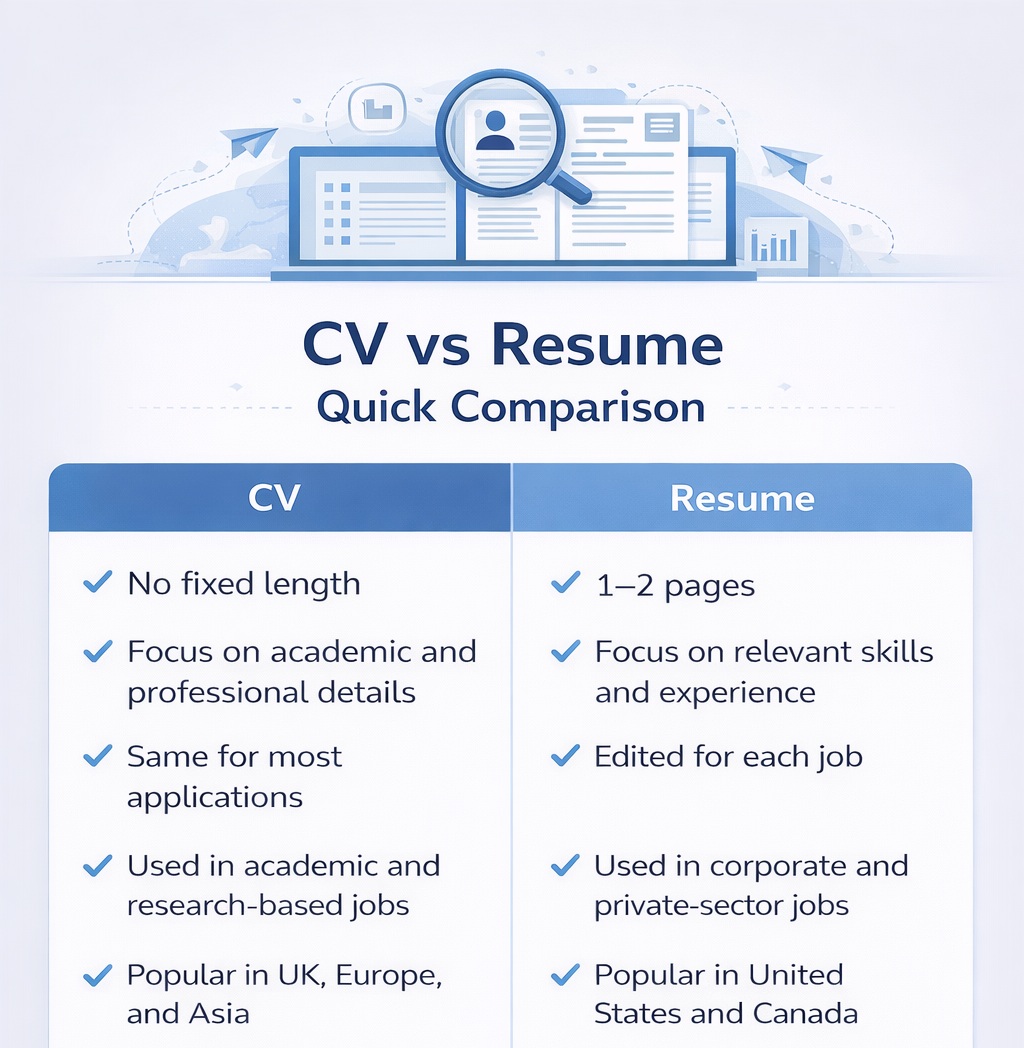
The table below highlights the 5 main differences between a CV and a resume to help you understand which document fits your situation.
CV vs resume: The 5 key differences
Basis of comparison | CV (Curriculum Vitae) | Resume |
Length | A CV has no fixed length and can run into multiple pages as your experience grows. | A resume is usually limited to one or two pages to keep information brief and focused. |
Content | A CV includes detailed academic and professional information such as education, research, publications, certifications, and awards. | A resume focuses on relevant work experience skills, and, achievements needed for the job. |
Ability to customise | A CV usually stays the same across applications and is updated only when you gain new qualifications or experience. | A resume is often edited for each job to highlight skills and experience that match the role. |
Usage | A CV is commonly used for academic, research, medical, teaching, and international positions. | A resume is mainly used for corporate, private sector, and industry based jobs. |
Geography | A CV is the standard document in India, the UK, Europe, the Middle East, and many Asian countries. | A resume is mainly expected in the United States and Canada for most non-academic roles. |
Still wondering, “What is the difference between a resume and a CV?” Take a look at the examples below for a clearer understanding.
CV vs Resume Examples
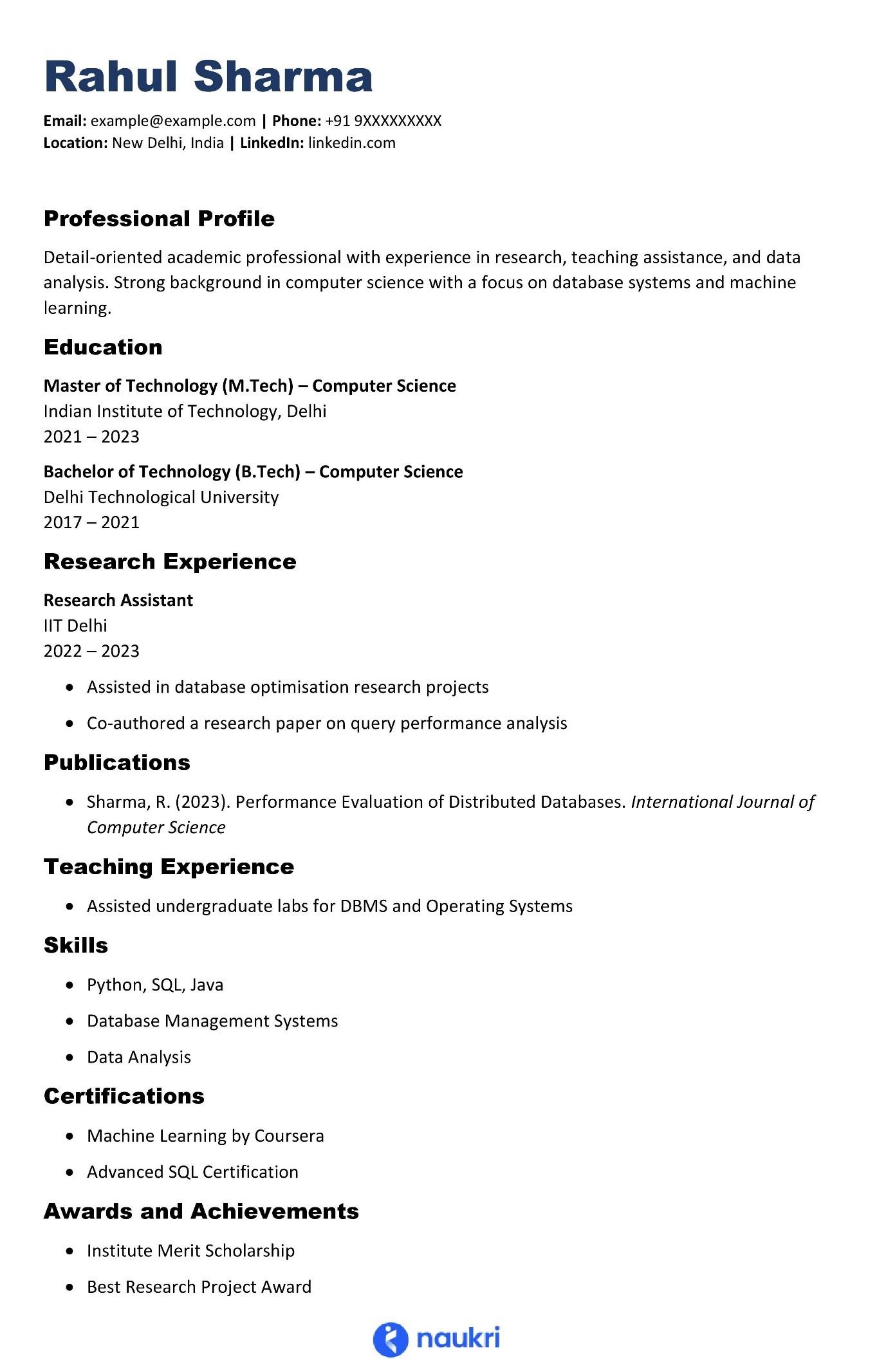
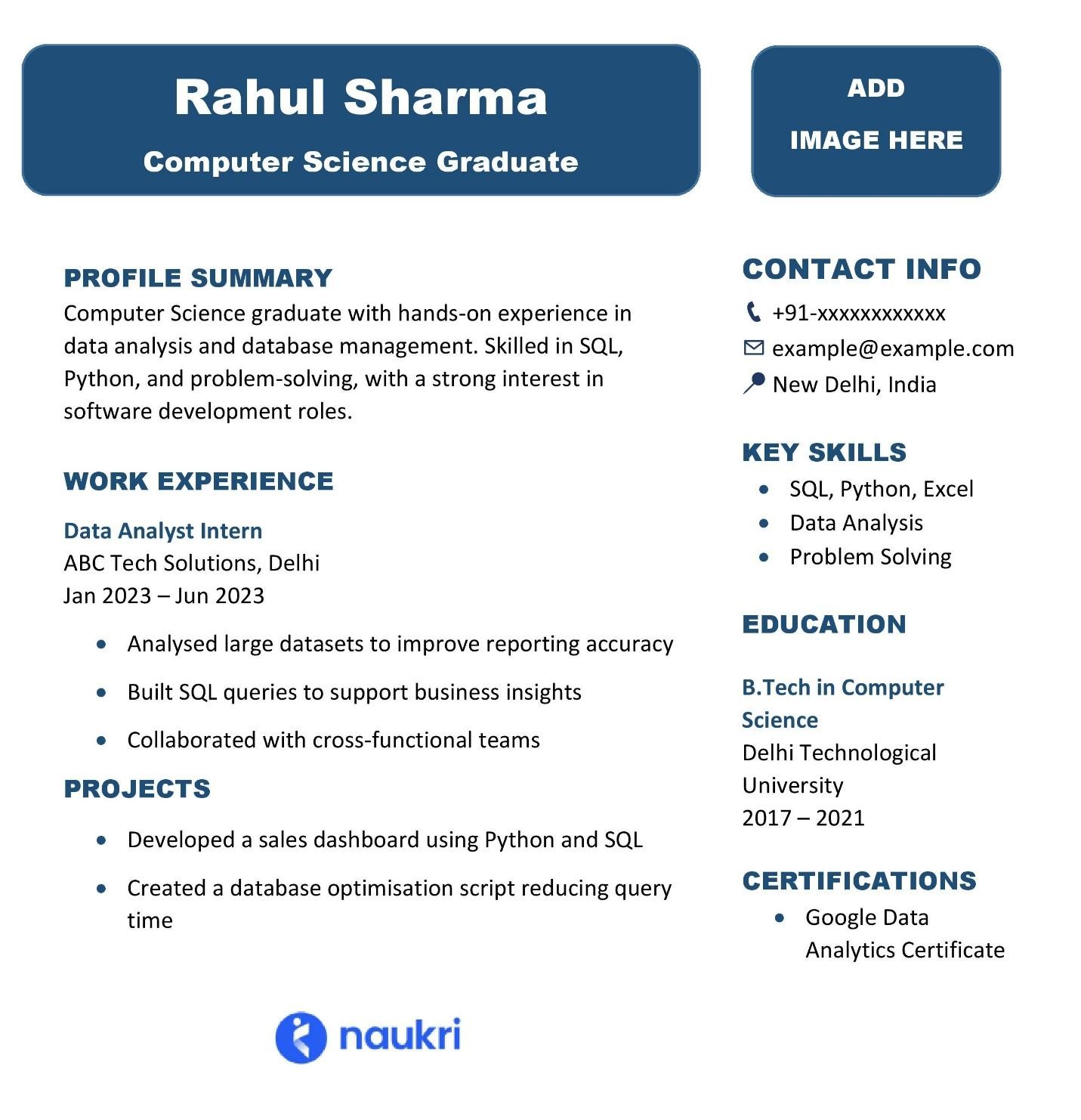
Now that you are aware of the main CV and resume differences, let’s take a look at some examples. These CV vs resume examples help you clearly see how the structure, length, and content of each document differ in actual job applications.
CV example
Resume example
What is a CV (Curriculum Vitae)?
A CV (short for curriculum vitae) is a formal career document used to present a detailed and chronological record of your academic background and professional development. It is commonly required for roles where employers need a deeper insight into your education and long term experience to make informed hiring decisions. A CV focuses on depth rather than brevity and is often used for academic and research-based roles. In India, a CV is also commonly used for government jobs and some corporate roles where recruiters require complete career information.
Some key components of a CV are -
● Contact information
● Professional summary
● Education and academic qualifications
● Work experience
● Research experience
● Skills and areas of expertise
● Certifications and training
● Publications and presentations
● Awards and recognitions
● Professional memberships or affiliations
Also read: What Is a CV (Curriculum Vitae)? Complete Guide with Examples
What is the format of a CV?
A well-formatted CV improves readability and helps recruiters review your profile quickly and accurately. Here are some recommended CV format guidelines you must follow:
● Length: Usually two or more pages depending on experience and role.
● Font type: Professional fonts such as Arial, Calibri, or Times New Roman.
● Font size: 10.5 to 12 points for body text and 14 to 16 points for section headings.
● Margins: Standard one-inch margins on all sides.
● Spacing: Single or 1.15 line spacing for clean readability.
● Colour theme: Neutral colours such as black, dark blue, or grey.
What is a resume?
A resume is a concise career document used to highlight your most relevant skills and work experience for a specific job role. Employers mainly use resumes to quickly assess whether a candidate matches the job requirements. Unlike a CV, a resume focuses on relevance rather than detail and is commonly used for corporate jobs. In India and many other countries, resumes are the standard document for most professional job applications.
Some key elements of a resume are:
● Contact information
● Profile summary or objective
● Work experience
● Skills
● Education
● Certifications
● Projects or internships
● Volunteer experience
What is the right format of a resume?
Follow these recommended resume format guidelines to make your resume ATS-friendly:
● Length: One page for freshers and up to two pages for experienced candidates.
● Font type: Professional fonts such as Arial, Calibri, or Helvetica; modern fonts may be used if they remain easy to read.
● Font size: 11 to 12 points for content and 14 to 16 points for headings.
● Margins: Around one inch, adjustable slightly to fit content neatly.
● Spacing: Single or 1.15 spacing to keep the resume compact.
● Colour theme: Neutral colours with minimal accents for section headings if appropriate.
Note: CV and resume formatting guidelines are mostly the same. Both should use a clean layout, readable fonts, and a professional structure to make the document easy for recruiters to review.
Also read: ATS-Friendly Resume Templates & Writing Tips
Curriculum vitae vs resume: International differences between a CV and a resume
Job application documents are not used the same way in every country. In some places, employers ask for a CV for almost all jobs, while in others, a CV and a resume are used for different types of roles. Because of this, sending the wrong document can confuse recruiters. Understanding what each country expects helps you apply with the right document and present your profile correctly.
Here’s a complete curriculum vitae vs resume comparison for different countries:
1. United Kingdom
● The term CV is used for almost all job applications.
● Employers do not usually ask for a resume.
2. Europe
● CV is the standard document across most countries.
● Resume is rarely used as a term.
3. United States
● Employers clearly differentiate between a CV and a resume.
● Most professional jobs require a resume.
● CVs are requested mainly for academic, research, medical and legal roles.
4. Australia and New Zealand
● Employers generally ask for a CV.
● Resume is not commonly mentioned in job postings.
5. Asia
● Resume or CV are mostly used interchangeably.
● Expectations depend on the country and employer.
● In India, CVs are common for government and academic roles, while resumes are widely used in the private sector.
6. Middle East
● Employers usually prefer a CV for most professional roles.
● CVs mostly include detailed work history and personal information.
● Resume-style documents are less common, especially for senior roles.
Important note:
Before you apply for international roles, always read the job description carefully. Understanding whether employers expect a CV or a resume will allow you to match the local hiring standards and present your qualifications in the most effective way.
CV vs resume difference: Which one should you use?
Choosing between a CV and a resume depends on what the employer expects. Checking these factors before applying can help you avoid common mistakes and apply with confidence.
1. Read the job description carefully to see if a CV or resume is mentioned.
2. Consider the type of role and industry you are applying for.
3. Check the country where the employer is based.
4. When unsure, contact the recruiter or hiring manager for clarity.
When to use a CV?
Use a CV for:
● Academic or research roles
● Medical, scientific, or legal positions
● Government jobs in India
● International roles where a CV is standard
When to use a resume?
Use a resume for:
● Corporate or private-sector jobs
● Business, marketing, engineering, or tech roles
● Jobs in the United States or Canada
● Roles requiring specific skills and achievements
Tips for writing a professional CV or resume
A strong CV or resume should clearly show why you are a good fit for the role. Instead of listing everything you have done, focus on presenting your skills and results in a way that is easy for employers to understand. So despite the curriculum vitae and resume differences, follow these practical tips to improve both the documents:
● List your most recent experience first to show your current level of expertise.
● Start bullet points with clear action words to describe what you achieved.
● Show results by adding numbers or outcomes wherever possible.
● Keep the design simple and use readable fonts that work well with hiring software.
● Review your document carefully to remove spelling or grammar mistakes.
● Update your document for each job by matching your skills with the role requirements.
You can also view details on CV vs Resume for Freshers
Wrapping up
Knowing the difference between a CV and a resume helps you choose the right document for each job. By considering the type of job and the region, you can meet employer expectations and present your qualifications in a clear and suitable format. Always review the job description before applying to avoid submitting the wrong document.