Table of Contents
- Non-Verbal Reasoning Questions – Key Highlights
- What is Non-Verbal Reasoning?
- Types of Non-Verbal Reasoning Questions
- Non-Verbal Reasoning Questions and Answers (With Explanation)
- How to Solve Non-Verbal Reasoning Questions Fast?
- Non-Verbal Reasoning Test Examples
- Free Resources to Practice Non-Verbal Reasoning Questions
- Wrapping Up
- FAQs
Non-Verbal Reasoning Questions – Key Highlights
- Non-verbal reasoning tests your ability to analyze visual information such as patterns and diagrams to solve problems logically.
- It is widely used in aptitude tests for campus placements, government exams, and psychometric assessments.
- Top companies such as TCS, Accenture, Wipro, Cognizant, Deloitte, Capgemini, HCL, and Tech Mahindra use non-verbal reasoning tests in campus recruitment.
- Common question types include series, analogies, mirror images, paper folding, figure classification, and embedded figures.
- Most non-verbal reasoning tests contain 20 to 30 questions to be solved within 15 to 25 minutes.
Non-verbal reasoning questions are a part of almost every aptitude test, including exams like SSC CGL and IBPS PO as well as placement tests like TCS NQT and AMCAT. They are also included in exams such as CA Foundation and MBA entrance exams. These questions offer a useful way to assess a candidate's logical thinking and problem-solving ability without depending on language skills. In this guide, you will find top non-verbal reasoning questions and answers, along with practical tips and a free practice test to help you perform better.
What is Non-Verbal Reasoning?
Non-verbal reasoning is the ability to understand and solve problems using visual information such as patterns and shapes as well as diagrams and images without relying on written language. It evaluates how well you can recognize relationships and understand spatial concepts to apply logic and arrive at the correct answer. Many non-verbal reasoning questions follow common visual patterns so with practice you can solve them faster by using simple shortcuts.
Types of Non-Verbal Reasoning Questions
There are many types of non-verbal reasoning questions, but most of them can be grouped into a few main categories. Each category tests a different skill. Understanding these types helps you quickly identify the question and apply the right method. Here are the common types of non-verbal logical reasoning questions:
- Series or sequences: You are given a sequence of figures and need to identify the rule to find the next image.
- Analogies: You must identify the relationship between two figures and apply the same rule to another pair.
- Classification or odd one out: A set of figures is given and you need to find the one that does not follow the common rule.
- Figure matrix or grids: A grid of images is given with one missing and you must identify the pattern across rows or columns to complete it.
- Pattern completion: You need to select the correct option that completes an incomplete figure or design.
- Mirror and water images: These questions test how a figure looks when reflected horizontally or vertically.
- Paper folding and cutting: You must predict how a paper will appear after folding and cutting when it is unfolded.
- Cube and 3D reasoning: These questions involve visualizing cubes, nets, or rotating shapes in three dimensions.
- Embedded figures: You need to identify a smaller hidden shape within a complex figure.
- Rule detection: You must identify the rule or logic that connects a group of figures.
Non-Verbal Reasoning Questions and Answers (With Explanation)
Practice these carefully selected non-verbal reasoning questions to improve pattern recognition speed and accuracy. Each question includes an explanation to help you understand the logic clearly. These questions are shortlisted from the most commonly asked types in competitive exams and placement tests used by companies like TCS, Wipro, Deloitte, Accenture, Cognizant, Capgemini, and Tech Mahindra.
Series / Sequences Question
Q1. Find the next figure in the series:
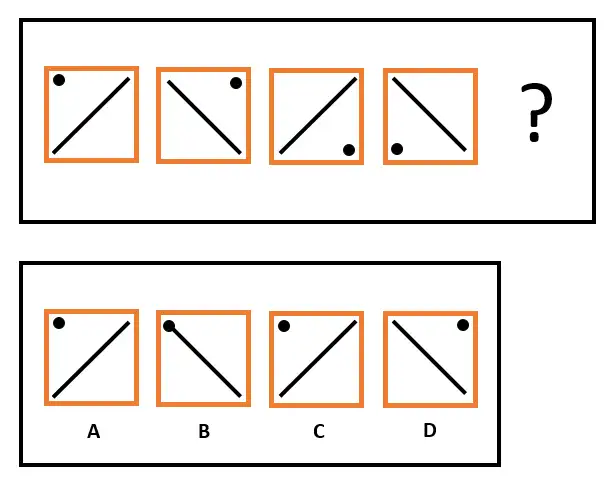
Correct Answer: (A) Diagonal ( / ) with dot at top-left
Explanation:
Two patterns are happening together:
The diagonal line alternates:
/ → \ → / → \ → /
The dot moves clockwise:
top-left → top-right → bottom-right → bottom-left → top-left
So the next figure returns to the starting position with a forward slash diagonal and dot at top-left.
Analogies
Q2. Identify the figure that should replace the missing space in the given pattern.
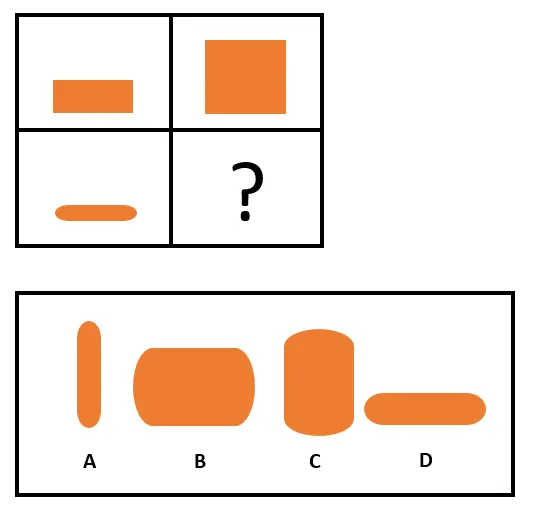
Answer: (B)
Explanation:
In each row, the figure on the left is an incomplete shape, while the figure on the right shows the completed version of that shape.
In the first row, a rectangle becomes a full square.
Following the same pattern, the incomplete capsule in the second row should become a complete capsule.
Therefore, the correct answer is (B) Capsule.
Classification / Odd One Out Question
Q3. Observe the following figures carefully and identify the one that is different from the others.
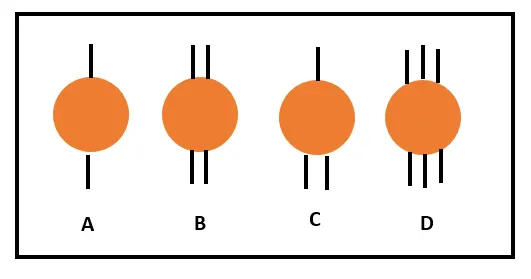
Correct Answer: (C)
Explanation: In all the figures except C, the number of lines attached to the circle is even. Figure C has three odd numbers of lines, which makes it different from the rest.
Figure Matrix or Grids
Q4. In each of the following, identify the figure that completes the given matrix. Choose the correct option from the answer figures.
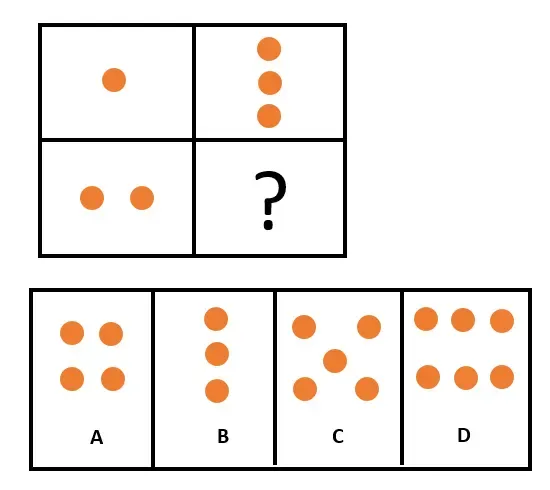
Correct Answer: (D) Figure with six dots
Explanation:
In each row, the second box contains three times the number of dots present in the first box. In the first row, one dot becomes three dots.
Applying the same pattern in the second row, two dots should become six dots.
Option (D) matches this rule, so it correctly completes the matrix.
Pattern Completion
Q5. Choose the option that correctly fills the missing part of the figure.
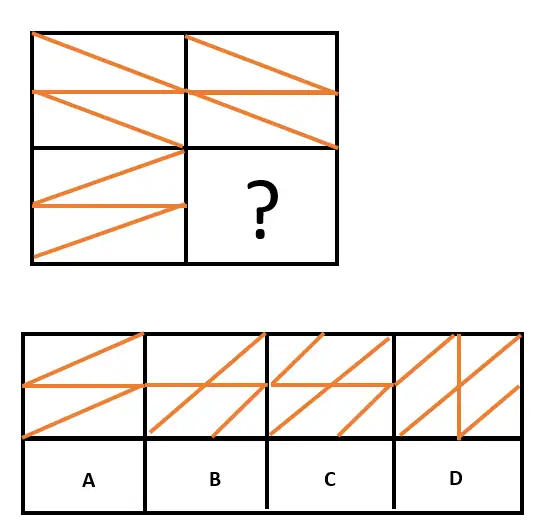
Correct Answer: (A)
Explanation:
The larger square follows a row-wise pattern. In each row, the slanting line appears in the same direction and position across the visible parts. The missing section must continue this same arrangement without changing the line pattern. Only (A) fits smoothly into the blank space and completes the design correctly.
Mirror and Water Images
Q6. Which of the following is the correct mirror image of the word NAUKRI?
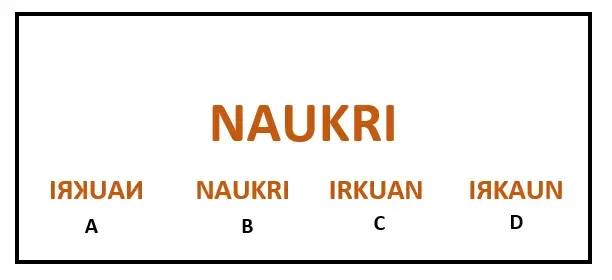
Correct Answer: (A)
Explanation:
In a vertical mirror reflection letters are reversed in order (I comes first, N comes last). Individual letters are flipped horizontally (N, R, A, U, K are reversed).
The resulting image is:
I (mirror image of I)
Я (mirror image of R)
ꓘ (mirror image of K)
U (mirror image of U)
A (mirror image of A)
И (mirror image of N)
NAUKRI → I Я ꓘ U A И
Options like (B) and (C) do not reverse the order correctly, and (D) has incorrect letter placement. Therefore, the correct answer is Option (A).
Paper Folding and Cutting
Q7. The sequence of folding a piece of paper and the way in which the folded paper is cut are shown in the figure. How will the paper look when unfolded?
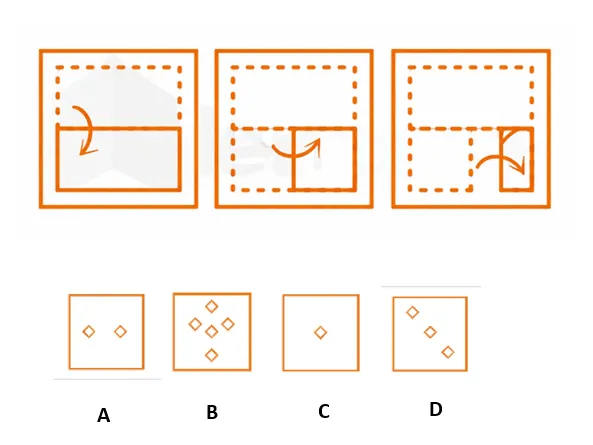
Correct Answer: (A)
Explanation:
The paper is folded twice, so the cut made on the folded part is repeated in two matching positions when the paper is unfolded. Because of the direction of the folds, the cut appears as a symmetric pattern on two sides. Only option A shows all the repeated diamond cuts in the correct arrangement.
Cube and 3D Reasoning
Q8. Select the option that represents a cube which can be formed by folding the given sheet.
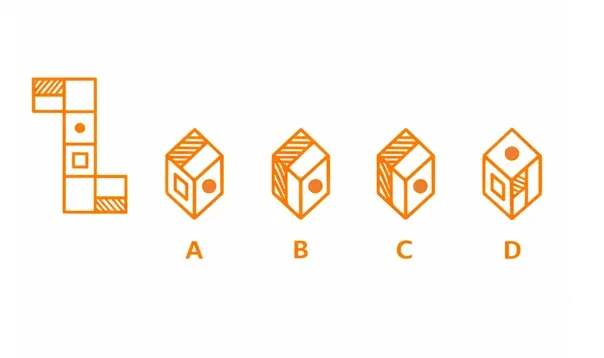
Correct Answer: (A)
Explanation:
When the given sheet is folded into a cube, certain faces become opposite to each other:
- The two half-shaded faces are positioned on opposite sides
- The face with the square is opposite one blank face
- The face with the circle is opposite the other blank face
Now check the options:
- In options (B) and (C), the two half-shaded faces are shown next to each other, which is not possible since they must be opposite
- In option (D), although the faces appear valid, the arrangement cannot be obtained through any rotation of the original cube
Only option (A) follows all the correct face relationships and can be formed from the given sheet.
Embedded Figures
Q9. Identify the option that contains the given figure as a part of it.
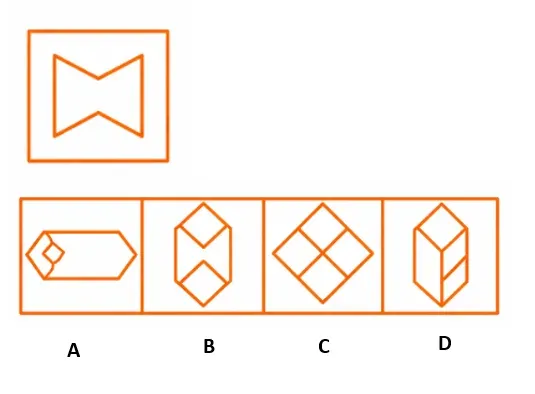
Correct Answer: (B)
Explanation:
The given figure is hidden within the larger shapes in the options. To solve this, focus on the exact arrangement of lines and angles in figure and try to locate the same structure within each option.
On close observation, only option B contains all the elements of figure in the correct orientation and proportion. The other options either miss certain parts or have a different arrangement of lines.
Rule Detection
Q10. Select the set of figures that correctly follows the pattern shown.
Rule: As the size of the circle becomes smaller, the number of divisions inside the circle increases.
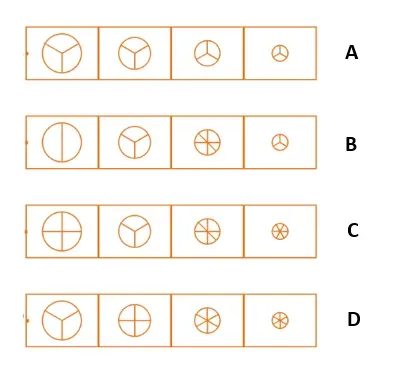
Correct Answer: (D)
Explanation:
The pattern shows an inverse relationship between size and segmentation. Larger circles have fewer sections, while smaller circles are divided into more parts.
Only Option D follows this rule consistently across all figures. The other options do not increase the number of sections correctly.
How to Solve Non-Verbal Reasoning Questions Fast?
Non-verbal logical reasoning questions are all about spotting patterns quickly under time pressure. Most questions follow a small set of rules, and once you learn how to recognize them, your speed improves significantly. Here are some practical tips that can help you solve questions faster in exams and placement tests.
- Use elimination to reduce options quickly: Instead of solving the entire question, remove options that clearly don't match the pattern. This saves time and narrows your focus.
- Break the figure into smaller parts: If a diagram looks complex, focus on individual elements like lines, shapes, or shaded areas and track how each one changes.
- Predict the answer before checking options: Try to identify the pattern and think of the answer first, then match it with the options. This avoids confusion from similar-looking choices.
- Check rotation and reflection early: Many questions involve shapes rotating or flipping. Always check this first before looking for complex logic.
- Focus on small differences in options: When options look similar, look for one small change such as direction, number of shapes, or position. This often reveals the correct answer.
- Practice with pen and paper for rotation questions: Draw or trace the figure and physically rotate the paper to understand how shapes change. This builds your ability to visualize rotations and reflections quickly during exams.
- Avoid spending too much time on one question: If a question is taking too long, move on and come back later. Non-verbal reasoning sections are time-based.
- Practice under time limits: Solve questions regularly with a timer to improve speed and get used to exam pressure.
Non-Verbal Reasoning Test Examples
Practicing with real non-verbal reasoning test examples helps you understand common patterns and improve your speed and accuracy. While many competitive exams include non-verbal reasoning as a section, some tests are designed entirely to assess visual reasoning skills.
Aptitude and Placement Tests (With Non-Verbal Reasoning Sections)
- TCS NQT – Common in campus placements and includes non-verbal logical reasoning questions as part of its aptitude test.
- AMCAT – Covers non-verbal reasoning along with other aptitude topics.
- CoCubes – Widely used by companies to assess logical and visual reasoning skills.
Pure Non-Verbal Reasoning Tests
- Raven's Progressive Matrices – One of the most widely used tests to measure abstract reasoning using pattern-based questions.
- Naglieri Nonverbal Ability Test – Used in education and recruitment to measure visual reasoning ability.
- Universal Nonverbal Intelligence Test – A fully non-verbal test used in psychological and academic evaluations.
These platforms and exams provide some of the best non-verbal reasoning practice, helping you get familiar with real question patterns and improve speed.
Free Resources to Practice Non-Verbal Reasoning Questions
If you are looking for reliable non-verbal reasoning practice, this section includes curated mock tests to help you improve speed and accuracy. These non-verbal reasoning MCQs objective questions are based on real exam patterns.
| Resource | Key Features |
|---|---|
| Practice Non-Verbal Aptitude Test on AmbitionBox |
|
| NCAT on Naukri Campus |
|
Wrapping Up
Non-verbal reasoning becomes easier once you understand common patterns and practice regularly. Focus on identifying changes quickly and use elimination technique. With consistent practice and the right method, you can improve both speed and accuracy. Use the non-verbal reasoning questions and tips in this guide to perform better in competitive exams and placement tests.
FAQs
What is non-verbal reasoning?
Non-verbal reasoning involves solving problems using visual information such as shapes and diagrams. It focuses on identifying relationships and applying logic without relying on language.
Are non-verbal reasoning questions difficult?
Non-verbal reasoning questions are not inherently difficult but can feel challenging due to time pressure and unfamiliar patterns. With practice, most question types become predictable and easier to solve.
How can I improve non-verbal reasoning?
You can improve non-verbal reasoning by practicing common question types, learning pattern shortcuts, and solving timed tests regularly.
What is non-verbal comprehension?
Non-verbal comprehension is another term for non-verbal reasoning. It involves understanding visual patterns and relationships quickly. It reflects how effectively you interpret diagrams, sequences, and spatial changes to solve non-verbal reasoning questions.
How many questions are asked in non-verbal reasoning tests?
Most non-verbal reasoning tests include around 15 to 30 questions per section, depending on the exam. The time limit is usually short, requiring quick pattern recognition.
What questions can I expect on a non-verbal aptitude test?
You can expect questions on series, analogies, classification, mirror and water images, paper folding, embedded figures, and matrix-based patterns in non-verbal reasoning tests.
Where are non-verbal logical reasoning questions asked?
Non-verbal logical reasoning questions are asked in competitive exams, campus placements, psychometric assessments, and intelligence tests to evaluate problem-solving ability without language bias.
What is the difference between verbal reasoning and non-verbal reasoning?
Verbal reasoning involves understanding and analyzing written information, while non-verbal reasoning focuses on solving visual problems using shapes, patterns, and diagrams.
What are the common non-verbal reasoning topics?
Common topics include pattern recognition, spatial reasoning, figure series, analogies, mirror images, embedded figures, and logical sequences involving shapes and diagrams.
Where can I find free non-verbal reasoning PDF for practice?
You can find free non-verbal reasoning PDFs on educational websites, exam preparation platforms, and mock test portals that offer downloadable question sets for practice.
What are the best non-verbal reasoning books?
Popular non-verbal reasoning books for competitive exams and aptitude preparation include titles like "A Modern Approach to Verbal & Non-Verbal Reasoning" by Dr. R.S. Aggarwal, "Non-Verbal Reasoning" by S. Chand, and "How to Pass Non-Verbal Reasoning Tests" by Harry Tolley.
Where can I find free non-verbal reasoning practice questions online?
You can find free non-verbal reasoning practice questions in this blog, where we have included topic-wise questions with answers and explanations.
