Sequence-based questions – Key highlights
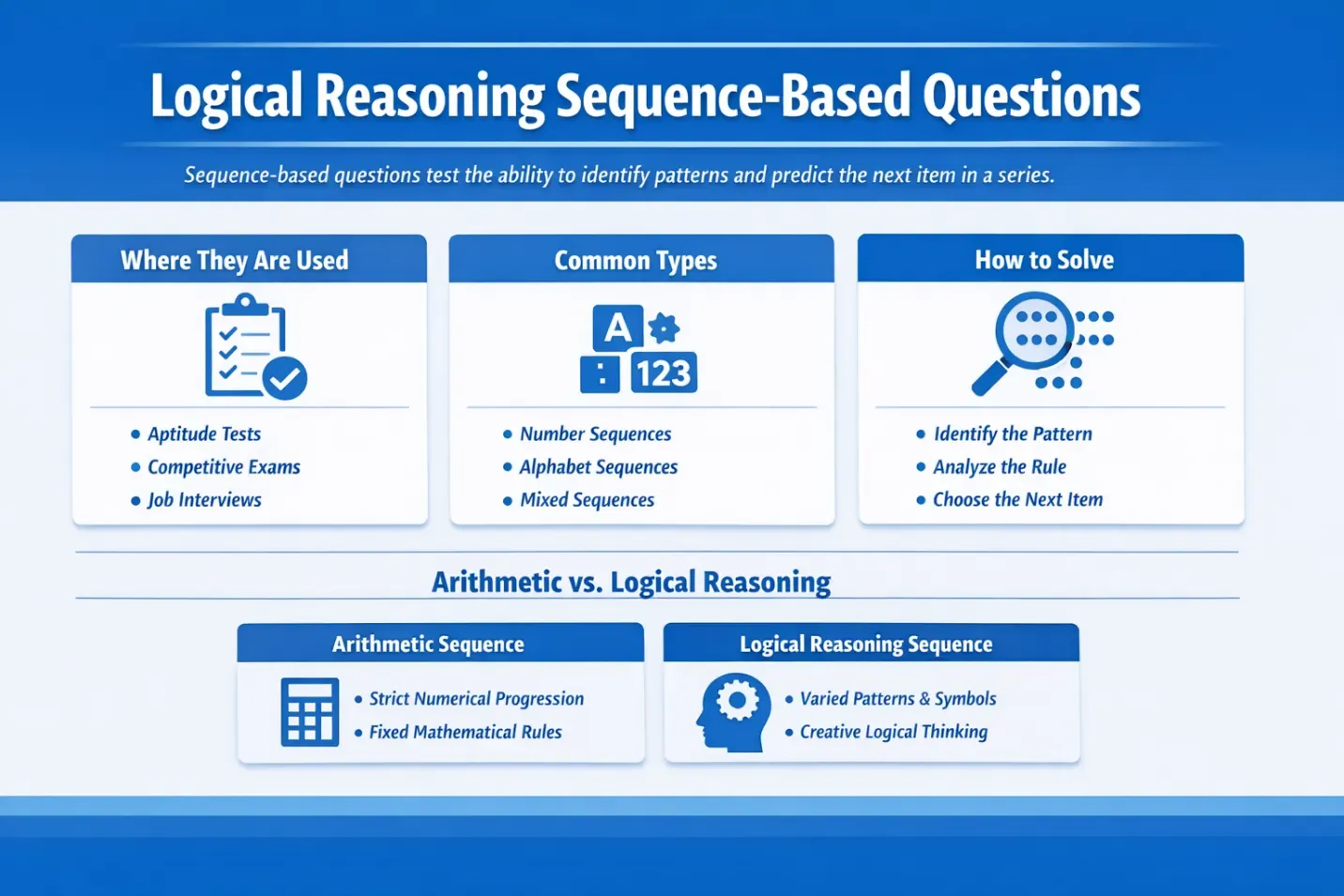
● Sequence questions test your ability to identify patterns in numbers and letters to find the next or missing term.
● They are a key topic in the logical reasoning section of exams like SBI, IBPS, SSC, and other aptitude tests.
● Around 2 to 5 sequence questions appear in the reasoning section of competitive exams and placement tests.
● Arithmetic sequence questions are different from logical sequence questions. Arithmetic follows a fixed formula, while logical sequences involve changing patterns.
● Logical sequences are asked in reasoning sections, while arithmetic sequences are a part of quantitative or mathematics sections.
Sequence questions are commonly asked in reasoning-based aptitude tests and campus recruitment exams conducted by companies such as TCS, Accenture, Wipro, Amazon, JP Morgan, KPMG, and Deloitte. They are one of the fastest ways to score as they do not require heavy calculation. These questions can be solved by recognizing patterns such as alternating operations or hidden number relationships. In this guide, you will find important logical reasoning sequence question examples with clear answers and a free practice test PDF to improve your speed and accuracy.
Relates: Logical Reasoning Topics and Meaning
What is sequence in logical reasoning?
A sequence in logical reasoning is an ordered set of numbers and letters arranged according to a hidden pattern. It involves identifying the rule behind the arrangement to predict the next term or complete the series. These questions focus on pattern recognition and logical thinking rather than complex calculations.
What are the different types of sequence questions?
Logical reasoning sequence questions can appear in different formats based on how the pattern is formed. Understanding these types helps you quickly identify the logic and solve questions more efficiently.
● Number sequence questions: In these questions, you are given a series of numbers that follow a specific pattern. The logic may involve simple operations like addition or multiplication, or more complex ideas such as squares, cubes, or alternating steps.
● Alphabet sequence questions: Here, the focus shifts to letters and their positions in the alphabet. You may need to track how letters move forward or backward, skip positions, or follow a repeating pattern.
● Alphanumeric sequence questions: These include a mix of numbers and letters in one sequence. The pattern may involve position-based changes or alternating between numbers and letters.
● Mixed pattern sequence questions: Unlike basic sequences, these do not follow a single rule throughout. The pattern may change at each step or involve multiple operations, which makes them slightly more challenging to decode.
● Arithmetic sequence questions: This type follows a consistent pattern where each term increases or decreases by the same value. Once you identify this fixed difference, the sequence becomes easy to continue.
Related: Logical Reasoning Question and Answers
Sequence questions and answers (with explanation)
Now let’s move to practice. The following sequence question examples are designed to help you identify patterns quickly and improve your problem-solving approach. Each question is followed by a clear answer and explanation to help you understand the logic step by step.
Directions: In each of the following questions, identify the pattern in the given sequence and choose the correct answer.
Number sequence questions:
Q1. Find the next number in the sequence: 3, 9, 10, 30, 31, ?
(a) 60
(b) 62
(c) 93
(d) 90
Answer: (c)
Solution:
Pattern alternates: ×3, +1
3 × 3 = 9
9 + 1 = 10
10 × 3 = 30
30 + 1 = 31
31 × 3 = 93
Q2. Find the missing number: 4, 6, 12, 14, 28, ?
(a) 30
(b) 32
(c) 56
(d) 34
Answer: (a)
Solution:
Pattern alternates: +2, ×2
4 + 2 = 6
6 × 2 = 12
12 + 2 = 14
14 × 2 = 28
28 + 2 = 30
Q3. Find the next number in the sequence: 2, 5, 11, 23, 47, ?
(a) 94
(b) 95
(c) 96
(d) 93
Answer: (b)
Solution:
Pattern: ×2 + 1
2 × 2 + 1 = 5
5 × 2 + 1 = 11
11 × 2 + 1 = 23
23 × 2 + 1 = 47
47 × 2 + 1 = 95
Q4. Find the missing number: 1, 4, 9, 16, 25, ?
(a) 30
(b) 36
(c) 49
(d) 35
Answer: (b)
Solution:
Pattern: Squares
1² = 1
2² = 4
3² = 9
4² = 16
5² = 25
6² = 36
Q5. Find the next number in the sequence: 7, 10, 8, 11, 9, 12, ?
(a) 10
(b) 13
(c) 11
(d) 14
Answer: (a)
Solution:
Two alternating sequences:
7, 8, 9, ? → +1 → 10
10, 11, 12 → +1
Next = 10
Related: Verbal Reasoning Questions and Answers
Alphabet sequence questions:
Q6. Find the next term in the sequence: A, C, F, J, O, ?
(a) T
(b) U
(c) V
(d) W
Answer: (b)
Solution:
Pattern: Increasing gaps
A → C (+2)
C → F (+3)
F → J (+4)
J → O (+5)
O → ? (+6) → U
Q7. Find the missing term: B, E, I, N, ?
(a) T
(b) S
(c) U
(d) R
Answer: (c)
Solution:
Pattern: +3, +4, +5, +6
B → E (+3)
E → I (+4)
I → N (+5)
N → ? (+6) → U
Q8. Find the next term in the sequence: AZ, BY, CX, DW, ?
(a) EV
(b) FU
(c) EW
(d) FV
Answer: (a)
Solution:
First letter increases: A, B, C, D → E
Second letter decreases: Z, Y, X, W → V
Answer = EV
Q9. Find the missing term: CAT, DBU, ECV, ?
(a) FDW
(b) FEW
(c) FDX
(d) GDW
Answer: (a)
Solution:
Each letter increases by +1
CAT → DBU
DBU → ECV
ECV → FDW
Q10. Find the next word in the sequence: DOG, FQI, HSK, JUM, ?
(a) KVN
(b) LWO
(c) LWN
(d) KVQ
Answer: (b)
Solution:
Each letter increases by +2
DOG → FQI
FQI → HSK
HSK → JUM
JUM → LWO
Answer = LWO
Logical sequence of words:
Directions to solve: In each of the following questions, arrange the given words in a meaningful order and choose the correct answer from the alternatives.
Q11. Arrange the words given below in a meaningful sequence.
1. Seed
2. Plant
3. Fruit
4. Flower
5. Sprout
(a) 1, 5, 2, 4, 3
(b) 1, 2, 5, 4, 3
(c) 5, 1, 2, 3, 4
(d) 2, 1, 5, 4, 3
Answer: (a) 1, 5, 2, 4, 3
Solution:
The natural growth order is: Seed → Sprout → Plant → Flower → Fruit
So the correct sequence is 1, 5, 2, 4, 3.
Q12. Arrange the words given below in the correct sequence.
1. College
2. School
3. Job
4. Interview
5. Application
(a) 2, 1, 5, 4, 3
(b) 2, 5, 1, 4, 3
(c) 1, 2, 5, 4, 3
(d) 2, 1, 4, 5, 3
Answer: (a) 2, 1, 5, 4, 3
Solution:
A typical order is: School → College → Application → Interview → Job
So the correct sequence is 2, 1, 5, 4, 3.
Q13. Arrange the words given below in the right sequence.
1. District
2. Country
3. State
4. Village
5. Block
(a) 4, 5, 1, 3, 2
(b) 4, 1, 5, 3, 2
(c) 5, 4, 1, 3, 2
(d) 4, 5, 3, 1, 2
Answer: (a) 4, 5, 1, 3, 2
Solution:
The order from smallest to largest is: Village → Block → District → State → Country
So the correct sequence is 4, 5, 1, 3, 2.
Q14. Arrange the words given below in a meaningful sequence.
1. Mix
2. Bake
3. Serve
4. Ingredients
5. Batter
(a) 4, 1, 5, 2, 3
(b) 1, 4, 5, 2, 3
(c) 4, 5, 1, 2, 3
(d) 4, 1, 2, 5, 3
Answer: (a) 4, 1, 5, 2, 3
Solution:
The correct process is: Ingredients → Mix → Batter → Bake → Serve
So the correct sequence is 4, 1, 5, 2, 3.
Q15. Arrange the words given below in a meaningful sequence.
1. Arrest
2. Crime
3. Trial
4. Punishment
5. Investigation
(a) 2, 1, 5, 3, 4
(b) 2, 5, 1, 3, 4
(c) 1, 2, 5, 3, 4
(d) 2, 5, 3, 1, 4
Answer: (b) 2, 5, 1, 3, 4
Solution:
The logical order is: Crime → Investigation → Arrest → Trial → Punishment
So the correct sequence is 2, 5, 1, 3, 4.
Related: Non Verbal Reasoning Questions and Answers
Arithmetic sequence questions and answers
An arithmetic sequence is a sequence of numbers in which the difference between consecutive terms remains constant. This fixed value is called the common difference. These math sequence questions often involve finding the common difference, specific terms, number of terms, or the sum of the sequence.
Key Formulas:
● Common difference: d = second term − first term
● nth term (Tₙ): Tₙ = a + (n − 1)d
● Number of terms (n): n = (last term − first term) / d + 1
● Sum of n terms (Sₙ): Sₙ = (n / 2) × (first term + last term)
Q1. Find the common difference of the sequence: 18, 24, 30, 36, 42
(a) 5
(b) 6
(c) 7
(d) 8
Answer: (b)
Solution:
Formula: d = second term − first term
d = 24 − 18 = 6
Q2. Find the 12th term of the sequence: 7, 11, 15, 19, …
(a) 49
(b) 51
(c) 53
(d) 55
Answer: (b)
Solution:
Formula: Tₙ = a + (n − 1)d
a = 7, d = 11 − 7 = 4
T₁₂ = 7 + (12 − 1) × 4
= 7 + 44
= 51
Q3. Find the number of terms in the sequence: 10, 20, 30, …, 200
(a) 18
(b) 19
(c) 20
(d) 21
Answer: (c)
Solution:
Formula: n = (last term − first term) / d + 1
a = 10, d = 20 − 10 = 10
n = (200 − 10) / 10 + 1
= 190 / 10 + 1
= 19 + 1
= 20
Q4. Find the missing term: 25, 32, 39, ?, 53
(a) 44
(b) 45
(c) 46
(d) 47
Answer: (c)
Solution:
Formula: d = second term − first term
d = 32 − 25 = 7
Missing term = 39 + d
= 39 + 7
= 46
Q5. Find the sum of the sequence: 15, 25, 35, 45, 55
(a) 150
(b) 165
(c) 175
(d) 185
Answer: (c)
Solution:
Formula: Sₙ = (n / 2) × (first term + last term)
n = 5, first term = 15, last term = 55
Sₙ = (5 / 2) × (15 + 55)
= (5 / 2) × 70
= 175
Q6. If the first term is 4 and the common difference is 6, find the 9th term.
(a) 52
(b) 54
(c) 56
(d) 58
Answer: (a)
Solution:
Formula: Tₙ = a + (n − 1)d
a = 4, d = 6
T₉ = 4 + (9 − 1) × 6
= 4 + 48
= 52
Related: Interview Questions And Answers Master Guide
How to solve sequence questions faster?
Sequence questions can be solved quickly when you follow a clear method instead of guessing patterns randomly. A few smart techniques can help you save time and improve accuracy in exams.
● Check the difference first: Look at the gap between consecutive terms. Many sequences follow a simple addition or subtraction pattern.
● Start with basic operations: Always test simple rules like addition, subtraction, multiplication, or division before trying complex logic.
● Look for alternating patterns: If one rule does not fit the entire sequence, check if two patterns are repeating alternately.
● Check second-level differences: If the pattern is not clear, find the difference between differences to identify hidden logic.
● Split the sequence when needed: Some questions follow two separate patterns. Try grouping alternate terms.
● Convert letters to numbers: For alphabet sequences, use positions like A = 1, B = 2 to make patterns easier to spot.
● Avoid overcomplicating: If the pattern feels too difficult, step back and check for a simpler rule.
● Manage your time wisely: Do not spend too long on one question. Move ahead and return later if needed.
● Practice regularly: Familiarity with patterns improves speed and helps you solve questions more confidently.
Free sequence practice questions PDF
To help you practice more effectively, we have compiled a set of carefully selected sequence question examples covering number, alphabet, and mixed patterns. This PDF includes 30+ sequence questions with answers and detailed solutions to help you improve speed and accuracy.
Wrapping up
Sequence questions are an important part of logical reasoning and can help improve your score in competitive exams and interview aptitude tests. Once you get familiar with common patterns, these questions become much easier and quicker to solve. Focus on identifying simple logic first and avoid overcomplicating problems. Use the practice sequence questions and PDF shared in this blog to prepare for your exams and interviews.
Related: Reasoning Puzzle Questions with Answers
