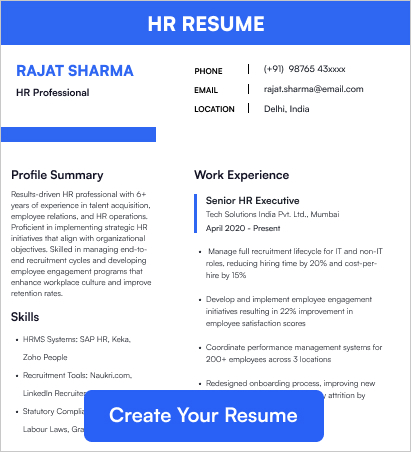
Why this HR resume sample works
ATS-friendly structure
Real, measurable impact
Impact-focused bullet points
HR-specific keywords
Clean & professional layout
Modern Human Resources skills included
Now that you already have a sample, let’s start spilling the secrets. These insights will help you avoid common mistakes and create a Human Resources resume that actually gets noticed.
Secret #1: Why most HR resumes fail (And how to fix it)
Many HR professionals make the mistake of using generic HR resume templates filled with buzzwords like “people-oriented” or “results-driven.” These phrases say little about real impact. Hiring managers scan resumes in just 6-8 seconds, looking for measurable achievements, relevant HR skills, and a clear career trajectory.
Another issue? Lack of metrics. Saying you “managed recruitment” doesn’t stand out, but stating you reduced hiring time by 30% or improved retention by 20% makes an impact.
Quick fixes:
Replace vague job descriptions with action-driven, quantified achievements.
Use ATS-friendly HR resume keywords relevant to your target job.
Keep formatting simple—complex designs often get rejected by applicant tracking systems (ATS).
Secret #2: The best HR resume format for 2025
Chronological format vs. Functional format (which works best?)
A reverse chronological resume works best for HR professionals because it highlights recent experience first, making it easy for recruiters to follow career growth. Functional resumes, which focus on skills over experience, often raise red flags.
Formatting tips:
Use Calibri, Arial, or Times New Roman (11-12 pt font) for readability.
Maintain consistent margins (0.75”-1”) and section spacing for a clean look.
One-page resumes work best for Human Resources professionals with less than 10 years of experience, while senior HR executives can extend to two pages.
Keeping your resume well-structured and easy to read increases your chances of getting shortlisted.
Secret #3: HR resume summary that instantly impresses
Your HR resume summary is the first thing recruiters read, so it needs to be clear, impactful, and customized to the role. Avoid generic statements like “HR professional with great communication skills.” Instead, highlight your years of experience, key HR functions, and measurable impact.
One secret tip: Always start with unique adjectives that describe your work style, such as "results-driven," "people-focused," or "process-oriented."
HR resume summary example (Experienced HR professional):
| “Progressive HR Manager with 8+ years of experience in talent acquisition, employee engagement, and compliance. Led HR policy development that improved retention by 20% and reduced hiring time by 30%. Proficient in HRIS and ATS systems." |
HR resume objective example (Freshers & career switchers):
| "People-focused HR graduate with hands-on experience in recruitment and employee relations. Passionate about creating workplace policies that foster employee satisfaction and organizational growth. Seeking an HR Generalist role to apply knowledge of talent management and compliance." |
Mistakes to avoid:
Using vague descriptions without results
Listing personal traits instead of skills
Making it too long—keep it 2-4 sentences max
Secret #4: HR resume skills hiring managers actually look for
HR professionals need a mix of technical and soft skills, but placement matters. Listing skills separately is not enough—strategically incorporate them into your summary and experience sections for both ATS optimization and recruiter visibility.
Top technical HR skills:
HRIS & ATS systems (Workday, SAP, BambooHR, Taleo)
Payroll & compliance (Labor laws, benefits administration)
Recruitment & talent acquisition (Employer branding, workforce planning)
Top soft HR skills:
Communication & conflict resolution (Handling grievances, negotiations)
Employee engagement & leadership (Building culture, performance management)
Unique and in-demand HR skills that will give you an edge:
People analytics & HR data interpretation
HR technology implementation
Diversity, equity & inclusion (DEI)
Crisis & change management
HR digital transformation
Employer branding & candidate experience
Proactive conflict resolution
Emotional intelligence & workplace well-being
Where to place these skills:
Skills section – Clearly listed for ATS
Work experience – Integrated into bullet points
Resume summary – Showcasing core expertise
Secret #5: Bullet points that showcase your HR impact
Recruiters skim resumes quickly, so your HR work experience needs to be direct and results-driven. The best way to do this is by using the STAR Method—Situation, Task, Action, Result.
Secret formula: Use action verbs + measurable results:
Good example: "Reduced hiring time by 30% by implementing an ATS tool, improving candidate pipeline efficiency."
Bad example: "Handled recruitment process."
How to quantify HR achievements (Even when they're intangible):
- Instead of “Managed employee training programs”, say “Developed a training initiative that increased employee productivity by 25%.”
- Instead of “Led performance management”, say “Implemented a feedback system that improved employee satisfaction scores by 15%.”
- Even if your work is not directly tied to revenue, you can use metrics like employee retention, time-to-hire, training success rates, or policy improvements to show real impact.