

If you’ve been scrolling job portals wondering whether “AI jobs” are actually real career options or just buzzword listings, here’s the short answer: they’re very real, and they’re growing faster than almost any other segment of India’s job market right now. AI-related job postings were up 33% in a single month this year, and India added roughly 3.5 lakh new AI-related openings within just a 90-day window in 2026.
If you’re a student or a first-time job seeker trying to figure out where to point your energy, this guide breaks down exactly which AI roles are hiring, what skills actually get you shortlisted, which companies are recruiting right now, and how much you can realistically expect to earn starting.
Are AI Jobs Actually in Demand Right Now?
Yes, and the numbers back it up clearly. Active tech openings in India crossed 117,000 as of mid-2026, with AI-specific postings surging 33% in a single month, the strongest hiring signal the sector has seen since early 2025.

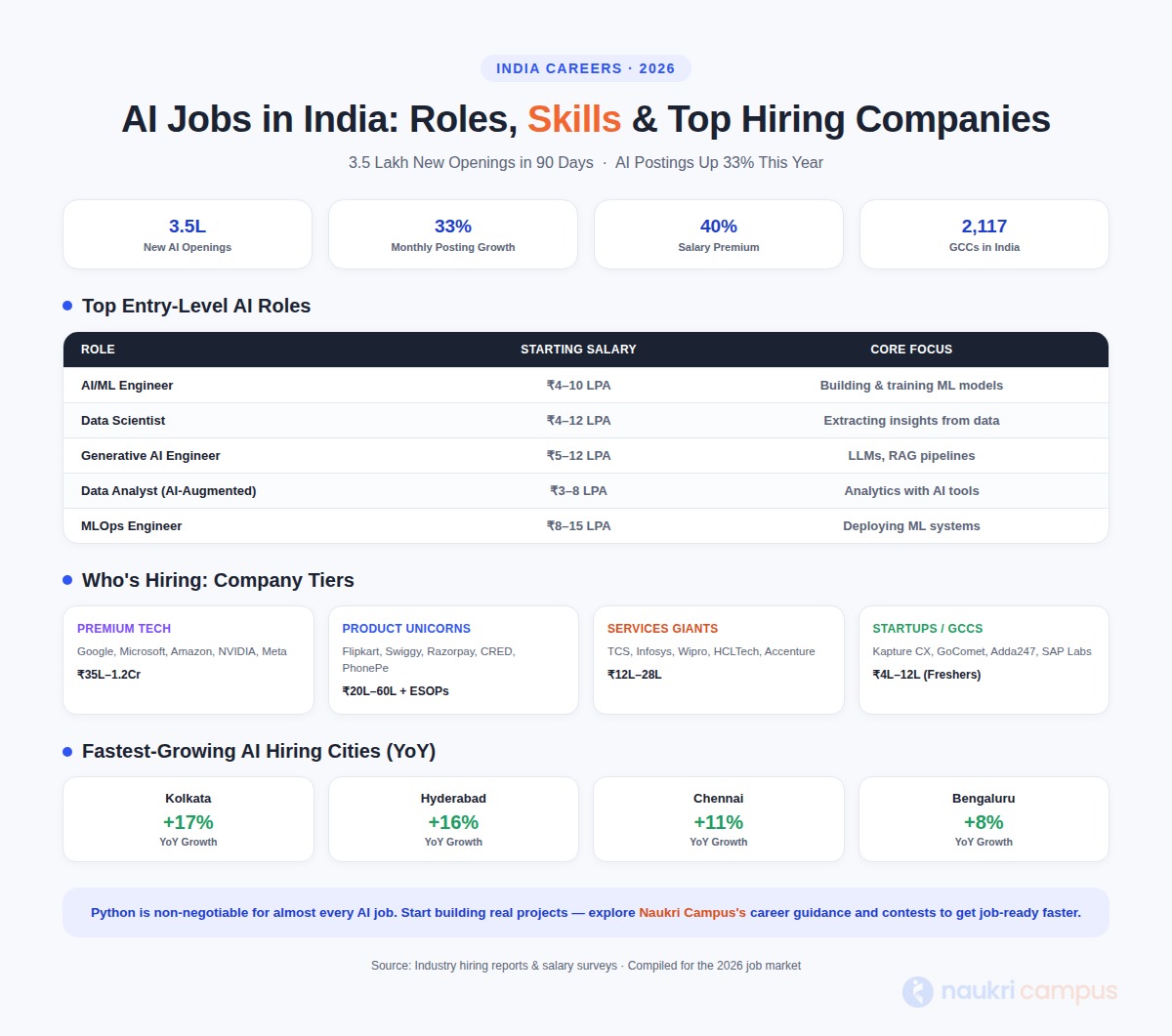
This isn’t a passing trend either. Global Capability Centres (GCCs) in India, now numbering over 2,100, have shifted focus from routine support work to high-value AI and machine learning projects, which is a big part of why this demand keeps climbing rather than leveling off.
What Are the Top AI Job Roles You Can Actually Apply For?
AI jobs aren’t one job title; it’s an umbrella covering everything from hands-on engineering to more analytical, less code-heavy roles. Here’s a breakdown of the roles freshers and first-time job seekers are actually getting hired into right now.
| Role | Starting Salary Range | Core Focus |
| AI/ML Engineer | ₹4–10 LPA | Building and training ML models |
| Data Scientist | ₹4–12 LPA | Extracting insights from data |
| Generative AI Engineer | ₹5–12 LPA | Building with LLMs and RAG pipelines |
| Data Analyst (AI-Augmented) | ₹3–8 LPA | Analytics using AI-assisted tools |
| MLOps Engineer | ₹8–15 LPA (early career) | Deploying and maintaining ML systems |
Notice that several of these roles, especially Data Analyst and Data Annotation Specialist, don’t require you to be a hardcore programmer, which makes AI careers more accessible than most students initially assume.
Which AI Role Should You Actually Aim For as a Fresher?
This is the question most students get stuck on, and the honest answer depends on your existing comfort level with code versus analysis. If Python and math don’t scare you, AI/ML engineer or data scientist roles are the classic entry points with strong long-term growth.
If you’re more comfortable with tools like Excel and SQL than with writing algorithms from scratch, data analyst or business intelligence analyst roles let you work adjacent to AI systems without needing deep machine learning expertise on day one.
| If You’re Comfortable With… | Consider This Role |
| Python, math, algorithms | AI/ML Engineer, Data Scientist |
| Excel, SQL, dashboards | Data Analyst, BI Analyst |
| Writing, structuring information | Prompt Engineer, AI Product Analyst |
| Attention to detail, patience | Data Annotation Specialist |
What Skills Do Companies Actually Look for in AI Hiring?
Across almost every AI job description in India right now, one skill shows up again and again: Python. Recruiters describe it as non-negotiable, and it appears in nearly every listing, regardless of the specific AI role you’re targeting.
Beyond Python, the specific tools matter less than most students expect; what actually gets you shortlisted is demonstrated project work, not just certificates. Recruiters increasingly favor candidates with shipped GitHub projects over resumes stacked with course completions alone.
| Skill Category | What to Learn |
| Programming | Python (essential), SQL |
| ML Frameworks | TensorFlow, PyTorch, scikit-learn |
| Data Handling | Pandas, NumPy, Power BI |
| GenAI Specific | Prompting, RAG, vector databases, OpenAI APIs |
| Soft Skill | Ability to explain technical work simply |
How Long Does It Actually Take to Become Job-Ready?
Most students overestimate how long this takes, assuming they need years of study before they’re employable. In reality, a focused, consistent 6-month runway is often enough to build the core skills needed for entry-level AI and data roles.
The key word here is focused; spreading yourself across ten different courses without building anything tangible tends to slow you down far more than picking two or three core skills and building real projects with them.
Which Companies Are Actually Hiring for AI Roles in 2026?
Company tiers matter here because pay, expectations, and entry difficulty vary significantly depending on where you’re applying. Understanding these tiers helps you set realistic targets instead of only aiming for the most competitive names.
| Tier | Example Companies | Typical Compensation |
| Premium/Global Tech | Google, Microsoft, Amazon, NVIDIA, Adobe, Meta | ₹35L–1.2Cr (experienced) |
| Indian Product Unicorns | Flipkart, Swiggy, Razorpay, Zomato, CRED, PhonePe | ₹20L–60L + ESOPs |
| Services Giants | TCS, Infosys, Wipro, HCLTech, Cognizant, Accenture | ₹12L–28L |
| Startups/GCCs | Kapture CX, GoComet, Adda247, SAP Labs, Carrier | ₹4L–12L (freshers) |
As a fresher, the startup and GCC tier is usually your most realistic entry point, and it’s not a lesser path; many of today’s senior AI engineers started exactly there before moving up.
Which Cities Have the Most AI Job Openings?
Location matters more in AI hiring than many other tech roles, since a large share of openings concentrate in specific hub cities tied to GCCs and major tech offices. Bengaluru continues to lead, but growth in other cities is accelerating fast.
| City | Year-on-Year Hiring Growth |
| Kolkata | +17% |
| Hyderabad | +16% |
| Chennai | +11% |
| Bengaluru | +8% |
If relocation is on the table, emerging hubs like Chennai and Kolkata are growing faster percentage-wise, even though Bengaluru still has the largest absolute number of openings.
Do AI Jobs Actually Pay More Than Regular Tech Roles?
Yes, and the premium is substantial enough to matter for your career planning. According to industry pay reports, emerging technology roles, including generative AI and machine learning, can command up to a 40% base-pay premium over comparable non-AI tech roles.
| Role (Experienced) | Median Compensation |
| AI Research Scientist | ₹25.1L |
| MLOps Engineer | ₹22.7L |
| Senior AI Engineer (Hyderabad) | ₹25L–40L |
This premium isn’t limited to senior roles either; even at the fresher level, AI-tagged positions in data and analytics tend to pay somewhat more than equivalent non-AI roles at the same company and experience level.
What Should Your First 90 Days of AI Prep Look Like?
Rather than trying to learn everything at once, the most effective approach is sequential: build one skill thoroughly before layering the next, since half-finished knowledge across many tools is weaker than solid command of a few.
| Phase | Focus |
| Weeks 1-4 | Python fundamentals + basic statistics |
| Weeks 5-8 | One ML framework (scikit-learn or TensorFlow) + a real project |
| Weeks 9-12 | SQL + one visualization tool (Power BI/Tableau) |
| Ongoing | Build 2-3 portfolio projects and publish on GitHub. |
By the end of this window, you should have at least one project you can genuinely explain in an interview, which matters far more than a stack of certificates with nothing built behind them.
What Industries Are Driving the Most AI Hiring?
Beyond tech companies themselves, a significant share of AI hiring demand is coming from industries applying AI to their own operations rather than building AI products directly. This broadens where you can look for opportunities well beyond typical “tech company” targets.
| Industry | How AI Roles Are Used |
| Finance/FinTech | Fraud detection, algorithmic trading, risk models |
| Healthcare | Diagnostics support, medical data analysis |
| Retail/E-commerce | Recommendation engines, demand forecasting |
| Banking | Customer service automation, credit scoring |
If you’re specifically interested in finance or healthcare as a domain, combining that subject knowledge with basic AI/data skills can actually make you a stronger candidate than someone with only generic AI skills and no domain context.
Final Thoughts
AI hiring in India isn’t a distant future trend; it’s happening right now, with hundreds of thousands of new openings, a genuine salary premium, and multiple entry points depending on your comfort with code versus analysis. Whether you’re aiming for a hands-on AI/ML engineer role or a more analytical data analyst position, the path is more accessible than most students assume.
Start with Python, pick one or two skills to go deep on rather than skimming many, and build real projects you can talk about confidently in an interview.
Frequently Asked Questions
Do I need a computer science degree to get an AI job in India?
No, while a technical background helps, many companies, especially in the startup and services tiers, hire based on demonstrated skills and projects rather than strictly requiring a CS degree.
Is Python really necessary for every AI job, even non-technical ones?
For most roles, yes; Python appears in the vast majority of AI job listings, though roles like Prompt Engineer or AI Product Analyst may weigh domain expertise and communication skills more heavily alongside basic Python knowledge.
Which AI job has the lowest entry barrier for someone just starting?
Data Annotation Specialist and Data Analyst roles are generally considered the most accessible entry points, requiring less deep technical expertise than AI/ML Engineer or Data Scientist positions.
Are AI jobs at risk of being automated themselves?
Ironically, AI-related roles are among the safer tech careers right now, since building, deploying, and maintaining AI systems requires ongoing human expertise that the technology itself can’t yet replace.
How much does relocating to a different city actually help my AI job search?
It can help, especially if you’re open to emerging hubs like Chennai, Hyderabad, or Kolkata, where year-on-year hiring growth is currently outpacing Bengaluru, though Bengaluru still has the highest absolute number of openings.
Should I choose a services company or a startup for my first AI job?
Services giants like TCS or Infosys offer more structured onboarding and stability, while startups and GCCs often give you broader hands-on exposure faster; the right choice depends on whether you value structure or speed of learning early in your career.
Is a certification enough, or do I really need to build projects?
Certifications alone rarely make the difference in hiring decisions anymore; recruiters increasingly prioritize candidates who can show real, working projects, so treat certifications as a starting point rather than the finish line.