

If you’ve been watching AI headlines and wondering how people actually land jobs building these systems, you’re asking the right question at the right time. Machine learning engineering is one of the fastest-growing tech careers in India, and unlike many trending fields, it doesn’t require a specific degree or a pedigree college name to get started.
This guide walks you through what an ML engineer does, the exact skills to learn, a month-by-month roadmap, free and paid learning options, realistic fresher salaries, and how to land your first role, written for students and first-time job seekers starting from scratch.
What Does a Machine Learning Engineer Actually Do?
A machine learning engineer builds systems that learn from data and make predictions or decisions; think recommendation engines, fraud detection, chatbots, or image recognition. Their job sits between data science (finding insights) and software engineering (building reliable products).
On a typical day, an ML engineer cleans and prepares data, trains and tests models, deploys them so real users can access them, and monitors performance once they’re live. Most of the work is practical engineering rather than pure research.
| Task | What It Looks Like in Practice |
| Data preparation | Cleaning, labelling, and structuring raw data |
| Model building | Training algorithms using Python and frameworks like PyTorch |
| Evaluation | Testing accuracy, fixing errors, comparing approaches |
| Deployment | Putting models into apps via APIs and cloud platforms |
| Monitoring | Tracking performance and retraining when results drift |
ML Engineer vs Data Scientist vs AI Engineer: What’s the Difference?
These titles get mixed up constantly in job listings, which confuses a lot of beginners. The overlap is real, but the focus of each role is different, and knowing the difference helps you pick the right learning path.
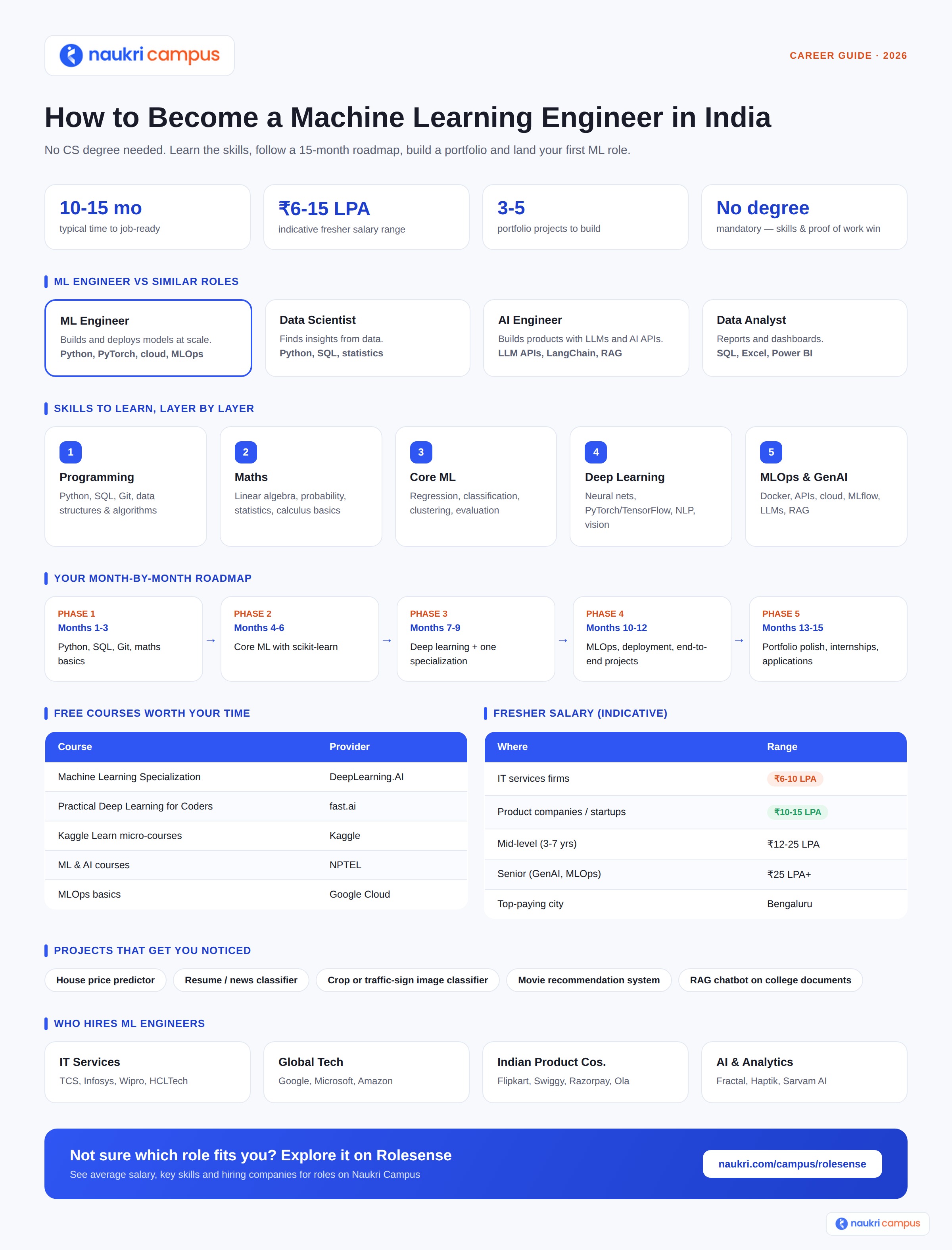
In short, data scientists focus on analysis and insight, ML engineers focus on building and deploying models at scale, and AI engineers increasingly focus on applying pre-built models, especially large language models, inside products.
| Role | Main Focus | Core Tools |
| Data Scientist | Analysis, statistics, insights | Python, SQL, Excel, visualization tools |
| ML Engineer | Building and deploying models | Python, PyTorch/TensorFlow, cloud, MLOps |
| AI Engineer | Using LLMs and AI APIs in products | LLM APIs, LangChain, vector databases |
| Data Analyst | Reporting and dashboards | SQL, Excel, Power BI/Tableau |
Not sure which of these roles fits your degree and interests? Naukri Campus’s Rolesense can help you decide. Pick your education and a role you’re curious about, and it shows the average salary, key skills, and hiring companies for that role, so you can compare paths before you commit months of learning to one. Over 76,000 students have already used it to explore their options.
Is Machine Learning a Good Career in India Right Now?
For students who are willing to keep learning, yes. Companies across banking, e-commerce, healthcare, edtech, and logistics are adopting AI, and demand for people who can build and deploy models is growing faster than the supply of trained candidates.

The honest caveat is that entry-level competition is real, because many learners have completed the same popular courses. Standing out comes from projects, deployment skills, and clear communication rather than from the course name on your resume.
| Factor | What It Means for You |
| Rising demand | More roles in GenAI, MLOps, and applied ML across industries |
| Skill gap | Employers struggle to find candidates with real project experience. |
| Strong pay growth | Salaries rise quickly once you specialize. |
| High competition at entry level | A portfolio matters more than certificates. |
Do You Need a Degree to Become a Machine Learning Engineer?
This is the single most asked question by students, and the encouraging answer is that no specific degree is mandatory. Many ML engineers come from a B.Tech in computer science, but plenty come from math, statistics, electronics, physics, and even self-taught backgrounds.
What matters far more to hiring teams is demonstrated skill: can you code in Python, do you understand how models work, and do you have projects that prove it? That said, a CS or math foundation does make some concepts easier, and some larger employers still list B.Tech or M.Tech as a preference for entry-level roles.
| Background | Your Advantage | What to Strengthen |
| B.Tech CS/IT | Coding and data structures | Maths, statistics, ML theory |
| B.Sc / BCA | Programming basics | Data structures, advanced maths |
| Maths / Statistics | Strong theoretical base | Software engineering and deployment |
| Non-technical degree | Domain knowledge | Python, maths and projects from scratch |
What Skills Do You Need to Become an ML Engineer?
Think of ML engineering skills in layers: a programming and math foundation first, then core machine learning, then the deployment skills that separate job-ready candidates from hobbyists. You don’t need all of it on day one, but you do need to climb the layers in order.
| Skill Layer | What to Learn |
| Programming | Python, SQL, Git, data structures, and algorithms |
| Maths foundations | Linear algebra, probability, statistics, basic calculus |
| Core ML | Regression, classification, clustering, model evaluation |
| Deep learning | Neural networks, PyTorch or TensorFlow, NLP, computer vision |
| Deployment (MLOps) | Docker, APIs, cloud platforms, MLflow |
| GenAI (high demand) | LLMs, RAG, fine-tuning basics, LangChain |
Skills in generative AI, MLOps, and cloud ML platforms are currently among the most in-demand and best-paid, so it’s worth adding them once your fundamentals are solid.
How Do You Become a Machine Learning Engineer Step by Step?
The most reliable path is sequential: build fundamentals, learn ML, go deep on one area, deploy something real, then apply. Jumping straight to deep learning or LLMs without Python and maths is the most common reason beginners stall.
Most learners need around 10 to 15 months of consistent effort to become job-ready, though people with a strong CS background can move faster.
| Phase | Timeline | Focus |
| 1 | Months 1-3 | Python, SQL, Git, maths basics |
| 2 | Months 4-6 | Core ML algorithms with scikit-learn |
| 3 | Months 7-9 | Deep learning and one specialization (NLP, vision or GenAI) |
| 4 | Months 10-12 | MLOps, deployment, end-to-end projects |
| 5 | Months 13-15 | Portfolio polish, internships, and job applications |
What Are the Best Free Courses to Learn Machine Learning?
You can learn almost everything an entry-level ML engineer needs without spending money, as long as you pair courses with hands-on practice. Recruiters care more about what you built than which platform you studied on.
| Resource | Provider | Best For |
| Machine Learning Specialization | DeepLearning.AI / Coursera (audit free) | ML fundamentals |
| Deep Learning Specialization | DeepLearning.AI | Neural networks and deep learning |
| Practical Deep Learning for Coders | fast.ai | Learning by building |
| Kaggle Learn | Kaggle | Short, hands-on micro-courses |
| NPTEL ML and AI courses | IIT / IISc faculty | Rigorous, India-friendly, free |
| Google Cloud MLOps basics | Google Cloud | Deployment fundamentals |
Pairing one structured course with Kaggle practice is usually more effective than collecting five certificates you never apply.
Are Paid ML Courses and Degrees Worth It?
Paid programs can be worth it when they give you structure, mentorship, placement support, or a recognized credential that free courses can’t. They aren’t worth it if they simply repackage free content at a high price.
Before paying, check the curriculum, the projects you’ll build, the instructor quality, and whether the placement claims are verifiable. Pricing varies widely, so treat any figure as approximate and confirm on the provider’s site.
| Option | Typical Fit | Consider If |
| M.Tech / MS in AI-ML | Deep specialization, research roles | You want a strong academic base |
| PG diploma/certificate programs | Structured career switch | You need accountability and mentorship |
| Online degree programs (e.g., IIT-linked) | Working learners, degree credential | You want a recognized qualification alongside work |
| Bootcamps | Fast, project-driven learning | You can commit full-time and verify placements |
What Projects Should You Build to Get Noticed?
Projects are what turn “I completed a course” into “I can do this job.” Aim for three to five end-to-end projects that go beyond training a model in a notebook and show you can ship something people can actually use.
Choose problems you care about, document your reasoning on GitHub, and deploy at least a couple as simple web apps or APIs.
| Project Idea | Skills It Shows |
| House price or loan default predictor | Data cleaning, regression/classification |
| Resume or news classifier | NLP, text preprocessing |
| Image classifier for crops or traffic signs | Computer vision, deep learning |
| Movie or course recommendation system | Recommendation algorithms |
| Chatbot using RAG on your college documents | GenAI, vector databases, deployment |
How Much Does an ML Engineer Earn in India?
Salaries vary widely depending on company type, city, and skill set, and different sources report different ranges, so treat the figures below as indicative rather than guaranteed. The clearest pattern is that product companies and AI-focused startups pay noticeably more than IT services firms for similar titles.
| Experience Level | Indicative Range |
| Fresher at IT services firms | ₹6-10 LPA |
| Fresher at product companies / startups | ₹10-15 LPA |
| Mid-level (3-7 years) | ₹12-25 LPA |
| Senior / specialist (GenAI, MLOps) | ₹25 LPA and above |
City matters too. Bengaluru typically pays the highest, followed by Hyderabad, with Pune and Mumbai somewhat lower at entry level.
| City | Typical Entry-Level Range |
| Bengaluru | ₹9.5-14 LPA |
| Hyderabad | ₹6.5-12 LPA |
| Mumbai | ₹8-10 LPA |
| Pune | ₹5-8 LPA |
Which Companies Hire ML Engineers in India?
Hiring spans IT services giants, global tech companies, Indian product firms, and a fast-growing AI startup ecosystem. For freshers, service companies and startups tend to offer the most entry points, while big tech usually expects stronger credentials and experience.
| Company Type | Examples |
| IT services | TCS, Infosys, Wipro, HCLTech |
| Global tech | Google, Microsoft, Amazon |
| Indian product companies | Flipkart, Swiggy, Razorpay, Ola |
| AI and analytics firms | Fractal Analytics, Haptik, Sarvam AI |
Search roles on Naukri, LinkedIn, and Internshala, and look for titles like “Junior ML Engineer,” “AI Engineer,” “Data Scientist – Fresher,” and “ML Intern.”
How Do You Get Your First ML Engineer Job as a Fresher?
Landing your first role is less about applying everywhere and more about building proof, visibility, and a few strong referrals. Internships are often the most reliable bridge from learner to employee, so apply for them aggressively while still studying.
| Step | What to Do |
| Build a portfolio | 3-5 projects on GitHub with clear READMEs |
| Compete | Take part in Kaggle competitions and hackathons |
| Optimise your resume | Highlight projects, tools and outcomes, not just courses |
| Network | Share work on LinkedIn and connect with ML professionals |
| Prepare for interviews | Python coding, ML fundamentals, SQL and project walkthroughs |
Expect interviews to test Python and data structures, core ML concepts like overfitting and evaluation metrics, and your ability to explain your own projects in simple language.
Before you apply, it also helps to check how your current skills stack up against what the role demands. Rolesense’s skill check and role pages on Naukri Campus let you see the key skills employers expect and the companies hiring for a role, so you know exactly what to fix before sending applications.
What Mistakes Do Beginners Make While Learning ML?
Most beginners don’t fail because ML is too hard; they stall because of avoidable habits. Knowing these in advance can save you months of effort.
| Mistake | Why It Hurts |
| Skipping maths and Python basics | Everything later becomes confusing |
| Only watching tutorials | No real skill without building |
| Jumping straight to LLMs | Weak fundamentals show up in interviews |
| Never deploying a model | Employers want engineers who ship |
| Collecting certificates over projects | Proof of work beats proof of attendance |
Final Thoughts
Becoming a machine learning engineer in India is a long game but a very achievable goal. You don’t need a famous college or a perfect degree; you need Python, solid ML fundamentals, deployment skills, and a portfolio that proves you can build.
Start with one free course this week, commit to a consistent schedule, and build in public. Twelve months from now, the projects you ship will speak louder than any line on your resume.
FAQs
Can I become a machine learning engineer without a computer science degree?
Yes. Employers prioritize Python skills, ML understanding, and a project portfolio, and many ML engineers come from maths, statistics, electronics, or self-taught backgrounds.
How long does it take to become an ML engineer?
Most learners need roughly 10 to 15 months of consistent effort, though people with a strong coding and maths foundation can get there sooner.
Is machine learning hard to learn for beginners?
It’s challenging but very learnable if you build step by step, starting with Python and basic maths before moving to algorithms and deep learning.
How much maths do I need for machine learning?
You need working knowledge of linear algebra, probability, statistics, and basic calculus, enough to understand how models learn rather than research-level depth.
What is the starting salary of an ML engineer in India?
Freshers typically earn around ₹6-10 LPA at IT services companies and ₹10-15 LPA at product companies and startups, depending on skills, city, and company.
Is ML a good career in India in 2026?
Yes, demand for AI and ML talent is growing quickly while skilled supply lags, particularly for roles involving generative AI, MLOps, and cloud deployment.
Should I learn machine learning or generative AI first?
Learn machine learning fundamentals first. Strong basics make generative AI and LLM skills much easier to pick up and far more valuable in interviews.