What is a Resume?
A resume is a document giving an overview of your professional background. It gives employers a quick preview of your career highlights, your experience and qualifications. A resume is mostly used when applying for jobs to help potential employers assess your suitability for the role.
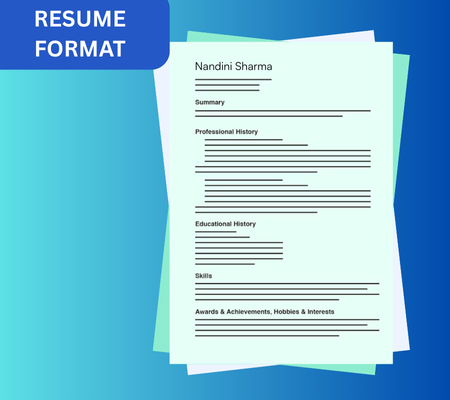
What to Include in A Resume?
The strength of a resume depends on how you write it. While filling in the contents of your resume, it is essential to ensure the resume format for the industry you work in is appropriate and will look good. The first thing recruiters notice is what your resume looks like; only then they start reading it. Here are the key elements of a resume:
- Contact information: Your contact information for resume should include your full name, phone number, email address, location and/or portfolio.
- Resume summary or objective: For your resume summary, write a brief statement that summarizes your achievements, relevant skills and expertise, and career goals.
- Work experience: Here, give a brief idea of your employment history that suggests you have the necessary skills and experience in reverse chronological order, including job titles, company names, employment dates, and achievements.
- Education: Mention your degrees, the institutions, and graduation dates. If you're a recent graduate, relevant coursework and academic honors should be included here.
- Skills: Highlight both your hard and soft skills that are relevant to the role, such as technical proficiencies, languages, or communication skills.
- Certifications and awards: Add any relevant certifications, licenses, or honors that demonstrate your expertise.
- Projects or portfolios: In creative or technical fields, consider adding a link to a portfolio or descriptions of relevant projects.
- Hobbies and interests: Relevant hobbies can show your personality, especially for creative or people-focused roles.
What is A Cover Letter?
A cover letter is an expansion of your resume, giving you a chance to differentiate yourself in a crowded job market. Your resume deals with the formal details, while your cover letter lets you share more of your personality, passion, and motivation for the job.
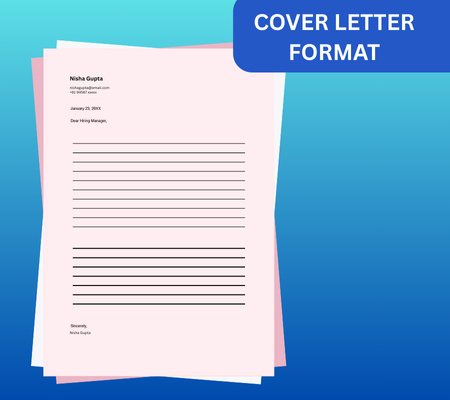
What to Include in A Cover Letter?
The resume format is more factual than that of a cover letter. How to write a cover letter? A cover letter elaborates your skills and achievements rather than just listing it out. Below, we’ve mentioned the key sections of an effective cover letter for resume:
- Header: Includes your contact details.
- Salutation: Address the recruiter by name, or use a salutation like "Dear Hiring Manager".
- Introduction: Open the cover letter with a clear, enthusiastic statement mentioning the position you're applying for and why you're interested and suitable for the job.
- Body: Focus on relevant skills, experiences, or achievements that match the job description, and showcase how you can contribute to the company.
- Closing: Reiterate your interest in the role and express your desire for an interview.
Difference Between A Cover Letter and A Resume
We now know what a resume and cover letter are, though they are similar to an extent, a resume and cover letter have key differences that we’ve listed below:
Aspect | Cover Letter | Resume |
Purpose | Introduces you and explains why you're a good fit for the position
| Provides a concise, factual overview of your qualifications
|
Structure | Typically 3-4 paragraphs (Introduction, Skills/Experience, Motivation, Closing)
| Structured with sections like Contact Info, Work Experience, Skills, Education
|
Content | Highlights your motivations, personality, and how your skills align with the job
| Lists your work experience, education, skills, and achievements in bullet points
|
Tone and Language | Professional yet personal and engaging, allowing room for enthusiasm
| Formal and concise, focused on clear, action-oriented statements
|
Customization | Highly customized to each job and company, addressing specific job requirements
| Modified but follows a more standard format, with adjustments based on the role
|
Length | Usually one page
| Typically 1-2 pages depending on experience level
|
Focus | Your motivation for applying, how you fit with the company culture
| Your work history, skills, and qualifications
|
When Should You Use A Cover Letter?
A cover letter should accompany a resume in the following situations:
1. When the Job Posting Requests One
- If the employer explicitly asks for a cover letter, you should always include it. Failing to submit a cover letter when requested can make your application appear incomplete or as if you didn't follow instructions.
2. When You Want to Personalize Your Application
- Even if a cover letter isn't required, submitting one can set you apart from other applicants. A well-written cover letter allows you to explain why you’re passionate about the role and how your specific skills and experience make you a good fit for the position.
3. When You’re Changing Careers
- If you’re switching fields, a cover letter is essential. It allows you to explain why you’re transitioning and highlight transferable skills, making it easier for employers to see why you're a viable candidate despite a different background.
4. When You Have Gaps in Employment
- If your resume has gaps in employment, unusual career transitions, or you lack direct experience for the role, a cover letter provides the opportunity to address these issues and frame your experience in a way that works for the employer.
5. When You Want to Show Enthusiasm
- A cover letter offers a chance to demonstrate genuine interest in the company and the role. If you're passionate about the company’s mission, culture, or products/services, a cover letter is a great place to express that.
When NOT to Include a Cover Letter:
- If the job posting explicitly says not to submit one: Some companies use automated systems that won’t even look at a cover letter if it’s not requested, and submitting one in this case might make your application seem like you didn’t read the instructions carefully.
- When you're applying through platforms that don't allow cover letters: Some job boards don’t have a section for cover letters, so it’s not always possible to include one.
Resume Sample and Cover Letter Sample
In this article, we’ve provided a sample resume and cover letter. These examples are designed to help you understand how to highlight technical skills, academic achievements, and project experience effectively to stand out to potential employers.
RESUME
ANIKA SHARMA Senior Journalist
Mumbai, Maharashtra
anikasharma@email.com
+91 98765 xxxxx
PROFESSIONAL SUMMARY Award-winning journalist with 8+ years of experience covering political, social, and environmental issues across print and digital media platforms. Known for investigative reporting that drives meaningful dialogue on pressing national concerns. Skilled in multimedia storytelling, with a proven ability to build source networks and produce impactful narratives that resonate with diverse audiences. WORK EXPERIENCE Senior Correspondent The Indian Chronicle
Mumbai, Maharashtra
June 2021 - Present - Lead investigative team covering political developments and policy reforms across Maharashtra and national politics
- Produced 20+ deep-dive investigative reports on government corruption that prompted two parliamentary inquiries
- Develop and maintain a network of over 100 high-level contacts across political spectrum and civil services
- Conceptualized and launched "Ground Reality" series, increasing digital subscriptions by 15%
- Mentor junior reporters and coordinate coverage for major political events including state and national elections
Political Reporter Dainik Samachar
New Delhi
March 2018 - May 2021 - Covered parliamentary proceedings, legislative developments, and political campaigns
- Reported on three national elections and five state assembly elections with real-time updates and analysis
- Conducted over 50 exclusive interviews with cabinet ministers, opposition leaders, and policy experts
- Pioneered bilingual reporting approach, creating content in both Hindi and English to reach wider audience
- Collaborated with data team to develop visual storytelling formats for complex political analyses
Staff Writer Eastern Express
Kolkata, West Bengal
July 2016 - February 2018 - Reported on local governance, urban development, and social issues in eastern India
- Broke story on illegal mining operations that led to state-level environmental policy reforms
- Produced weekly feature pieces highlighting grassroots social movements and community initiatives
- Developed expertise in covering Sundarbans environmental concerns and climate change impacts
- Trained in multimedia reporting, consistently producing video content alongside written reports
EDUCATION Master of Arts in Mass Communication and Journalism
Jamia Millia Islamia University, New Delhi
2014 - 2016 Bachelor of Arts in Political Science
St. Xavier's College, Mumbai
2011 - 2014 SKILLS - Reporting: Investigative journalism, political reporting, feature writing, source development
- Technical: Data journalism, multimedia storytelling, content management systems, Adobe Creative Suite
- Languages: English (Fluent), Hindi (Native), Marathi (Proficient), Bengali (Conversational)
- Research: FOIA requests, public records analysis, statistical data interpretation, fact verification
- Digital: SEO optimization, social media reporting, podcast production, video storytelling
AWARDS & RECOGNITION - Ramnath Goenka Excellence in Journalism Award (2023) - Investigation into water crisis in Maharashtra
- Red Ink Award (2022) - Series on farmer protests and agricultural policy
- Press Council of India National Award (2020) - Coverage of pandemic response and healthcare system challenges
- South Asian Journalists Association Award (2019) - Reporting on cross-border environmental issues
PROFESSIONAL MEMBERSHIPS - Member, Editors Guild of India
- Member, Mumbai Press Club
- Associate, Network of Women in Media, India (NWMI)
- Member, International Federation of Journalists
|
COVER LETTER
Anika Sharma
Mumbai, Maharashtra
anikasharma@email.com
+91 98765 xxxxx
April 24, 2025
Rajiv Mehta
Editor-in-Chief
The National Herald
No. 14, Bahadur Shah Zafar Marg
New Delhi - 110002
Dear Mr. Mehta,
I am writing to express my interest in the Senior Political Correspondent position at The National Herald, as advertised on your website. With eight years of experience in journalism across multiple publications and a demonstrated track record of investigative reporting on political and social issues, I believe I can make significant contributions to your respected publication.
During my tenure at The Indian Chronicle, I have developed extensive expertise in political reporting, with a particular focus on the intersection of policy decisions and their impact on ordinary citizens. My investigative series on irrigation fund misappropriation in drought-affected districts of Maharashtra not only won the Ramnath Goenka Excellence in Journalism Award but also prompted a state-level inquiry commission. This reflects my commitment to journalism that goes beyond mere reporting to drive accountability and positive change.
What particularly attracts me to The National Herald is your publication's long-standing tradition of balanced political coverage and commitment to constitutional values. In a media landscape increasingly characterized by polarization, I admire your editorial team's emphasis on factual reporting and nuanced analysis. I am especially interested in your recent expansion into multimedia storytelling and data journalism, areas where I have developed considerable skills over the past three years.
My experience working in both English and Hindi media environments has given me a unique perspective on the diverse political narratives across India's linguistic landscape. Having reported from three different regions of the country, I understand the complex interplay of national politics with regional aspirations and concerns. Additionally, my network of sources across party lines would be an asset in providing your readers with insightful and balanced political coverage.
I am particularly excited about the opportunity to contribute to your planned coverage of upcoming state elections and policy reforms. My background in data-driven political analysis would complement your team's approach to electoral reporting, while my investigative skills could further strengthen your accountability journalism.
I would welcome the opportunity to discuss how my experience, skills, and vision align with the future direction of The National Herald. Thank you for considering my application, and I look forward to the possibility of contributing to your esteemed publication.
Sincerely,
Anika Sharma
|
Conclusion
Understanding the difference between a cover letter and a resume is crucial for building a job application. Using a well-designed resume cover letter template can help you present both documents clearly and professionally, making it easier for recruiters to see your strengths. Together, the resume cover letter template creates a complete picture of you as a candidate, helping you stand out in a competitive job market.