Thanks to the rise of artificial intelligence, job seekers now have powerful tools at their fingertips to streamline and elevate the application process. AI can help you create a professional and personalized cover letter in minutes. In this guide, we'll show you how to effectively use AI to write a cover letter that captures your strengths, aligns with the job description, and impresses recruiters without sounding robotic.
Should You Consider Using AI to Write Your Cover Letter?
Writing a cover letter for resume is not an easy task. You have to research the company, identify the keywords of the role you’re applying for from the job description and represent your skills and experience in a way that aligns with the role and highlights you as the best candidate for the role.
Additionally, it is advised that a candidate should use a unique cover letter for every job application. Hence, this process starts over again for each application’s cover letter. The next question that arises is how do you write a cover letter unique to every job application?
Here’s how AI can help you when writing a cover letter:
1. Saves Time
Writing a customized cover letter from scratch for every job application is time-consuming. AI tools streamline this process by generating a draft in just a few seconds. You simply enter a few key inputs such as the job title, company name, your experience, and sometimes your resume or LinkedIn profile and the AI generates a full letter based on this data. What usually takes hours now takes minutes, allowing you to apply to more opportunities without compromising quality.
2. Enhances Personalization
AI tools can analyze job descriptions to understand the employer’s specific needs. They extract relevant keywords, responsibilities, and skills mentioned in the listing, and then align your qualifications with those requirements in the generated cover letter. This ensures your letter speaks directly to what the recruiter is looking for, thus increasing your chances of getting noticed.
For example, if a job description emphasizes “cross-functional teamwork” and “data analysis,” the AI can include those phrases in your cover letter, showing that your experience directly matches the employer’s expectations.
3. Improves Language and Tone
Many candidates struggle with using the right tone - sounding confident without being boastful, or professional without being robotic. AI writing assistants are trained on large datasets of professional writing, allowing them to generate content that sounds polished, fluent, and appropriate for corporate settings.
These tools can also adjust tone based on your input, for example, you can choose between formal, enthusiastic, conversational, or concise depending on the role or industry you're applying to.
4. Reduces Mental Fatigue
Job hunting is emotionally and mentally taxing especially when you're juggling multiple applications, interviews, and rejections. AI takes a huge mental load off by handling the bulk of the writing, so you don’t have to start from zero every time.
Instead of staring at a blank page, you get a full draft to edit and customize. This makes the process more manageable and keeps you motivated to apply to more jobs without burnout.
5. Helps with Structure and Formatting
A cover letter should follow a clear, effective structure: a strong opening, a persuasive body, and a confident closing. AI tools are trained to produce content that naturally fits this format, so even if you’re unsure how to organize your ideas, you’ll get a well-structured starting point. Some tools also format the letter for you with proper greetings, paragraphs, and closings — saving you from common formatting mistakes.
The Structure of a Cover Letter
A cover letter lists your qualifications and presents you as the best fit for the role. There’s a significant difference between a cover letter and resume. Compared to the resume format which is more factual, a cover letter elaborates your skills and achievements instead of listing it out.
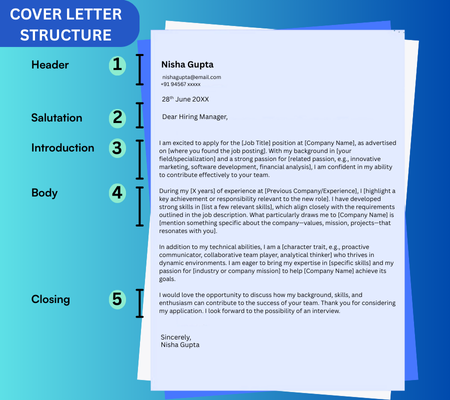
Below, we’ve explained the structure an effective cover letter:
1. Header
The header of the cover letter includes your contact information; this is placed at the top:
- Full Name
- Address
- Phone Number
- Email Address
2. Salutation
A cover letter should be addressed to the recruiter either by name or designation or any other professional greeting.
3. Introduction
This is the section that opens your cover letter. Here, you mention the position you’re applying for, how you found out about the job. This is the best opportunity for you to express enthusiasm for the role and the company. This makes a lasting impression on the recruiter.
4. Body (Usually, 1-2 Paragraphs)
This is the core of your cover letter where you highlight your qualifications, connecting your skills and experiences to the job description. Share your achievements that highlight your value, backed by numbers to make a lasting impact. Show how you’re a good fit for the role and the company.
5. Closing
This section wraps up your cover letter. Be confident and reiterate your interest in the role. Below, attach your resume and request for an interview. Don’t forget to thank the reader for their time and consideration.
Steps for Writing a Cover Letter with AI
1. Create A Resume
First off, you should only start writing a cover letter with AI only if your resume is ready. The reason for this is your cover letter is supposed to complement your resume. When done correctly, your cover letter will expand on your work history, skills, achievements, and any other qualifications that you've listed in your resume.
The details of your resume will give the AI insight into your professional journey and help write a persuasive cover letter that perfectly aligns with your qualifications. The strength of your cover letter depends on how you write a resume.
2. Go Through the Job Description Thoroughly
To create the most effective cover letter with AI, you need to know and understand what the employer exactly wants. To do this thoroughly read the job posting to look for keywords related to the role.
Additionally, research the company to find out about the tone they use and company values and mission. This will help you generate a cover letter that is in sync with their culture.
3. Cover Letter Prompt for the AI
Even with all your details and the details from the job description, you would still generate a generic cover letter with the AI, if your prompt is generic. This is because the output depends on the input given.
Here are some prompts you could refer to while writing a cover letter with AI, for different roles. Each prompt includes all the right info to get a great result.
Example 1: Marketing Manager – Mid-Level Role
Prompt: Write a cover letter for a Marketing Manager position at Spotify. Here's the job description: "We’re looking for a data-driven marketing manager to lead integrated campaigns and drive subscriber growth across global markets. Must have experience with digital channels, performance marketing, and team leadership." My background: I have 6 years of marketing experience, currently working at a SaaS startup where I led a team of 4 and increased inbound leads by 70% YoY. I specialize in performance marketing, email campaigns, and brand strategy. My tone: Strategic and enthusiastic. |
Example 2: UX Designer – Career Transition
Prompt: I’m transitioning from graphic design to UX design. Write a cover letter for a UX Designer role at Dropbox. Job description: "Looking for a UX designer to craft intuitive experiences across our core products. Must be user-focused, collaborative, and familiar with Figma and prototyping tools." My background: I have 7 years of experience in graphic and visual design. I recently completed a UX design bootcamp and worked on 3 client projects involving user research, wireframes, and usability testing. My tone: Confident but humble, with an emphasis on design thinking and empathy. |
Example 3: Data Analyst – Entry-Level
Prompt: Write a cover letter for a Data Analyst position at Airbnb. Job Description: "Join our data science team to help uncover insights that improve customer experiences. Must know SQL, Python, and have strong analytical thinking." I’m a recent graduate with a B.Sc. in Statistics from NYU. I’ve completed internships at a fintech company and a healthcare startup, where I built dashboards in Tableau and analyzed customer retention using SQL and Python. My tone: Analytical and eager to learn. |
Example 4: Senior Software Engineer – Leadership Role
Prompt: Write a cover letter for a Senior Software Engineer role at Stripe. Job Description: "Looking for an experienced backend engineer to lead technical initiatives and mentor junior engineers. Experience in distributed systems, APIs, and cloud infrastructure required." My background: 10 years in backend engineering, most recently at Shopify where I led a team of 6. I built scalable microservices in Go and deployed on AWS. I also created internal APIs that reduced processing time by 40%. Tone: Technical and leadership-driven. |
Example 5: Social Media Coordinator – Creative Industry
Prompt: Write a cover letter for a Social Media Coordinator job at Netflix. Job Description: "Looking for a savvy content creator to manage our social media platforms and engage our audiences in fun, creative ways. Must be fluent in pop culture and skilled in video editing, memes, and community building." My background: I’m a social media freelancer who’s grown three Instagram accounts to 50k+ followers each. I create TikToks, write trend-savvy captions, and know how to keep engagement high. Tone: Energetic, witty, and creative. |
4. Review and Edit
The last step is to review and edit the cover letter generated by the AI. Check if the tone still sounds like you. Even AI needs a human touch at times. Make sure every listed achievement and qualification truly reflects you and your experience. The plus point of writing a cover letter with AI, is that most of the common cover letter mistakes a human would make while writing the letter, gets reduced.
Conclusion
Using AI to write your cover letter truly makes the entire process a lot easier. It not only speeds up the writing process but also helps create personalized, well-structured, and impactful letters modified to each opportunity. However, while AI can make an impressive draft, it is crucial to add your personal touch to ensure authenticity and emotional connection with the recruiter.