

Code360 powered by Coding Ninjas X Naukri.com. Code360 powered by Coding Ninjas X Naukri.com

Maximum Width In Binary Tree

Moderate
0/80
Average time to solve is 38m
profile
Contributed by
60 upvotes
Asked in companies
MicrosoftFlipkartAmazon

Problem statement

You have been given a Binary Tree of integers. You are supposed to return the maximum width of the given Binary Tree. The maximum width of the tree is the maximum width among all the levels of the given tree.


The width of one level is defined as the length between the leftmost and the rightmost, non-null nodes in the level, where the null nodes in between the leftmost and rightmost are excluded into length calculation.


For example :
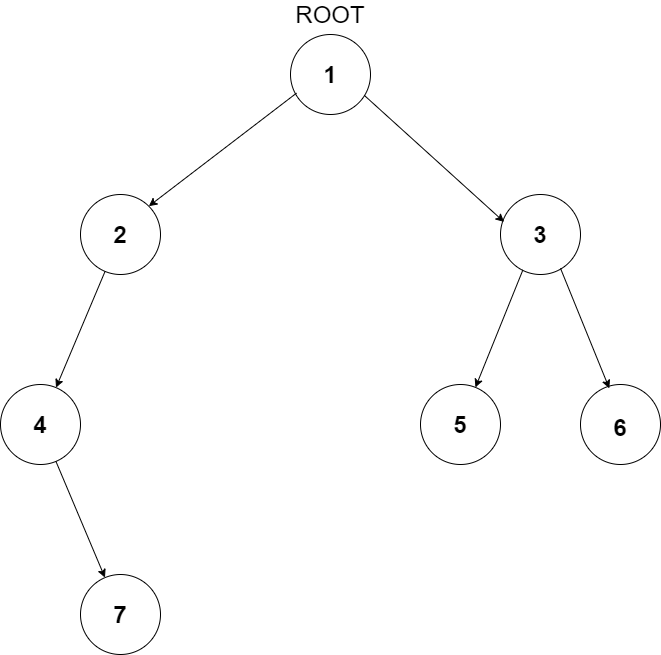
For the given binary tree

Example

The maximum width will be at the third level with the length of 3, i.e. {4, 5, 6}.
Detailed explanation ( Input/output format, Notes, Images )
Input Format :
The only line of input contains elements in the level order form. The line consists of values of nodes separated by a single space. In case a node is null, we take -1 in its place.

For example, the input for the tree depicted in the below image would be :

Example

1
2 3
4 -1 5 6
-1 7 -1 -1 -1 -1
-1 -1

Explanation :

Level 1 :
The root node of the tree is 1

Level 2 :
Left child of 1 = 2
Right child of 1 = 3

Level 3 :
Left child of 2 = 4
Right child of 2 = null (-1)
Left child of 3 = 5
Right child of 3 = 6

Level 4 :
Left child of 4 = null (-1)
Right child of 4 = 7
Left child of 5 = null (-1)
Right child of 5 = null (-1)
Left child of 6 = null (-1)
Right child of 6 = null (-1)

Level 5 :
Left child of 7 = null (-1)
Right child of 7 = null (-1)

The first not-null node(of the previous level) is treated as the parent of the first two nodes of the current level. The second not-null node (of the previous level) is treated as the parent node for the next two nodes of the current level and so on.
The input ends when all nodes at the last level are null(-1).
Note :
The above format was just to provide clarity on how the input is formed for a given tree. 
The sequence will be put together in a single line separated by a single space. Hence, for the above-depicted tree, the input will be given as:

1 2 3 4 -1 5 6 -1 7 -1 -1 -1 -1 -1 -1
Output Format :
Print a single line that contains a single integer that denotes the maximum width for the given tree.
Note :
You do not need to print anything; it has already been taken care of. Just implement the given function.
Sample Input 1 :
1 2 3 4 -1 5 6 -1 7 -1 -1 -1 -1 -1 -1
Sample Output 1 :
3
Explanation of Sample Input 1 :

Example The maximum width will be at the third level with the length of 3, i.e. {4, 5, 6}.

Sample Input 2 :
2 7 5 2 6 -1 9 -1 -1 5 11 4 -1 -1 -1 -1 -1 -1 -1
Sample Output 2 :
3
Constraints :
0 <= 'N' <= 5 * 10 ^ 5
0 <= 'DATA' <= 10 ^ 6 and data != -1
Where ‘N’ is the total number of nodes in the binary tree, and 'DATA' is the value of the binary tree node.

Time Limit: 1sec.
Hint

How can you find the number of nodes in each level of the given tree?

Approaches (3)
Brute Force

The straightforward intuition is that first, find the maximum levels possible in the given tree, called the "HEIGHT" of the tree. And then, for each level in height, we will find the number of nodes in each level. And the maximum number of the node among all levels will be the maximum width of the given binary tree. So the implementation of our intuition takes bellow steps:

  1. First, find the height of the tree. And for finding the height of the tree, steps are:
  • If the root is "NULL", return 0 as height is 0.
  • Else, call the recursive function for left subtree and right subtree and which has a maximum height, which would be the height of the subtree for the "ROOT" node. So the height of the "ROOT" node will be
    • 1+max("LEFT-HEIGHT", “RIGHT-HEIGHT”)
  • Return the height of the "ROOT" node.

    2. We will go for each level in [1: "HEIGHT"] and find how many nodes it contains at that level. The maximum number of nodes among all levels will be the maximum width of the given tree. For finding the number of nodes at any level, let's say "LEVEL", Steps are as follows:

  • If the root is "NULL", return 0 as there will be no node possible.
  • If "level" becomes 1, then return 1 as this root node is a node in required level.
  • Else, call recursive on left subtree with "level-1" and store in "LEFTNODES" and call recursive on right subtree with "level-1" and store in "RIGHTNODES". So the total number of nodes for the current level will be "("LEFTNODES" +"RIGHTNODES" )".

   3. The maximum number of nodes among all levels will be the maximum width of the given tree.

Time Complexity

O(N * H), where ‘N’ is the number of nodes in the given binary tree, and ‘H’ is the height of the binary tree.


We are finding the height of the binary tree, which will take cost O(H), in the worst case (Skewed Trees), ‘H’ is equal to ‘N’. And for each level in height, we will find the number of nodes in each level. So there can be at most ‘H’ level, and for each level, we will find the number of nodes that can take O(N) cost. So overall time complexity will be O(N * H).

Space Complexity

O(H), where ‘H’ is the height of the binary tree.


We are using a recursive algorithm to find the height of the tree and find the number of nodes in each level. For getting the number of nodes for each level, the level will be at most the height of the tree. So in the worst case (Skewed Trees), 'H' is equal to 'N', there can be at most 'N' height for which we will have to push function 'N' time into the stack. So overall space complexity would be O(H).

Video Solution
Unlock at level 3
(75% EXP penalty)
Code Solution
(100% EXP penalty)
Maximum Width In Binary Tree
All tags
Sort by
Search icon

Interview problems

C++ solution

int getMaxWidth(TreeNode<int> *root)

{

    if(root==NULL) return 0;

      queue<TreeNode<int>*>q;

      int res=INT_MIN;

      q.push(root);

      while(q.empty()==false)

      {

          int ct=q.size();

           res=max(res,ct);

          for(int i=0;i<ct;i++)

          {

               TreeNode<int>*curr=q.front();

               q.pop();


              if(curr->left !=NULL)

               q.push(curr->left);

              if(curr->right !=NULL)

               q.push(curr->right);

          }

      }

      return res;

}

77 views
0 replies
0 upvotes

Interview problems

C++ || Level order

int getMaxWidth(TreeNode<int> *root){


    if(!root) return 0;


    int ans = 0;


    queue<TreeNode<int>*> q;

    q.push(root);


    while(!q.empty()){


        int n = q.size();


        ans = max(ans, n);


        for(int i=0; i<n; i++){


            TreeNode<int>* front = q.front();

            q.pop();


            if(front->left)

              q.push(front->left);


            if(front->right)

              q.push(front->right);


        }


    }


    return ans;


}

490 views
0 replies
1 upvote

Interview problems

Best Solution using BFS traversal

/*

        Time Complexity    : O(N)

        Space Complexity  : O(N)

*/


/************************************************************


    Following is the TreeNode class structure


    template <typename T>

    class TreeNode {

       public:

        T val;

        TreeNode<T> *left;

        TreeNode<T> *right;


        TreeNode(T val) {

            this->val = val;

            left = NULL;

            right = NULL;

        }

    };


************************************************************/


int getMaxWidth(TreeNode<int> *root)

{

    if(!root)return 0;

    queue<TreeNode<int>*> q;

    q.push(root);

    int maxi=0;

    while(!q.empty()){

        int size=q.size();

        vector<int> row;

        while(size--){

            TreeNode<int>* node=q.front();

            q.pop();

            row.push_back(node->val);

            if(node->left)q.push(node->left);

            if(node->right)q.push(node->right);

        }

        int n=row.size();


        maxi=max(maxi,n);


   }


   return maxi;


}

200 views
0 replies
1 upvote

Interview problems

Python working code

class Pair:

def __init__(self,node,num):

self.node=node

self.num=num


def getMaxWidth(root):

if root is None:

return 0


ans = 0

q = deque()

q.append(Pair(root, 0))


while q:

size = len(q)

mmin = q[0].num

first, last = 0, 0


for i in range(size):

cur_pair = q.popleft()

cur_id = cur_pair.num - mmin

node = cur_pair.node


if i == 0:

first = cur_id

if i == size - 1:

last = cur_id


if node.left:

q.append(Pair(node.left, cur_id * 2 + 1))

if node.right:

q.append(Pair(node.right, cur_id * 2 + 2))


ans = max(ans, last - first + 1)


return ans

27 views
1 reply
0 upvotes

Interview problems

Simple C++ solution using lambda function

int getMaxWidth(TreeNode<int> *root)
{   
     
    if(!root){
        return 0;
    } 
    function <int(TreeNode<int> *)>getWidth=[&](TreeNode<int> *root){
        queue<TreeNode<int> *>q;
        int ans = 0;
        q.push(root);
        while(!q.empty()){
            auto k = q.front();
            int size = q.size();
            ans = max(ans,size);
            for(int i=0;i<size;i++){
                auto it = q.front();
                if(it->left){
                    q.push(it->left);
                }
                if(it->right){
                    q.push(it->right);
                }
                q.pop();
            }
        }
        return ans;
    };
    return getWidth(root);
}
165 views
1 reply
0 upvotes

Interview problems

Simple c++ soln, TC-O(N), S.C-O(W)

int getMaxWidth(TreeNode<int> *root){

    if(!root) return 0;

    queue<TreeNode<int>*> q;

    q.push(root);

    q.push(NULL);

    int ans=0,cnt=0;

    while(!q.empty()){

       TreeNode<int>* temp=q.front();

       q.pop();


       if(temp==NULL){

         ans=max(ans,cnt);

         cnt=0;

         if(!q.empty()) q.push(NULL);

       }

        else {

         cnt++;

         if (temp->left)  q.push(temp->left);

         if (temp->right)  q.push(temp->right);

       }

    }

    return ans;

}

189 views
0 replies
0 upvotes

Interview problems

simple java solution using Level order traversal

 import java.util.*;


// import javax.swing.tree.TreeNode;

public class Solution {

    public static int getMaxWidth(TreeNode root) {

        if (root == null) return 0;

        Queue<TreeNode> queue= new LinkedList();

        queue.offer(root);

        // TreeSet<Integer> l = new TreeSet();

        int max = Integer.MIN_VALUE;


        while(!queue.isEmpty()) {

            int size = queue.size();

            List<Integer> ll = new ArrayList<>();

            for (int i=0;i<size;i++) {

                if (queue.peek().left !=null) {

                    queue.offer(queue.peek().left);

                }


                if (queue.peek().right != null) {

                    queue.offer(queue.peek().right);

                }

                ll.add(queue.poll().val);

            }

            max = Math.max(max,ll.size());

        }


        return max;       

    }

}

153 views
0 replies
0 upvotes

Interview problems

C++ Easy Solution Using Queue

int getMaxWidth(TreeNode<int> *root)
{
    // Write your code here.
    if(root == NULL) return 0;
    int count = 0, ans = INT_MIN;
    queue<TreeNode<int> *> q;
    q.push(root);
    q.push(NULL);

    while(!q.empty()){
        TreeNode<int> *top = q.front();
        q.pop();
        if(top == NULL){
            if(q.empty()) return ans = max(ans,count);
            ans = max(ans,count);
            count = 0;
            q.push(NULL);
        }
        else{
            count++;
            if(top->left) q.push(top->left);
            if(top->right) q.push(top->right);
        }
    }
    return ans;
}
184 views
0 replies
0 upvotes

Interview problems

c++ #levelordertraversal

int getMaxWidth(TreeNode<int> *root)

{

    // Write your code here.

    queue<TreeNode<int>*>q;

    q.push(root);

    int maxi =INT_MIN;

    if(root==NULL)

    {

        return 0;

    }

    while(!q.empty())

    {

int size =q.size();

int count =0;

for(int i=0;i<size;i++)

{

TreeNode<int>*top=q.front();q.pop();

count++;

if(top->left)

{

    q.push(top->left);

}

if(top->right)

{

    q.push(top->right);

}

}

maxi=max(maxi,count);

    }

    return maxi;

}

180 views
0 replies
1 upvote

Interview problems

python

from queue import Queue


def getMaxWidth(root):

# Write your code here.

if not root:

return 0


max_width = float('-inf')

q = Queue()

q.put(root)


while not q.empty():

level_width = q.qsize()

max_width = max(max_width, level_width)


for i in range(level_width):

current = q.get()


if current.left:

q.put(current.left)


if current.right:

q.put(current.right)


return max_width


pass

46 views
0 replies
0 upvotes
Full screen
Console