





Accenture interview experience Real time questions & tips from candidates to crack your interview

Advanced Application Engineer Analyst
Accenture


3 rounds | 3 Coding
problems

 Selected
 Interview preparation journey

Preparation
Duration: 9 months
Topics: Arrays, Strings, Recursion, LinkedList, Stacks and Queues, Dynamic Programming and Graphs, HR, Managerial Round.

Tip 1 : Complete all the questions that are available in the Coding Ninjas course.
Tip 2 : Keep practicing the same question in IDE also so that you can write the full-length code (driver code as well)
Tip 3 : Do practice from more websites like GFG, Codezen, and Leetcode so that you can tackle any question related to that topic.
Application process
Where: Campus
Eligibility: 6.5 CGPA
Tip 1 : Try to make a resume from Novoresume as the template matches with the companies pattern. They are ATS friendly.
Tip 2 : Write only the technical skills in which you can answer accurately.
Tip 3 : Mention your big projects and insert the link of your code like GitHub URLs.
Interview rounds
01
Round
Hard
Online Coding Interview
Duration90 minutes
Interview date4 Oct 2021
Coding problem2
As it was 4 rounds. If you clear the first round MCQ then only you can jump it to the coding round. First-round is MCQ and it was comprised of 90 minutes and you had to solve 90 MCQs.Coding round timing was 45 minutes and I need to solve 2 questions. One was hard and another was medium level. You have to clear all the test cases then only you will get selected for another round.
1. Magic Index
Easy
20m average time
80% success

0/40
Asked in companies


You are given a sorted array A consisting of N integers. Your task is to find the magic index in the given array.
Note :
1. A magic index in an array A[0 ... N - 1] is defined to be an index i such that A[i] = i.
2. The elements in the array can be negative.
3. The elements in the array can be repeated multiple times.
4. There can be more than one magic index in an array.
2. Count Strings
Moderate
20m average time
80% success
0/80
Asked in companies

Peter Parker (Spider-Man) want to time travel to save Tony Stark.
So Peter came to Doctor Strange for help. Doctor strange told Peter that he would help him if he can solve Strange’s problem. Peter accepts the challenge.
Doctor Strange gave Peter a grid having ‘N’ strings of size ‘M’ each. Then he gave Peter a string ‘S’. The task is to count the total number of paths in grid starting from any coordinate in the grid by moving only in left, right, up and down directions such that the string formed by characters in the path will be equal to ‘S’. Also, visiting a coordinate twice in a path is not allowed.
As Peter wants to bring Tony back as soon as possible, he called you for help.
The fate of Tony and Peter lies in your hand.
02
Round
Medium
Assignment
Duration45 minutes
Interview date6 Oct 2021
Coding problem1
1. Binary Tree Pruning
Moderate
20m average time
80% success
0/80
Asked in companies



You have been given a Binary Tree where the value of each node is either 0 or 1. Your task is to return the same Binary Tree but all of its subtrees that don't contain a 1 have been removed.
Note :
A subtree of a node X is X, plus every node that is a descendant of X.
For Example :
Look at the below example to see a Binary Tree pruning.
Input: [1, 1, 1, 0, 1, 0, 1, 0, 0, -1, -1, -1, -1, -1, -1, -1, -1, -1, -1]
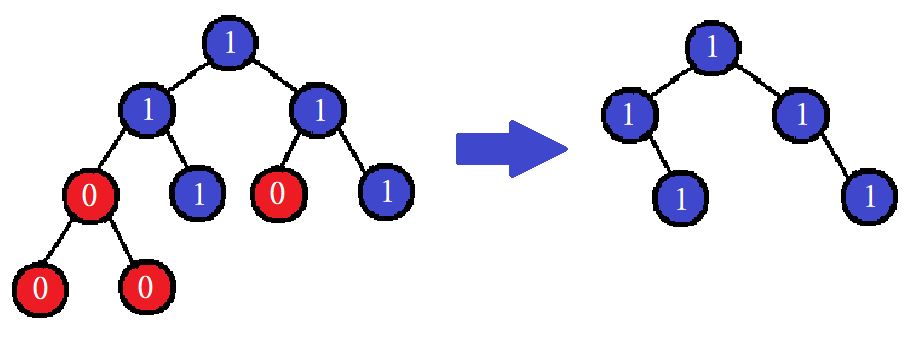
Output: [1, 1, 1, -1, 1, -1, 1, -1, -1, -1, -1]

For example, the input for the tree depicted in the below image would be :
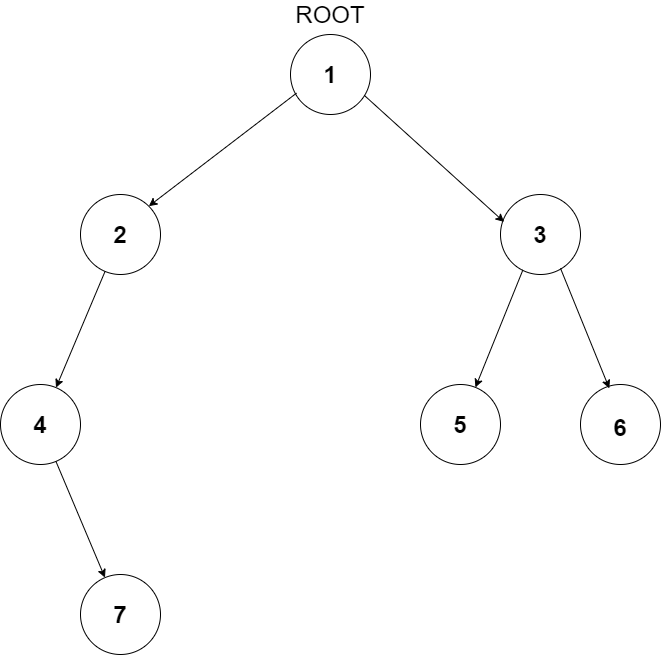
1
2 3
4 -1 5 6
-1 7 -1 -1 -1 -1
-1 -1
Explanation :
Level 1 :
The root node of the tree is 1

Level 2 :
Left child of 1 = 2
Right child of 1 = 3

Level 3 :
Left child of 2 = 4
Right child of 2 = null (-1)
Left child of 3 = 5
Right child of 3 = 6

Level 4 :
Left child of 4 = null (-1)
Right child of 4 = 7
Left child of 5 = null (-1)
Right child of 5 = null (-1)
Left child of 6 = null (-1)
Right child of 6 = null (-1)

Level 5 :
Left child of 7 = null (-1)
Right child of 7 = null (-1)

The first not-null node (of the previous level) is treated as the parent of the first two nodes of the current level. The second not-null node (of the previous level) is treated as the parent node for the next two nodes of the current level and so on.
The input ends when all nodes at the last level are null (-1).
Note :
The above format was just to provide clarity on how the input is formed for a given tree.

The sequence will be put together in a single line separated by a single space. Hence, for the above-depicted tree, the input will be given as:
1 2 3 4 -1 5 6 -1 7 -1 -1 -1 -1 -1 -1
03
Round
Hard
Face to Face
Duration40 minutes
Interview date8 Oct 2021
Coding problem0
During my interview, he asked a few questions from Trees (implementation of AVL tree), searching and sorting algorithms, questions from Java, projects, and explain the code that was in my project. Deep questions from DBMS and Operating system.


Here's your problem of the day 
Solving this problem will increase your chance to get selected in this company
Skill covered: Programming
To make an AI less repetitive in a long paragraph, you should increase:
Choose another skill to practice
Similar interview experiences
Associate Software Engineer
3 rounds | 2 problems
Interviewed by Accenture
Selected 
3747 views

1 comments

0 upvotes
Application Development Associate
2 rounds | 3 problems
Interviewed by Accenture
 Selected
 1170 views
0 comments
0 upvotes
Associate Software Engineer
4 rounds | 10 problems
Interviewed by Accenture
Selected 2174 views
0 comments
0 upvotes
Associate Software Engineer
3 rounds | 11 problems
Interviewed by Accenture
Rejected
4985 views
1 comments
0 upvotes