





Accolite interview experience Real time questions & tips from candidates to crack your interview

SDE - 1
Accolite


3 rounds | 6 Coding
problems

 Selected
 Interview preparation journey

Journey
It was an excellent session throughout the interview journey, and in which I answered adequately, I got the offer from Accolite Digital company.
Application story
I got this opportunity on campus, and it was only for girls, which was a significant advantage for all of us. I answered very well in my interview and was truthful about my project explanation. Only try to copy-paste your project if you have done it yourself.
Why selected/rejected for the role?
I was selected for the software development role because I answered well, and the interviewer was very satisfied. Additionally, if I did not know the answer, I directly stated that I didn't know.
Preparation
Duration: 10 months
Topics: Data structure and algorithm, Operating system, DBMS, OOPS, Computer network, Web development, Cyber Security

Tip 1 : Be very clear with your project explanation.
Tip 2 : Try to cover all the explanations of the CS core subjects.
Application process
Where: Campus
Eligibility: 6.5 cgpa in Graduation and 65% in 12th is minimum requirement
Tip 1: Make it clear with proper knowledge.
Tip 2: Provide accurate information and avoid lying about things you are not sure of.

Interview rounds
01
Round
Easy
Video Call
Duration60 mins
Interview date25 Aug 2021
Coding problem2
It was morning time, starting at 9:00 am. It happened via the Google Meet online process, and it was a very smooth onboarding. The interviewer was very friendly.
1. Swap Nodes in Pairs
Moderate
40m average time
60% success

0/80
Asked in companies



You are given a singly linked list of integers.
Your task is to swap every two adjacent nodes, and return the head of the modified, linked list.
For Example:
We have a linked list 1->2->3->4->5->6->7 and so on. You are supposed to swap pairs of a linked list like swap (1,2), (3,4), (5,6), and so on.
Note:
1. You may not modify the data in the list’s nodes; only nodes themselves may be changed. Because imagine a case where a node contains many fields, so there will be too much unnecessary swap.

2. If a pair of a node does not exist, then leave the node as it is.
Problem approach
class Node:
# Constructor to initialize the node object
def __init__(self, data):
self.data = data
self.next = None
class LinkedList:
# Function to initialize head
def __init__(self):
self.head = None
# Function to pairwise swap elements of a linked list
def pairwiseSwap(self):
temp = self.head
# There are no nodes in linked list
if temp is None:
return
# Traverse further only if there are at least two
# left
while(temp and temp.next):
# If both nodes are same,
# no need to swap data
if(temp.data != temp.next.data):
# Swap data of node with its next node's data
temp.data, temp.next.data = temp.next.data, temp.data
# Move temp by 2 to the next pair
temp = temp.next.next
# Function to insert a new node at the beginning
def push(self, new_data):
new_node = Node(new_data)
new_node.next = self.head
self.head = new_node
# Utility function to print the LinkedList
def printList(self):
temp = self.head
while(temp):
print temp.data,
temp = temp.next
# Driver program
llist = LinkedList()
llist.push(5)
llist.push(4)
llist.push(3)
llist.push(2)
llist.push(1)
print "Linked list before calling pairWiseSwap() "
llist.printList()
llist.pairwiseSwap()
print "\nLinked list after calling pairWiseSwap()"
llist.printList
2. Sliding Maximum
Moderate
25m average time
85% success
0/80
Asked in companies



You are given an array 'ARR' of integers of length 'N' and a positive integer 'K'. You need to find the maximum elements for each and every contiguous subarray of size K of the array.
For example
'ARR' =  [3, 4, -1, 1, 5] and 'K' = 3
Output =  [4, 4, 5]

Since the maximum element of the first subarray of length three ([3, 4, -1]) is 4, the maximum element of the second subarray of length three ([4, -1, 1]) is also 4 and the maximum element of the last subarray of length three ([-1, 1, 5]) is 5, so you need to return [4, 4, 5].
02
Round
Medium
Video Call
Duration60 mins
Interview date2 Sep 2021
Coding problem2
It was once again the morning session, and the interviewer was very supportive, giving me a hint to think about the approach. Finally, I came up with the solution that he was expecting.
1. Closest Binary Search Tree Value
Easy
15m average time
85% success
0/40
Asked in companies


You have been given a binary search tree of integers with ‘N’ nodes and a target integer value ‘K’. Your task is to find the closest element to the target ‘K’ in the given binary search tree.
A node in BST is said to be the closest to the target if its absolute difference with the given target value ‘K’ is minimum. In the case of more than one closest element, return the element with a minimum value.
A binary search tree (BST) is a binary tree data structure with the following properties.
• The left subtree of a node contains only nodes with data less than the node’s data.

• The right subtree of a node contains only nodes with data greater than the node’s data.

• Both the left and right subtrees must also be binary search trees.
For Example:
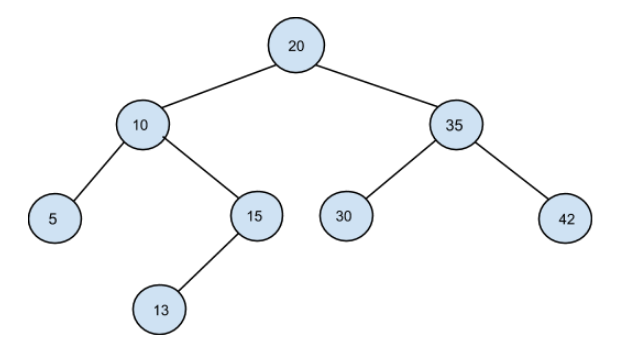
For the given BST and target value ‘K’ = 32, the closest element is 30 as the absolute difference between 30 and 32 (|32 - 30|) is the minimum among all other possible node-target pairs.
Problem approach
# Recursive Python program to find key
# closest to k in given Binary Search Tree.
# Utility that allocates a new node with the
# given key and NULL left and right pointers.
class newnode:
# Constructor to create a new node
def __init__(self, data):
self.key = data
self.left = None
self.right = None
# Function to find node with minimum
# absolute difference with given K
# min_diff --> minimum difference till now
# min_diff_key --> node having minimum absolute
# difference with K
def maxDiffUtil(ptr, k, min_diff, min_diff_key):
if ptr == None:
return
# If k itself is present
if ptr.key == k:
min_diff_key[0] = k
return
# update min_diff and min_diff_key by
# checking current node value
if min_diff > abs(ptr.key - k):
min_diff = abs(ptr.key - k)
min_diff_key[0] = ptr.key
# if k is less than ptr->key then move
# in left subtree else in right subtree
if k < ptr.key:
maxDiffUtil(ptr.left, k, min_diff,
min_diff_key)
else:
maxDiffUtil(ptr.right, k, min_diff,
min_diff_key)
# Wrapper over maxDiffUtil()
def maxDiff(root, k):
# Initialize minimum difference
min_diff, min_diff_key = 999999999999, [-1]
# Find value of min_diff_key (Closest
# key in tree with k)
maxDiffUtil(root, k, min_diff, min_diff_key)
return min_diff_key[0]
# Driver Code
if __name__ == '__main__':
root = newnode(9)
root.left = newnode(4)
root.right = newnode(17)
root.left.left = newnode(3)
root.left.right = newnode(6)
root.left.right.left = newnode(5)
root.left.right.right = newnode(7)
root.right.right = newnode(22)
root.right.right.left = newnode(20)
k = 18
print(maxDiff(root, k))
2. Reverse Level Order Traversal
Moderate
30m average time
52% success
0/80
Asked in companies

You have been given a Binary Tree of integers. You are supposed to return the reverse of the level order traversal.
For example:
For the given binary tree
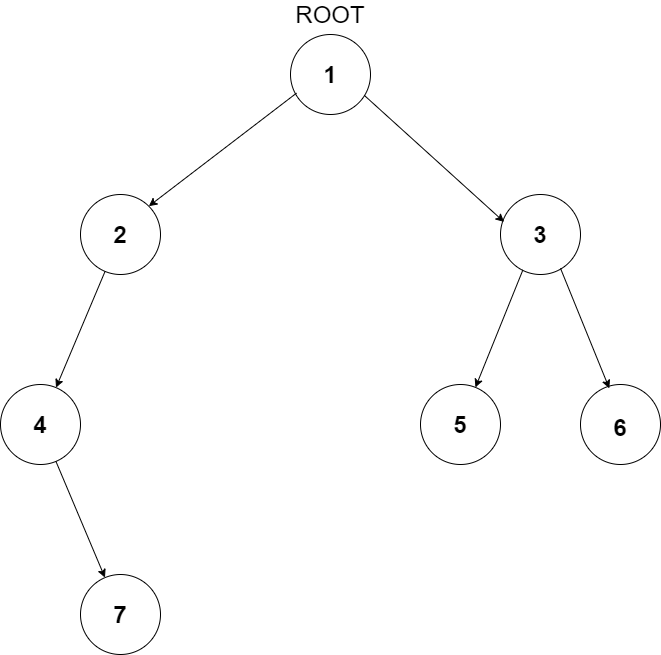
The reverse level order traversal will be {7,6,5,4,3,2,1}.
03
Round
Medium
Face to Face
Duration60 mins
Interview date7 Sep 2021
Coding problem2
It was conducted in the late evening and happened very smoothly.
1. OS question
What is Kernel and write its main functions? (Learn)
Problem approach
The kernel is basically a computer program usually considered the central component or module of an OS. It is responsible for handling, managing, and controlling all operations of computer systems and hardware. Whenever the system starts, the kernel is loaded first and remains in the main memory. It also acts as an interface between user applications and hardware.


Here's your problem of the day 
Solving this problem will increase your chance to get selected in this company
Skill covered: Programming
How do you remove whitespace from the start of a string?
Choose another skill to practice
Similar interview experiences
SDE - 1
3 rounds | 7 problems
Interviewed by Accolite
Rejected

703 views

0 comments

0 upvotes
SDE - 1
3 rounds | 6 problems
Interviewed by Accolite
Rejected
777 views
0 comments
0 upvotes
SDE - 1
3 rounds | 6 problems
Interviewed by Accolite
Rejected
677 views
0 comments
0 upvotes
SDE - 1
3 rounds | 8 problems
Interviewed by Accolite
Rejected
668 views
0 comments
0 upvotes
Companies with similar interview experiences
SDE - 1
5 rounds | 12 problems
Interviewed by Amazon
 Selected
 115097 views
24 comments
0 upvotes
SDE - 1
4 rounds | 5 problems
Interviewed by Microsoft
Selected 58238 views
5 comments
0 upvotes
SDE - 1
3 rounds | 7 problems
Interviewed by Amazon
 Selected
 35147 views
7 comments
0 upvotes