





Accolite interview experience Real time questions & tips from candidates to crack your interview

SDE - 1
Accolite


4 rounds | 11 Coding
problems
 Selected
 Interview preparation journey

Journey
I wasn't able to score that good in JEE mains so took admission in a local engineering college. I was not having a computer or laptop at home so mostly focused on theory subjects and utilized whatever time I use to get in college computer lab. I got laptop in the start of my 3rd year of engineering, with the help of my college friends started practicing on various coding platform like codechef, codeforces, hackerrank, coding ninjas, geekforgeeks, leetcode plus the regular theory subjects . With this I was able to crack 5-6 offers On-campus along with Accolite Digital.
Application story
It was a On-campus drive so college placement cell shared google form to fill our details. Students were shortlisted on the basis of CGPA and number of offers they have in hand.
Why selected/rejected for the role?
I was able to clear all the rounds and was able to show them that I have skills which they are looking for, not just coding but overall as a software engineer
Preparation
Duration: 3 months
Topics: Data Structures, OOPS, Algorithms, Computer Networks, Operating System, Database Management System

Tip 1 : Practice variety of problems, try to find patterns rather than learning solutions
Tip 2 : don't leave Computer Fundamentals behind
Tip 3 : make sure you keep balance in DSA and development.
Application process
Where: Campus
Eligibility: Above 6 CGPA, No Active Backlogs
Tip 1 : Have some projects on resume of which you are confident to explain
Tip 2 : add certifications you have done till now that showcase your skills

Interview rounds
01
Round
Medium
Online Coding Interview
Duration90 minutes
Interview date23 Dec 2021
Coding problem1
1. Minimum Steps
Moderate
20m average time
80% success

0/80
Asked in companies



You are given an array ‘ARR’ consisting of ‘N’ integers. Your task is to make all the numbers equal. You decrease one of the largest numbers present in the array into a number that is just lower than the maximum number in one step.
For example:
You are given ‘ARR’ = [5, 2, 3]
In the first step, you can change 5 to 3, so the new array is [3, 2,3].

In the second step, you can change the 3 to 2, then the array is [2, 2,3].

In the third step, you can change the 3 to 2, then the array is [2, 2, 2]

Hence the answer is 3.
02
Round
Medium
Video Call
Duration40 minutes
Interview date5 Jan 2022
Coding problem5
1. OS Question
What is Fragmentation in OS ..?
Problem approach
Tip 1 : Go through GFG and coding ninjas Operating System crash course
2. OS Question
difference between internal frqagmentation and external fragmentation
Problem approach
Tip 1 : Go through GFG and coding ninjas Operating System crash course
3. DBMS Question
what is belady's anomaly.
Problem approach
Tip 1 : Go through GFG and coding ninjas DBMS crash course
4. Add Strings
Easy
0/40
Asked in companies


You are given two non-negative integers, ‘NUM1’ and ‘NUM2’, in the form of strings. Return the sum of both strings.
Note :
You do not need to print anything, it has already been taken care of. Just implement the given function.
Example:
Let ‘NUM1’ be: “5”
Let ‘NUM2’ be: “21”
The sum of both numbers will be: “26”.
Problem approach
Step 1 : tried extracting integer from a string, Scan each character of the input string and if a number is formed by consecutive characters of the string, then increment the result by that amount.
Step 2 : Interviewer asked me to optimise the solution.
Step 3 : Then I recursively traversed over the string and find out the numbers then add these numbers to the result, at last return the result.
5. Segregate Even And Odd Nodes In a Linked List
Easy
15m average time
85% success
0/40
Asked in companies



You are given the head node of a singly linked list 'head'. Your task is to modify the linked list in such a way that all the even valued nodes appear before the all odd valued node and order of nodes remain the same.
Example :-
The given singly linked list is 6 -> 5 -> 3 -> 4 -> 7 -> 1 -> 2
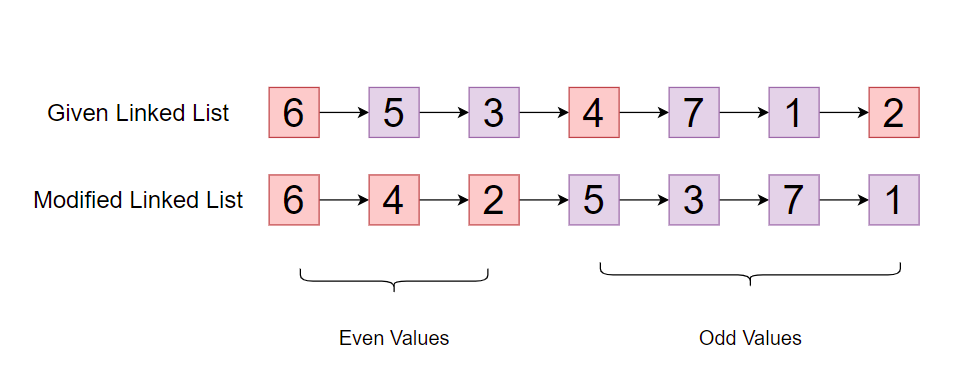
The modified linked list should have all even values in starting and odd values in the end.
03
Round
Medium
Video Call
Duration75 minutes
Interview date6 Jan 2022
Coding problem4
1. Output Question
a code snippet was given and asked to tell the output of code : using namespace std; int N= 10; int main(){ static int x = 1; if ( cout << x << " " && x++ < N && main()){ } return 0; }
Problem approach
Step 1 : make a note of static declaration, the increment operator and main function call. its a post increment kept that in mind.
2. Maximum Area of a Triangle
Easy
10m average time
90% success
0/40
Asked in companies


You are given 2D array/list 'POINTS' containing N distinct points on a 2D coordinate system where 'POINTS[i] = [Xi, Yi]. You have to find the maximum area of the triangle that can be formed by using any 3 points out of these N points.
Example
Let 'N' = 5, and the 'POINTS' = [ [0, 0], [2, 1], [0, 4], [0, 2], [5, 0] ].
Here, the maximum area triangle will be formed by using the points [0, 0], [0, 4], [5, 0] as shown below.
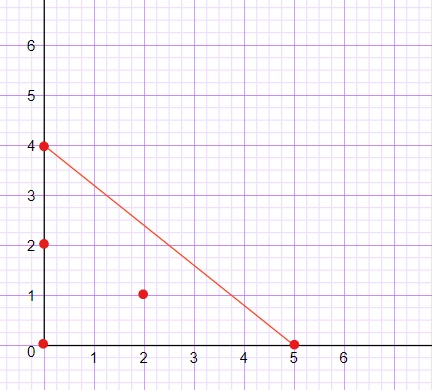
Hence, the area will be 10 units.
3. Queue Using Stack
Moderate
30m average time
60% success
0/80
Asked in companies



Implement a queue data structure which follows FIFO(First In First Out) property, using only the instances of the stack data structure.
Note:
1. To implement means you need to complete some predefined functions, which are supported by a normal queue such that it can efficiently handle the given input queries which are defined below.


2. The implemented queue must support the following operations of a normal queue:

a. enQueue(data) : This function should take one argument of type integer and place the integer to the back of the queue.

b. deQueue(): This function should remove an integer from the front of the queue and also return that integer. If the queue is empty, it should return -1.

c. peek(): This function returns the element present in the front of the queue. If the queue is empty, it should return -1.

d. isEmpty(): This function should return true if the queue is empty and false otherwise.


3. You will be given q queries of 4 types:

a. 1 val - For this type of query, you need to insert the integer val to the back of the queue.

b. 2 - For this type of query, you need to remove the element from the front of the queue, and also return it.

c. 3 - For this type of query, you need to return the element present at the front of the queue(No need to remove it from the queue).

d. 4 - For this type of query, you need to return true if the queue is empty and false otherwise.


4. For every query of type:

a. 1, you do not need to return anything.

b. 2, return the integer being deQueued from the queue.

c. 3, return the integer present in the front of the queue.

d. 4, return “true” if the queue is empty, “false” otherwise.
Example
Operations:
1 5
1 10
2
3
4

Enqueue operation 1 5: We insert 5 at the back of the queue.
Queue: [5]

Enqueue operation 1 10: We insert 10 at the back of the queue.
Queue: [5, 10]

Dequeue operation 2: We remove the element from the front of the queue, which is 5, and print it.
Output: 5
Queue: [10]

Peek operation 3: We return the element present at the front of the queue, which is 10, without removing it.
Output: 10
Queue: [10]

IsEmpty operation 4: We check if the queue is empty.
Output: False
Queue: [10]
Problem approach
Step1 : implemented Queue data structure using 2 stacks.
enQueue(q, x)
1) Push x to stack1 (assuming size of stacks is unlimited).
Here time complexity will be O(1)
deQueue(q)
1) If both stacks are empty then error.
2) If stack2 is empty
While stack1 is not empty, push everything from stack1 to stack2.
3) Pop the element from stack2 and return it.
4. DBMS Question
Give an overview of database design for employee attendance system , what will the ER diagram look like, explain how tables are related ( primary keys, foreign keys)
Problem approach
Tip 1 : Do practice ER diagram
Tip 2 : check out some system design video/ articles available on internet
04
Round
Easy
HR Round
Duration30 minutes
Interview date6 Jan 2022
Coding problem1
1. Basic HR Questions
Where have you heard about accolite ?
Why you want to join Accolite ?
What's your preferred location?
Problem approach
Tip 1 : Research about the company beforehand


Here's your problem of the day 
Solving this problem will increase your chance to get selected in this company
Skill covered: Programming
How do you remove whitespace from the start of a string?
Choose another skill to practice
Similar interview experiences
SDE - 1
3 rounds | 7 problems
Interviewed by Accolite

Rejected

703 views

0 comments

0 upvotes
SDE - 1
3 rounds | 6 problems
Interviewed by Accolite
Rejected
777 views
0 comments
0 upvotes
SDE - 1
3 rounds | 6 problems
Interviewed by Accolite
Rejected
678 views
0 comments
0 upvotes
SDE - 1
3 rounds | 8 problems
Interviewed by Accolite
Rejected
668 views
0 comments
0 upvotes
Companies with similar interview experiences

SDE - 1
5 rounds | 12 problems
Interviewed by Amazon
 Selected
 115097 views
24 comments
0 upvotes

SDE - 1
4 rounds | 5 problems
Interviewed by Microsoft
Selected 58238 views
5 comments
0 upvotes
SDE - 1
3 rounds | 7 problems
Interviewed by Amazon
 Selected
 35147 views
7 comments
0 upvotes