





Accolite interview experience Real time questions & tips from candidates to crack your interview

SDE - 1
Accolite


5 rounds | 7 Coding
problems
 Selected
 Interview preparation journey

Journey
I started my preparation when I was in the 6th semester then this company Accolite digital came to my campus for campus Hiring then I started my research on this company from YouTube and by reading blogs. So in total, there were five rounds each round is an elimination round. and after qualifying all these Five rounds I got my offer letter from Accolite Digital within no time
Application story
It came to my university for campus hiring. The Placement Coordinator of my college shared one Google form where I have to fill in all the necessary information and also the company asks for my resume. Before the technical interview rounds, there were two elimination rounds one is a quiz round and the second one is a coding round after that the candidate will go for two technical interviews and proceed with an HR interview
Why selected/rejected for the role?
After complete completing all the rounds I finally got my offer letter to track this company one must be fluent in Communication skills and also one must possess good coding skills. Also for me, I have some prior experience in web development so that works as a plus point for me during my interview process.
Preparation
Duration: 7 months
Topics: OOPS, DBMS, CN, Data structures, CPP, OS

Tip 1 : Pick up a coding platform like leetcode and practice daily
Tip 2 : Make yourself an expert in any of the popular programming languages like CPP, JAVA
Tip 3 : Do mock interviews, this boosts your confidence.
Application process
Where: Campus
Eligibility: Above 7 CGPA
Tip 1 : Resume should be one page
Tip 2 : Don't put anything in your resume that you can't prove, like any skill that you are not aware of.

Interview rounds
01
Round
Medium
Online Coding Interview
Duration90 minutes
Interview date11 Jun 2021
Coding problem1
So this one consists of all of the core subjects like computer networking operating system oops and we can select our own timing for this round
1. Maximum Product Subarray
Moderate
25m average time
75% success

0/80
Asked in companies



You are given an array “arr'' of integers. Your task is to find the contiguous subarray within the array which has the largest product of its elements. You have to report this maximum product.
An array c is a subarray of array d if c can be obtained from d by deletion of several elements from the beginning and several elements from the end.

For e.g.- The non-empty subarrays of an array [1,2,3] will be- [1],[2],[3],[1,2],[2,3],[1,2,3].
For Example:
If arr = {-3,4,5}.
All the possible non-empty contiguous subarrays of “arr” are {-3}, {4}, {5}, {-3,4}, {4,5} and {-3,4,5}.
The product of these subarrays are -3, 4, 5, -12, 20 and -60 respectively.
The maximum product is 20. Hence, the answer is 20.
Follow Up:
Can you solve this in linear time and constant space complexity?
Problem approach
Step 1 : Run a nested for loop to generate every subarray
Step 2 : Calculate the product of elements in the current subarray
Step 3 : Return the maximum of these products calculated from the subarrays
02
Round
Medium
Online Coding Test
Duration30 minutes
Interview date25 Jun 2021
Coding problem1
In this round, there was one coding problem and the time provided was 30 minutes regarding the timings so we have the liberty to select our own time
1. Reverse Linked List
Moderate
15m average time
85% success
0/80
Asked in companies



Given a singly linked list of integers. Your task is to return the head of the reversed linked list.
For example:
The given linked list is 1 -> 2 -> 3 -> 4-> NULL. Then the reverse linked list is 4 -> 3 -> 2 -> 1 -> NULL and the head of the reversed linked list will be 4.
Follow Up :
Can you solve this problem in O(N) time and O(1) space complexity?
Problem approach
The idea is to use three pointers curr, prev, and next to keep track of nodes to update reverse links.
03
Round
Medium
Video Call
Duration60 minutes
Interview date29 Jun 2022
Coding problem2
This is a technical interview round it was scheduled during the afternoon the interviewer was really helpful, and he asked everything regarding the core subject and there was two coding problem that I have to solve in front of him while sharing my screen.
1. Check for Mirror Trees
Moderate
0/80
Asked in companies

While learning DSA, Ninja found two N-ary trees and wants to check whether they are mirror images of each other or not. But, he can’t find a suitable method to check the same. Can you help Ninja to solve this problem?
You are given two N-ary trees, ‘TREEA’ and ‘TREEB’ having ‘N’ vertices labeled from 0 to ‘N’-1, and both the trees are rooted at node 0. Your task is to find whether the trees are mirror images of each other or not. Edges of the tree are in order from left to right.
For Example:
For the given example below, the trees are mirror images of each other.

Problem approach
Firstly I took 10 to 15 minutes to think about the solution then I gave him my approach and when he was fully satisfied with the approach he asked me to code it
approach: In order to change the original tree in its mirror tree, we simply swap the left and right link of each node. If the node is leaf node then do nothing.
2. Zigzag Binary Tree Traversal
Easy
10m average time
90% success
0/40
Asked in companies


You are given a ‘Binary Tree’.
Return the level-order traversal of the Binary Tree.
Example:
Input: Consider the following Binary Tree:
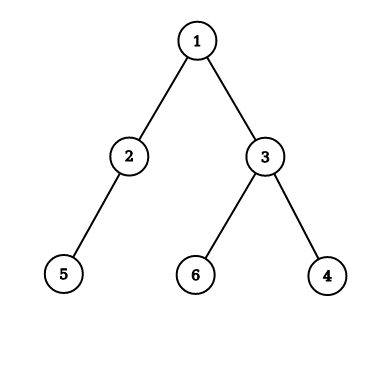
Output:
Following is the level-order traversal of the given Binary Tree: [1, 2, 3, 5, 6, 4]
Problem approach
I used DFS approach to solve this for problem run a for loop and then recursively solve for each node of the tree
04
Round
Medium
Video Call
Duration80 minutes
Interview date1 Jul 2021
Coding problem2
This is also a technical round it was scheduled in the morning the interviewer was really helpful
1. Check If The String Is A Palindrome
Easy
10m average time
90% success
0/40
Asked in companies



You are given a string 'S'. Your task is to check whether the string is palindrome or not. For checking palindrome, consider alphabets and numbers only and ignore the symbols and whitespaces.
Note :
String 'S' is NOT case sensitive.
Example :
Let S = “c1 O$d@eeD o1c”.
If we ignore the special characters, whitespaces and convert all uppercase letters to lowercase, we get S = “c1odeedo1c”, which is a palindrome. Hence, the given string is also a palindrome.
Problem approach
By reversing the string we can compare the reverse string with the original string and that way we can check whether it is a string or not
2. Special String
Moderate
25m average time
75% success
0/80
Asked in companies

A string ‘S’ is said to be special if each of its characters is one of the first ‘P’ letters of the English alphabet and ‘S’ doesn't contain any palindrome contiguous substring of length 2 or more. You will be given a special string ‘S’ of length ‘N’, find the lexicographically next special string of the same length, or else state that such string does not exist. Print the output string if it exists, otherwise, print "NO" (without quotes).
A string “s1” is a substring of another string “s2” if “s2” contains the same characters as in “s1”, in the same order and in a continuous fashion also.
Example: Given a string “cba” and ‘P’ equals 3. So, the next strings which are lexicographically bigger than string ‘S’ are “cbb”, “cbc”, “cca”, “ccb” and “ccc” of size 3. But all of them have a palindrome substring of the size at least 2. So, we will return “NO” as output. If the given string is “cbd” and ‘P’ equals 4 then the next string will be “cda” and it is special. So, we can return an output here.
Note:
It is guaranteed that the input string is special.
Problem approach
Iterate through all the characters of the string.
Alongside we will be checking each character for being a letter, a digit, or whitespace
It is found to be none of the above signifying special characters.
then print it
05
Round
Easy
HR Round
Duration30 minutes
Interview date15 Jul 2021
Coding problem1
This is a HR round it is scheduled in the morning
1. Basic HR Questions
Give a brief description of yourself
where did you get to know Accolite digital
where do you see yourself in five years in accolite
Problem approach
Tip 1 : Be confident
Tip 2 : Don't lie about your skills and hobbies
Tip 3 : Well dressed.


Here's your problem of the day 
Solving this problem will increase your chance to get selected in this company
Skill covered: Programming
Which of the following ensures referential integrity in SQL?
Choose another skill to practice
Similar interview experiences
SDE - 1
3 rounds | 7 problems
Interviewed by Accolite

Rejected

734 views

0 comments

0 upvotes
SDE - 1
3 rounds | 6 problems
Interviewed by Accolite
Rejected
812 views
0 comments
0 upvotes
SDE - 1
3 rounds | 6 problems
Interviewed by Accolite
Rejected
707 views
0 comments
0 upvotes
SDE - 1
3 rounds | 8 problems
Interviewed by Accolite
Rejected
702 views
0 comments
0 upvotes
Companies with similar interview experiences
SDE - 1
5 rounds | 12 problems
Interviewed by Amazon
 Selected
 115908 views
24 comments
0 upvotes
SDE - 1
4 rounds | 5 problems
Interviewed by Microsoft
Selected 58859 views
5 comments
0 upvotes
SDE - 1
3 rounds | 7 problems
Interviewed by Amazon
 Selected
 35449 views
7 comments
0 upvotes