





Accolite interview experience Real time questions & tips from candidates to crack your interview

Software Engineer
Accolite


3 rounds | 4 Coding
problems

 Selected
 Interview preparation journey

Preparation
Duration: 8 month
Topics: Data structure and algorithm, operating system, dbms, oops, computer network, web development

Tip 1 : Be very clear with your project explaination.
Tip 2 : Also try to cover all the cs core subjects explaination clearly.
Application process
Where: Campus
Eligibility: 6.5 cgpa and 65% 12th marks minimun requirement
Tip 1 : Make it clean with appropriate knowledge.
Tip 2 : Provide true information and avoid telling lie in which You are not sure.

Interview rounds
01
Round
Medium
Video Call
Duration40 minutes
Interview date6 Aug 2021
Coding problem1
It was morning time and from 9:00 am . It happened via the google meet online process and it was very smooth onboarding . Interviewer was very friendly kind of nature .
1. Add Two Numbers As Linked Lists
Moderate
20m average time
80% success

0/80
Asked in companies



You are given two non-negative numbers 'num1' and 'num2' represented in the form of linked lists.
The digits in the linked lists are stored in reverse order, i.e. starting from least significant digit (LSD) to the most significant digit (MSD), and each of their nodes contains a single digit.
Calculate the sum of the two numbers and return the head of the sum list.
Example :
Input:
'num1' : 1 -> 2 -> 3 -> NULL
'num2' : 4 -> 5 -> 6 -> NULL

Output: 5 -> 7 -> 9 -> NULL

Explanation: 'num1' represents the number 321 and 'num2' represents 654. Their sum is 975.
Problem approach
PROGRAM:
class Solution
{
public:
//Function to add two numbers represented by linked list.
Node*reverse(struct Node*head){
Node*curr=head;
Node*prev=NULL;
Node*nxt;
while(curr!=NULL){
nxt=curr->next;
curr->next=prev;
prev=curr;
curr=nxt;
}
return prev;
}
public:
struct Node* addTwoLists(struct Node* first, struct Node* second)
{
// code here
first=reverse(first);
second=reverse(second);
int c=0;
int s=0;
Node*temp;
Node*cur;
Node*res=NULL;
while(first!=NULL||second!=NULL){
s=c+(first?first->data:0)+(second?second->data:0);
if(s>9){
c=1;
}
else{
c=0;
}
s=s%10;
temp=new Node(s);
if(res==NULL)res=temp;
else{
cur->next=temp;
}
cur=temp;
if(first)first=first->next;
if(second)second=second->next;
}
if(c!=0){
temp=new Node(c);
cur->next=temp;
cur=temp;
}
res=reverse(res);
return res;
}
};
02
Round
Medium
Video Call
Duration45 minutes
Interview date7 Aug 2021
Coding problem1
It was again the morning session and the interviewer was very supportive in nature and gave me the hint too to think the approach and finally i came up the solution which he was expecting.
1. Flatten A Linked List
Easy
15m average time
85% success
0/40
Asked in companies



You are given a linked list containing 'n' 'head' nodes, where every node in the linked list contains two pointers:
(1) ‘next’ which points to the next node in the list
(2) ‘child’ pointer to a linked list where the current node is the head.
Each of these child linked lists is in sorted order and connected by 'child' pointer.
Your task is to flatten this linked such that all nodes appear in a single layer or level in a 'sorted order'.
Example:
Input: Given linked list is:
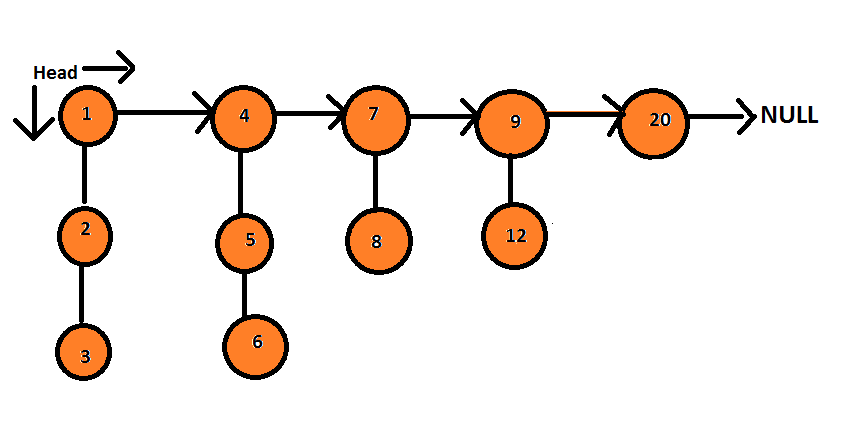
Output:
1 → 2 → 3 → 4 → 5 → 6 → 7 → 8 → 9 → 12 → 20 → null.


Explanation:
The returned linked list should be in a sorted order. All the elements in this returned linked list are connected by 'child' pointers and 'next' pointers point to null.
Problem approach
PROGRAM:
Node*merge(Node*a,Node*b){//a=root b=root ka right wala
if(a==NULL)return b;
if(b==NULL)return a;
Node*res;
if(a->datadata)
{
res=a;
res->bottom=merge(a->bottom,b);
}
else{
res=b;
res->bottom=merge(a,b->bottom);
}
res->next=NULL;
return res;
}
Node *flatten(Node *root)
{
if(root==NULL || root->next==NULL)return root;
return merge(root,flatten(root->next));
}
03
Round
Easy
Video Call
Duration15 minutes
Interview date7 Aug 2021
Coding problem2
It was late evening and happened in a very smooth way.
1. OS Questions
Ques: What is thread in OS?
Problem approach
Ans: Thread is a path of execution that is composed of a program counter, thread id, stack, and set of registers within the process. It is a basic unit of CPU utilization that makes communication more effective and efficient, enables utilization of multiprocessor architectures to a greater scale and greater efficiency, and reduces the time required in context switching. It simply provides a way to improve and increase the performance of applications through parallelism. Threads are sometimes called lightweight processes because they have their own stack but can access shared data.
Multiple threads running in a process share: Address space, Heap, Static data, Code segments, File descriptors, Global variables, Child processes, Pending alarms, Signals, and signal handlers.
Each thread has its own: Program counter, Registers, Stack, and State.
2. OS Question
ques:What do you mean by FCFS?
Problem approach
Ans: FCFS (First Come First Serve) is a type of OS scheduling algorithm that executes processes in the same order in which processes arrive. In simple words, the process that arrives first will be executed first. It is non-preemptive in nature. FCFS scheduling may cause the problem of starvation if the burst time of the first process is the longest among all the jobs. Burst time here means the time that is required in milliseconds by the process for its execution. It is also considered the easiest and simplest OS scheduling algorithm as compared to others. Implementation of FCFS is generally managed with help of the FIFO (First In First Out) queue


Here's your problem of the day 
Solving this problem will increase your chance to get selected in this company
Skill covered: Programming
How do you remove whitespace from the start of a string?
Choose another skill to practice
Similar interview experiences
Software Engineer
3 rounds | 4 problems
Interviewed by Accolite
 Selected
844 views

0 comments

0 upvotes
Software Engineer
3 rounds | 4 problems
Interviewed by Accolite
Selected 692 views
0 comments
0 upvotes
Software Engineer
5 rounds | 15 problems
Interviewed by Accolite
Selected 1450 views
0 comments
0 upvotes
Software Engineer
5 rounds | 7 problems
Interviewed by Accolite
Selected 393 views
0 comments
0 upvotes
Companies with similar interview experiences

Software Engineer
3 rounds | 7 problems
Interviewed by Optum
 Selected
 7977 views
1 comments
0 upvotes

Software Engineer
5 rounds | 5 problems
Interviewed by Microsoft
 Selected
 10148 views
1 comments
0 upvotes
Software Engineer
2 rounds | 4 problems
Interviewed by Amazon
Selected 4448 views
1 comments
0 upvotes