





Accolite interview experience Real time questions & tips from candidates to crack your interview

Software Engineer
Accolite


4 rounds | 6 Coding
problems

 Selected
 Interview preparation journey

Journey
As a non-cs background student, I was not knowing programming till my 1st year of college. But after you start this journey you will fall in love with the problems and their multiple ways of solutions. You will boost your confidence day by day by solving different patterns of questions. I am still learning new patterns daily by solving varieties of questions.
Application story
I applied it through my college placement program. The whole process took 3 days. It contains 1 MCQ-based screening round, 1 coding round, 2 interview rounds, and 1 HR round.
Why selected/rejected for the role?
The whole process was smooth and fast. I worked on my programming skills and it helped me a lot. The interview experience helped me as well.
Preparation
Duration: 6 months
Topics: Data Structures, OOPS, DBMS, Web Development, Algorithms

Tip 1 : Try to solve at least 200 questions of different patterns.
Tip 2 : Make at least 1-2 good projects.
Tip 3 : Put some focus on DBMS, OS, CN as well.
Application process
Where: Campus
Eligibility: Above 6 CGPA
Tip 1 : At least have 2 projects on your resume. It should not be copy pasted.
Tip 2 : Do not put false things.

Interview rounds
01
Round
Medium
Online Coding Interview
Duration90 mins
Interview date1 Jul 2021
Coding problem1
It consists of 2 tests. The first test was the MCQ round which took place for 30 minutes. The 2nd test was coding round which took place for 6 minutes.
1. Minimum Steps
Moderate
20m average time
80% success

0/80
Asked in companies



You are given an array ‘ARR’ consisting of ‘N’ integers. Your task is to make all the numbers equal. You decrease one of the largest numbers present in the array into a number that is just lower than the maximum number in one step.
For example:
You are given ‘ARR’ = [5, 2, 3]
In the first step, you can change 5 to 3, so the new array is [3, 2,3].

In the second step, you can change the 3 to 2, then the array is [2, 2,3].

In the third step, you can change the 3 to 2, then the array is [2, 2, 2]

Hence the answer is 3.
Problem approach
Step 1: Take the target array first.
Step 2:Take the result as 0.
If all are even, divide all elements by 2
and increment result by 1.
Step 3:Find all odd elements, and make them even by
reducing them by 1. and for every reduction,
increment result by 1.
Step 4:Finally, we get all zeros in the target array.
02
Round
Medium
Video Call
Duration60 mins
Interview date2 Jul 2021
Coding problem2
The timing was at 9 AM. The interviewer was helpful. He started by introducing himself and later asked about me. He asked 2 DSA questions and asked me to implement a piece of my JavaScript project. I was able to do both things.
1. 3Sum
Moderate
15m average time
85% success
0/80
Asked in companies



You are given an array/list ARR consisting of N integers. Your task is to find all the distinct triplets present in the array which adds up to a given number K.
An array is said to have a triplet {ARR[i], ARR[j], ARR[k]} with sum = 'K' if there exists three indices i, j and k such that i!=j, j!=k and i!=j and ARR[i] + ARR[j] + ARR[k] = 'K'.
Note:
1. You can return the list of values in any order. For example, if a valid triplet is {1, 2, -3}, then {2, -3, 1}, {-3, 2, 1} etc is also valid triplet. Also, the ordering of different triplets can be random i.e if there are more than one valid triplets, you can return them in any order.
2. The elements in the array need not be distinct.
3. If no such triplet is present in the array, then return an empty list, and the output printed for such a test case will be "-1".
Problem approach
Intially i told him brute force approach with O(N^3) .
He asked me to optimize it so i told him using pointer approach.
2. Cycle Detection in a Singly Linked List
Moderate
15m average time
80% success
0/80
Asked in companies



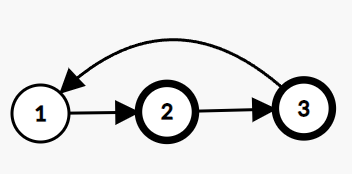
You are given a Singly Linked List of integers. Return true if it has a cycle, else return false.
A cycle occurs when a node's next points back to a previous node in the list.
Example:
In the given linked list, there is a cycle, hence we return true.
Problem approach
Use slow and fast pointer approach.
03
Round
Medium
Video Call
Duration60 mins
Interview date2 Jul 2021
Coding problem2
The timing was at 2 PM the same day. The interviewer was helpful. She started by introducing herself and later asked about me. She asked 2 DSA questions, some SQL queries, and project-related questions.
1. Diameter of a Binary Tree
Easy
10m average time
90% success
0/40
Asked in companies

You are given a Binary Tree.
Return the length of the diameter of the tree.
Note :
The diameter of a binary tree is the length of the longest path between any two end nodes in a tree.

The number of edges between two nodes represents the length of the path between them.
Example :
Input: Consider the given binary tree:
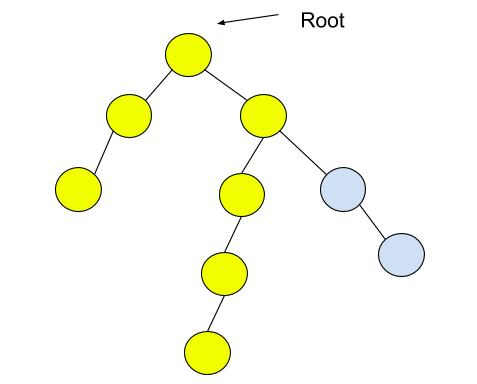
Output: 6

Explanation:
Nodes in the diameter are highlighted. The length of the diameter, i.e., the path length, is 6.
Problem approach
1. Traverse the tree recursively.
2. At every node, calculate height of left and right subtrees.
3. Calculate the diameter for every node .
4. Calculate the maximum of all diameters.
2. Palindrome Linked List
Easy
20m average time
90% success
0/40
Asked in companies


You are given a singly Linked List of integers. Your task is to return true if the given singly linked list is a palindrome otherwise returns false.
For example:
The given linked list is 1 -> 2 -> 3 -> 2-> 1-> NULL.
It is a palindrome linked list because the given linked list has the same order of elements when traversed forwards and backward.
Follow Up:
Can you solve the problem in O(N) time complexity and O(1) space complexity iteratively?
Problem approach
The first approach was to store all list numbers in ArrayList and then perform some operations.
The second approach was to use slow and fast pointers to find the middle element and then check.
04
Round
Easy
HR Round
Duration20 mins
Interview date3 Jul 2021
Coding problem1
It was an HR round and this was for around 20 minutes and asked me to introduce myself and several other questions.
1. HR Questions
1. Introduce yourself.
2. What are your hobbies?


Here's your problem of the day 
Solving this problem will increase your chance to get selected in this company
Skill covered: Programming
How do you remove whitespace from the start of a string?
Choose another skill to practice
Similar interview experiences
Software Engineer
3 rounds | 4 problems
Interviewed by Accolite
 Selected
1116 views

0 comments

0 upvotes
Software Engineer
3 rounds | 4 problems
Interviewed by Accolite
Selected 843 views
0 comments
0 upvotes
Software Engineer
5 rounds | 15 problems
Interviewed by Accolite
Selected 1450 views
0 comments
0 upvotes
Software Engineer
5 rounds | 7 problems
Interviewed by Accolite
Selected 392 views
0 comments
0 upvotes
Companies with similar interview experiences

Software Engineer
3 rounds | 7 problems
Interviewed by Optum
 Selected
 7976 views
1 comments
0 upvotes
Software Engineer
5 rounds | 5 problems
Interviewed by Microsoft
 Selected
 10148 views
1 comments
0 upvotes
Software Engineer
2 rounds | 4 problems
Interviewed by Amazon
Selected 4448 views
1 comments
0 upvotes