





Aditya Birla group interview experience Real time questions & tips from candidates to crack your interview
SDE - 1
Aditya Birla group


3 rounds | 6 Coding
problems

Rejected
Interview preparation journey

Journey
My life has had many ups and downs, but I somewhat managed to get admission to the college where I took computer science as a subject. Then my coding journey started from here.
Application story
I applied through a friend. I referred by a person who is working in this company.
Why selected/rejected for the role?
I was rejected because I was not able to answer all the questions correctly and precisely.
Preparation
Duration: 4 months
Topics: Data Structures, Pointers, OOPS, System Design, Algorithms, Dynamic Programming

Tip 1: Understand the Fundamentals: Ensure you grasp fundamental programming concepts such as data structures, algorithms, and object-oriented programming. Review key topics like arrays, linked lists, stacks, queues, trees, sorting, searching, and graph algorithms.
Tip 2: Practice, Practice, Practice: Regular practice is essential for coding rounds. Solve various coding problems from different sources, including coding websites, books, and online coding platforms. Start with easier problems and gradually move to more complex ones to build problem-solving skills.
Application process
Where: Referral
Eligibility: No criteria
Tip 1 : Have some projects on your resume.
Tip 2 : Do not put false things on your resume.

Interview rounds
01
Round
Easy
Video Call
Duration60 minutes
Interview date21 Jun 2023
Coding problem2
It was at 10 am sharp in the morning. There were two parts to the online assessment round. The first part is the coding round(two questions were asked). And 2nd part is the work simulation round.
1. Equilibrium Index
Easy

0/40
Asked in companies



You are given an array Arr consisting of N integers. You need to find the equilibrium index of the array.
An index is considered as an equilibrium index if the sum of elements of the array to the left of that index is equal to the sum of elements to the right of it.
Note:
1. The array follows 0-based indexing, so you need to return the 0-based index of the element.
2. Note that the element at the equilibrium index won’t be considered for either left sum or right sum.
3. If there are multiple indices which satisfy the given condition, then return the left-most index i.e if there are indices i,j,k…. which are equilibrium indices, return the minimum among them
4. If no such index is present in the array, return -1.
Problem approach
The idea is to get the total sum of the array first. Then Iterate through the array and keep updating the left sum, which is initialized as zero. In the loop, we can get the correct sum by subtracting the elements individually.
2. Subarray With Given Sum
Moderate
15m average time
85% success
0/80
Asked in companies



Given an array ARR of N integers and an integer S. The task is to find whether there exists a subarray(positive length) of the given array such that the sum of elements of the subarray equals to S or not. If any subarray is found, return the start and end index (0 based index) of the subarray. Otherwise, consider both the START and END indexes as -1.
Note:
If two or more such subarrays exist, return any subarray.
For Example: If the given array is [1,2,3,4] and the value of S is equal to 7. Then there are two possible subarrays having sums equal to S are [1,2,3] and [3,4].
Problem approach
An efficient solution is while traversing the array, storing sum so far in currsum. Also, maintain the count of different values of currsum in a map. If the value of currsum is equal to the desired sum at any instance increment count of subarrays by one.
The value of currsum exceeds the desired sum by currsum – sum. If this value is removed from currsum then the desired sum can be obtained. From the map, find the number of subarrays previously found having sum equal to currsum-sum. Excluding all those subarrays from the current subarray, gives new subarrays having the desired sum.
So increase count by the number of such subarrays. Note that when currsum is equal to the desired sum then also check the number of subarrays previously having a sum equal to 0. Excluding those subarrays from the current subarray gives new subarrays having the desired sum. Increase the count by the number of subarrays having sum 0 in that case.
02
Round
Medium
Video Call
Duration60 minutes
Interview date23 Jun 2023
Coding problem2
It was at 9 am in the morning. The interviewer, an SDE-2, introduced himself and asked me to do the same. Then, he inquired about my internship before directly jumping to coding questions.
1. Level Order Traversal
Easy
10m average time
90% success
0/40
Asked in companies


You are given a ‘Binary Tree’.
Return the level-order traversal of the Binary Tree.
Example:
Input: Consider the following Binary Tree:
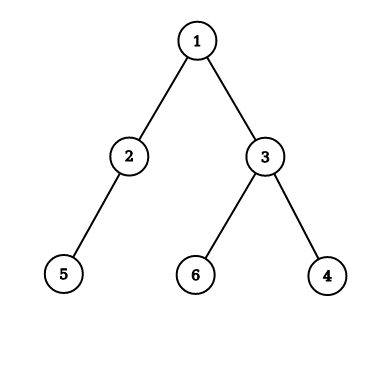
Output:
Following is the level-order traversal of the given Binary Tree: [1, 2, 3, 5, 6, 4]
Problem approach
For each node, first, the node is visited and then it’s child nodes are put in a FIFO queue. Then again the first node is popped out and then it’s child nodes are put in a FIFO queue and repeat until queue becomes empty.
2. Remove Consecutive Duplicates
Easy
0/40
Asked in companies



You are given a string ‘str’ of size ‘N’. Your task is to remove consecutive duplicates from this string recursively.
For example:
If the input string is ‘str’ = ”aazbbby”, then your output will be “azby”.
Note that we are just removing adjacent duplicates.
Problem approach
Basic Approach is to create a Stack that store the
Character and its continuous repetition number This is
done using pair Further we check at each
iteration, whether the character matches the top of stack
if it does then check for number of repetitions
else add to top of stack with count 1
03
Round
Medium
Video Call
Duration75 minutes
Interview date23 Jun 2023
Coding problem2
The test had 3 questions that had to be solved in 75 minutes. The test was of medium difficulty.
1. Find a value whose XOR with a given value is maximum
Easy
20m average time
80% success
0/40
Asked in companies



You are given an integer 'X' and your task is to find an integer 'Y' such that the bitwise XOR of the integers 'X' and 'Y' give the maximum possible value. The integer 'Y' should not be greater than 2305843009213693951 ((2^61) - 1).
A bitwise XOR is a binary operation that takes two bit patterns of equal length and performs the logical exclusive OR operation on each pair of corresponding bits. The result in each position is 1 if only one of the bits is 1, but will be 0 if both are 0 or both are 1.
Note:
1. The maximum obtainable value can always be stored in 64-bit memory space.
2. The given number 'X' is always non-negative.
Problem approach
A bitwise XOR is a binary operation that takes two bit patterns of equal length and performs the logical exclusive OR operation on each pair of corresponding bits. The result in each position is 1 if only one of the bits is 1 but will be 0 if both are 0 or both are 1.
2. Frequency In A Sorted Array
Easy
15m average time
85% success
0/40
Asked in companies


You are given a sorted array 'ARR' and a number 'X'. Your task is to count the number of occurrences of 'X' in 'ARR'.
Note :
1. If 'X' is not found in the array, return 0.
2. The given array is sorted in non-decreasing order.
Problem approach
We have given a sorted array arr and a number X. We have given task is to count the number of occurrences of X in arr.


Here's your problem of the day 
Solving this problem will increase your chance to get selected in this company
Skill covered: Programming
How do you remove whitespace from the start of a string?
Choose another skill to practice
Similar interview experiences
SDE - 1
2 rounds | 4 problems
Interviewed by Aditya Birla group
Rejected

1562 views

0 comments

0 upvotes
SDE - 1
3 rounds | 5 problems
Interviewed by Aditya Birla group
Rejected
1059 views
0 comments
0 upvotes
SDE - 1
4 rounds | 8 problems
Interviewed by Amazon
 Selected
 11210 views
0 comments
0 upvotes
SDE - Intern
1 rounds | 3 problems
Interviewed by Amazon
Selected 4456 views
0 comments
0 upvotes
Companies with similar interview experiences
SDE - 1
5 rounds | 12 problems
Interviewed by Amazon
 Selected
 117552 views
24 comments
0 upvotes

SDE - 1
4 rounds | 5 problems
Interviewed by Microsoft
Selected 60143 views
5 comments
0 upvotes
SDE - 1
3 rounds | 7 problems
Interviewed by Amazon
 Selected
 36138 views
7 comments
0 upvotes