





Aditya Birla group interview experience Real time questions & tips from candidates to crack your interview
SDE - 1
Aditya Birla group


3 rounds | 5 Coding
problems

Rejected
Interview preparation journey

Journey
My seniors advised me to practice DSA from the very start of B.Tech, but I did not take their advice seriously. Honestly speaking, I regretted not taking their advice, and in the third year, I started coding and had to increase my practice hours because I started late. By the end of the third year, I was confident in DSA and development, but even then, I kept revising the concepts.
Application story
This company visited my campus for placements. We just had to upload our resumes and fill in all the details in the form. First, they conducted an online assessment. Later, they called us for the interview rounds.
Why selected/rejected for the role?
The primary reason for my rejection was my lack of strong knowledge of core DSA fundamentals and the need to improve my problem-solving ability.
Preparation
Duration: 3 months
Topics: Data Structures, Algorithms, OOPS, Dynamic Programming

Tip 1: Practice popular questions from Arrays, Binary Trees, and LinkedLists from CodeStudio's Interview Problems.
Tip 2: Ensure you know how to calculate the time and space complexity for every problem you code.
Tip 3: Prepare through mock interviews to practice explaining your approach while solving problems in an actual interview.
Application process
Where: Campus
Eligibility: Above 7 CGPA
Tip 1: Describe the best of your projects in minimum words. Don't forget to add buzzwords like REST APIs, DB Indexing, Benchmarking, etc., if you worked on the backend.
Tip 2: Don't add school achievements like Olympiads or Class Topper in your resume.
Tip 3: If you have some work experience, present it in a way that markets yourself. Use terms like "Created" and "Owned the project through the entire SDLC.

Interview rounds
01
Round
Easy
Video Call
Duration60 minutes
Interview date3 Jun 2023
Coding problem2
1. Target Sum
Moderate

0/80
Asked in companies



You are given an array ‘ARR’ of ‘N’ integers and a target number, ‘TARGET’. Your task is to build an expression out of an array by adding one of the symbols '+' and '-' before each integer in an array, and then by concatenating all the integers, you want to achieve a target. You have to return the number of ways the target can be achieved.
For Example :
You are given the array ‘ARR’ = [1, 1, 1, 1, 1], ‘TARGET’ = 3. The number of ways this target can be achieved is:
1. -1 + 1 + 1 + 1 + 1 = 3
2. +1 - 1 + 1 + 1 + 1 = 3
3. +1 + 1 - 1 + 1 + 1 = 3
4. +1 + 1 + 1 - 1 + 1 = 3
5. +1 + 1 + 1 + 1 - 1 = 3
These are the 5 ways to make. Hence the answer is 5.
2. Search In A Row Wise And Column Wise Sorted Matrix
Moderate
15m average time
80% success
0/80
Asked in companies



You are given an 'N * N' matrix of integers where each row and each column is sorted in increasing order. You are given a target integer 'X'.
Find the position of 'X' in the matrix. If it exists then return the pair {i, j} where 'i' represents the row and 'j' represents the column of the array, otherwise return {-1,-1}
For example:
If the given matrix is:
[ [1, 2, 5],
  [3, 4, 9],
  [6, 7, 10]]
We have to find the position of 4. We will return {1,1} since A[1][1] = 4.
Problem approach
The idea is to remove a row or column in each comparison until an element is found. Start searching from the top-right corner of the matrix.
02
Round
Easy
Video Call
Duration60 minutes
Interview date3 Jun 2023
Coding problem2
1. Copy List with Random Pointer
Easy
10m average time
90% success
0/40
Asked in companies


Given a linked list having two pointers in each node. The first one points to the next node of the list, however, the other pointer is random and can point to any node of the list or null. The task is to create a deep copy of the given linked list and return its head. We will validate whether the linked list is a copy of the original linked list or not.
A deep copy of a Linked List means we do not copy the references of the nodes of the original Linked List rather for each node in the original Linked List, a new node is created.
For example,
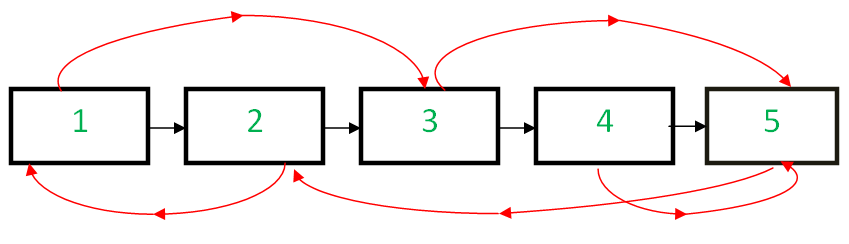
Random pointers are shown in red and next pointers in black.
Problem approach
Insert a new node after every node with the same value
Make a copy
Separate the two lists
2. Row Wave Form
Easy
15m average time
80% success
0/40
Asked in companies


You are given a 2D array with dimensions ‘N*M’. You need to read the array elements row-wise and return a linear array that stores the elements like a wave i.e the 1st-row elements are stored from left to right, 2nd-row elements are stored from right to left, and so on.
Problem approach
If we make sure that all even-positioned (at index 0, 2, 4, ..) elements are greater than their adjacent odd elements, we don’t need to worry about odd-positioned elements.
03
Round
Easy
HR Round
Duration20 minutes
Interview date3 Jun 2023
Coding problem1
1. Basic HR Questions
Tell me about yourself.
Why should I hire you?
What are your strengths and weaknesses?
Why do you want to work at our company?


Here's your problem of the day 
Solving this problem will increase your chance to get selected in this company
Skill covered: Programming
How do you remove whitespace from the start of a string?
Choose another skill to practice
Similar interview experiences

SDE - 1
3 rounds | 7 problems
Interviewed by OYO
 Selected
6182 views

0 comments

0 upvotes
SDE - 1
2 rounds | 4 problems
Interviewed by Aditya Birla group
Rejected
1562 views
0 comments
0 upvotes
SDE - 1
3 rounds | 6 problems
Interviewed by Aditya Birla group
Rejected
1239 views
0 comments
0 upvotes

SDE - 1
3 rounds | 9 problems
Interviewed by Salesforce
 Selected
 4552 views
0 comments
0 upvotes
Companies with similar interview experiences
SDE - 1
5 rounds | 12 problems
Interviewed by Amazon
 Selected
 117552 views
24 comments
0 upvotes

SDE - 1
4 rounds | 5 problems
Interviewed by Microsoft
Selected 60143 views
5 comments
0 upvotes
SDE - 1
3 rounds | 7 problems
Interviewed by Amazon
 Selected
 36138 views
7 comments
0 upvotes