





Adobe interview experience Real time questions & tips from candidates to crack your interview

MTS 1
Adobe


3 rounds | 6 Coding
problems

 Selected
 Interview preparation journey

Preparation
Duration: 3 months
Topics: Data Structure & algorithms, Java Low Level Design, Operating System, DBMS

Tip 1 : Solve medium level of LeetCode and GFG
Tip 2 : Good understanding of your project
Tip 3 : Mention only that thing in resume in which you are confident
Application process
Where: Linkedin
Eligibility: No
Tip 1 : Mention good projects and highlights your skill
Tip 2 : Mention your codeforce/codechef rating

Interview rounds
01
Round
Medium
Video Call
Duration60 minutes
Interview date10 Aug 2022
Coding problem2
1. Subarray With Given Sum
Moderate
15m average time
85% success

0/80
Asked in companies


Given an array ARR of N integers and an integer S. The task is to find whether there exists a subarray(positive length) of the given array such that the sum of elements of the subarray equals to S or not. If any subarray is found, return the start and end index (0 based index) of the subarray. Otherwise, consider both the START and END indexes as -1.
Note:
If two or more such subarrays exist, return any subarray.
For Example: If the given array is [1,2,3,4] and the value of S is equal to 7. Then there are two possible subarrays having sums equal to S are [1,2,3] and [3,4].
Problem approach
Traverse the array from start to end.
From every index start another loop from i to the end of the array to get all subarrays starting from i, and keep a variable currentSum to calculate the sum of every subarray.
For every index in inner loop update currentSum = currentSum + arr[j]
If the currentSum is equal to the given sum then print the subarray.
2. Top View Of Binary Tree
Moderate
25m average time
70% success
0/80
Asked in companies



You are given a Binary Tree of 'n' nodes.
The Top view of the binary tree is the set of nodes visible when we see the tree from the top.
Find the top view of the given binary tree, from left to right.
Example :
Input: Let the binary tree be:
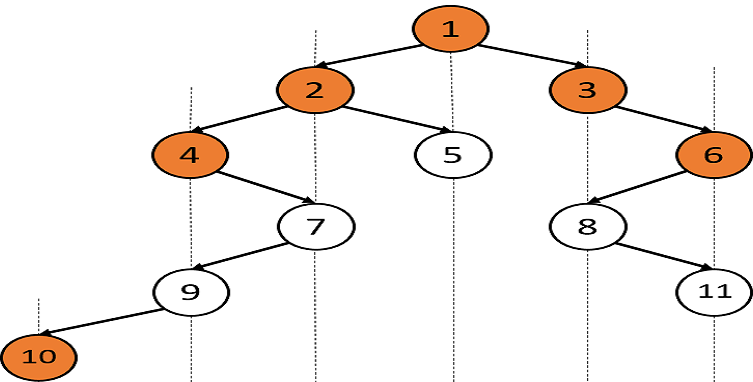
Output: [10, 4, 2, 1, 3, 6]

Explanation: Consider the vertical lines in the figure. The top view contains the topmost node from each vertical line.
Problem approach
This approach is based on the level order traversal. We’ll keep a record of the current max so far left, right horizontal distances from the root.
And if we found less distance (or greater in magnitude) then max left so far distance then update it and also push data on this node to a stack (stack is used because in level order traversal the left nodes will appear in reverse order), or if we found greater distance then max right so far distance then update it and also push data on this node to a vector.
02
Round
Medium
Video Call
Duration60 minutes
Interview date18 Aug 2022
Coding problem2
1. First and Last Position of an Element In Sorted Array
Easy
15m average time
85% success
0/40
Asked in companies

You have been given a sorted array/list 'arr' consisting of ‘n’ elements. You are also given an integer ‘k’.
Now, your task is to find the first and last occurrence of ‘k’ in 'arr'.
Note :
1. If ‘k’ is not present in the array, then the first and the last occurrence will be -1.
2. 'arr' may contain duplicate elements.
Example:
Input: 'arr' = [0,1,1,5] , 'k' = 1

Output: 1 2

Explanation:
If 'arr' = [0, 1, 1, 5] and 'k' = 1, then the first and last occurrence of 1 will be 1(0 - indexed) and 2.
2. Median of two sorted arrays
Hard
25m average time
65% success
0/120
Asked in companies


Given two sorted arrays 'a' and 'b' of size 'n' and 'm' respectively.
Find the median of the two sorted arrays.
Median is defined as the middle value of a sorted list of numbers. In case the length of list is even, median is the average of the two middle elements.
The expected time complexity is O(min(logn, logm)), where 'n' and 'm' are the sizes of arrays 'a' and 'b', respectively, and the expected space complexity is O(1).
Example:
Input: 'a' = [2, 4, 6] and 'b' = [1, 3, 5]

Output: 3.5

Explanation: The array after merging 'a' and 'b' will be { 1, 2, 3, 4, 5, 6 }. Here two medians are 3 and 4. So the median will be the average of 3 and 4, which is 3.5.
Problem approach
The given arrays are sorted, so merge the sorted arrays in an efficient way and keep the count of elements inserted in the output array or printed form. So when the elements in the output array are half the original size of the given array print the element as a median element. There are two cases:
Case 1: m+n is odd, the median is at (m+n)/2 th index in the array obtained after merging both the arrays.
Case 2: m+n is even, the median will be the average of elements at index ((m+n)/2 – 1) and (m+n)/2 in the array obtained after merging both the arrays
03
Round
Easy
Video Call
Duration60 minutes
Interview date21 Aug 2022
Coding problem2
1. Matrix Chain Multiplication
Easy
0/40
Asked in companies

You are given ‘N’ 2-D matrices and an array/list “ARR” of length ‘N + 1’ where the first ‘N’ integers denote the number of rows in the Matrices and the last element denotes the number of columns of the last matrix. For each matrix, the number of columns is equal to the number of rows of the next matrix. You are supposed to find the minimum number of multiplication operations that need to be performed to multiply all the given matrices.
Note :
You don’t have to multiply the matrices, you only have to find the minimum number of multiplication operations.
For Example :
ARR = {2, 4, 3, 2}

Here, we have three matrices with dimensions {2X4, 4X3, 3X2} which can be multiplied in the following ways:
a. If the order of multiplication is (2X4, 4X3)(3X2), then the total number of multiplication operations that need to be performed are: (2*4*3) + (2*3*2) = 36

b. If the order of multiplication is (2X4)(4X3, 3X2), then the total number of multiplication operations that need to be performed are  (2*4*2) + (4*3*2) = 40
Problem approach
Create a recursive function that takes i and j as parameters that determines the range of a group.
Iterate from k = i to j to partition the given range into two groups.
Call the recursive function for these groups.
Return the minimum value among all the partitions as the required minimum number of multiplications to multiply all the matrices of this group.
The minimum value returned for the range 0 to N-1 is the required answer.
2. Symmetric Tree
Easy
20m average time
82% success
0/40
Asked in companies


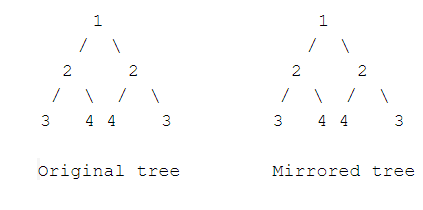
You are given a binary tree, where the data present in each node is an integer. You have to find whether the given tree is symmetric or not.
Symmetric tree is a binary tree, whose mirror image is exactly the same as the original tree.
For Example:
Problem approach
The idea is to write a recursive function isMirror() that takes two trees as an argument and returns true if trees are the mirror and false if trees are not mirrored. The isMirror() function recursively checks two roots and subtrees under the root.


Here's your problem of the day 
Solving this problem will increase your chance to get selected in this company
Skill covered: Programming
How do you remove whitespace from the start of a string?
Choose another skill to practice
Similar interview experiences
MTS 1
6 rounds | 10 problems
Interviewed by Adobe

Rejected

4050 views

1 comments

0 upvotes
MTS 1
2 rounds | 5 problems
Interviewed by Adobe
Rejected
1550 views
1 comments
0 upvotes
MTS 1
3 rounds | 9 problems
Interviewed by Adobe
 Selected
 0 views
0 comments
0 upvotes
MTS 1
2 rounds | 6 problems
Interviewed by Adobe

Rejected
557 views
0 comments
0 upvotes
Companies with similar interview experiences
MTS 1
4 rounds | 14 problems
Interviewed by Oracle
 Selected
 4096 views
0 comments
0 upvotes