





Adobe interview experience Real time questions & tips from candidates to crack your interview

Product Intern
Adobe


2 rounds | 4 Coding
problems

 Selected
 Interview preparation journey

Journey
My journey to landing an internship at Adobe has been a mix of learning, persistence, and guidance from some incredible people. It all started when I was introduced to programming through C and C++ in college. Like most beginners, I struggled a bit at first, but the logic and structure of coding really intrigued me.
With guidance from seniors and friends, I realized the importance of DSA (Data Structures and Algorithms). That was a game-changer. I started dedicating time to solving problems, learning algorithms, and improving my problem-solving skills, which I soon realized were crucial for tech interviews.
Alongside that, I explored web development, which opened up a whole new world of building actual applications and seeing my code turn into something tangible. It gave me a broader understanding of how tech works in real-world scenarios, and I found myself enjoying the creative and technical blend that comes with development.
I started applying for internships and giving interviews. Honestly, I didn’t crack everything on my first try, but each interview taught me something new – whether it was how to approach problems differently or improve my communication during technical discussions. I learned from my mistakes, refined my strategies, and kept moving forward.
One of the pivotal moments in my journey was cracking the DESIS Ascend Educare mentorship program. It gave me exposure to mentorship, networking, and a deeper understanding of the industry. It boosted my confidence and provided me with direction on where I wanted to take my career.
Finally, when the Adobe interview came around, I felt more prepared than ever. All those hours of practice, learning, and persistence came together. The interview process was tough, but it tested both my technical and problem-solving skills, and I was able to approach it with a calm and structured mindset.
Looking back, the journey was full of ups and downs, but each step – from learning C++ to cracking mentorship programs – helped me grow. I think the key takeaway for anyone is to stay curious, learn from mistakes, and surround yourself with people who push you to be better.
Application story
I applied for the Adobe internship through She Codes, which is considered an off-campus drive. However, the application link was shared with specific colleges. In my case, our Training and Placement Cell shared the link, and I applied through that.
After submitting my application, I received an email inviting me to take an online assessment. Once I completed the assessment, I received a selection email, and my interview rounds were scheduled. About a week after the interviews, I received the final selection email confirming my internship offer.
Why selected/rejected for the role?
I believe I was selected because of my strong foundation in DSA, relevant project work, and continuous learning from previous interviews. My persistence, combined with improving problem-solving and communication skills, made a difference during the interview process.
Preparation
Duration: 11 months
Topics: Data Structures and Algorithms, OOPS, Web Development, C++ Basics, Puzzles

Tip 1: Practice DSA questions with different patterns. I found this to be crucial in building a strong foundation in problem-solving. It helps you get comfortable with various patterns and techniques that often come up in interviews.
Tip 2: Work on at least 2 projects. Having hands-on projects not only shows your technical ability but also demonstrates your understanding of how to build something real. It also gives you more to talk about during interviews.
Application process
Where: Campus
Eligibility: above 7 CGPA (Salary: 12LPA)
Tip 1: Include at least 2-3 relevant projects. Projects showcase your skills and give interviewers something tangible to discuss during the interview.
Tip 2: Do not put false or exaggerated claims on your resume. Be honest about your skills and experiences—interviewers can easily spot inconsistencies.
Tip 3: Keep your resume clear and concise. Stick to one page if possible and focus on your most important achievements and skills.
Tip 4: Highlight your key technical skills and tools. Make sure your resume reflects the skills that align with the role you're applying for.

Interview rounds
01
Round
Medium
Online Coding Interview
Duration90 minutes
Interview date28 Oct 2022
Coding problem2
1. Puzzle
The 25 Horses Puzzle: You have 25 horses, and you want to find the top 3 fastest horses. However, you can only race 5 horses at a time, and there is no timer. How many races are needed to determine the fastest three?
2. Longest Substring Without Repeating Characters
Moderate
20m average time
80% success

0/80
Asked in companies


Given a string 'S' of length 'L', return the length of the longest substring without repeating characters.
Example:
Suppose given input is "abacb", then the length of the longest substring without repeating characters will be 3 ("acb").
Problem approach
To solve the 'Longest Substring Without Repeating Characters' problem, I used the sliding window technique:
- Pointers and Hash Map: I initialized two pointers, start and end, to represent the current substring's boundaries. I also used a hash map to track the last index of each character.
- Iterate with end: As I iterated through the string with the end pointer, I checked if the character was already in the hash map. If it was, I moved the start pointer to the right of the last occurrence of that character to avoid duplicates.
- Update Maximum Length: After adjusting the start pointer, I calculated the length of the current substring and updated the maximum length found.
- Return Result: Finally, I returned the maximum length of the substring without repeating characters.
02
Round
Hard
Face to Face
Duration60 Minutes
Interview date23 Nov 2022
Coding problem2
1. copy list with random pointer
Easy
10m average time
90% success
0/40
Asked in companies



Given a linked list having two pointers in each node. The first one points to the next node of the list, however, the other pointer is random and can point to any node of the list or null. The task is to create a deep copy of the given linked list and return its head. We will validate whether the linked list is a copy of the original linked list or not.
A deep copy of a Linked List means we do not copy the references of the nodes of the original Linked List rather for each node in the original Linked List, a new node is created.
For example,
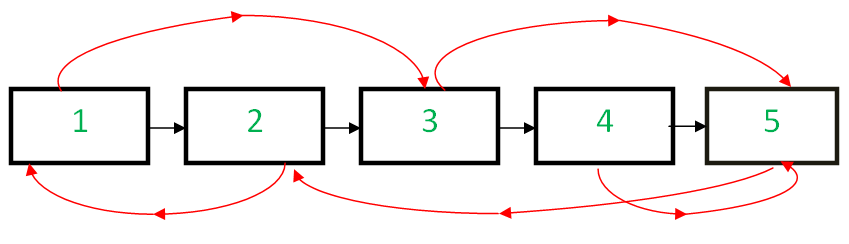
Random pointers are shown in red and next pointers in black.
Problem approach
I solved the 'Copy List with Random Pointer' problem using a three-step approach:
- Interweaving Nodes: I created a copy of each node and inserted it right next to the original node. This allowed me to easily access the copied nodes later.
- Setting Random Pointers: I then iterated through the interleaved list and set the random pointers for the copied nodes based on the original nodes' random pointers.
- Separating the Lists: Finally, I separated the interleaved list into the original and copied lists, restoring the original while keeping the deep copy intact.
This method runs in O(n) time and uses O(1) additional space.


Here's your problem of the day 
Solving this problem will increase your chance to get selected in this company
Skill covered: Programming
What is the correct syntax to inherit a class in Java?
Choose another skill to practice
Similar interview experiences
Product Intern
2 rounds | 8 problems
Interviewed by Adobe
Selected 
2224 views

0 comments

0 upvotes
Product Intern
2 rounds | 3 problems
Interviewed by Adobe
Selected 1805 views
0 comments
0 upvotes
Product Intern
2 rounds | 6 problems
Interviewed by Adobe
Rejected
864 views
0 comments
0 upvotes
Product Intern
2 rounds | 7 problems
Interviewed by Adobe
Selected 1218 views
0 comments
0 upvotes