





Adobe interview experience Real time questions & tips from candidates to crack your interview

SDE - 1
Adobe


5 rounds | 8 Coding
problems
 Selected
 Interview preparation journey

Preparation
Duration: 3 months
Topics: Data Structures, OOPS, System Design, Dynamic Programming, Operating Systems

Tip 1 : Believe in yourself, don't loose confidence if you are not able to solve the problems in single go, thing takes time.
Tip 2 : Be Consistent, always do 2-3 coding questions a day, it will help you in. clearing online test and interviews.
Tip 3 : If preparing for Adobe, you can leave DataBases since Adobe don't. ask questions from this topic.
Tip 4 : Showcase your internships and project in resume at the very top, it will increase your chance to get an interview call. Always remember, getting an interview is much more difficult than clearing it, so please make a good resume.
Application process
Where: Linkedin
Eligibility: CGPA > 7.5
Tip 1 : Showcase your Internships and Project
Tip 2 : Resume should be clean and eye catchy

Interview rounds
01
Round
Medium
Online Coding Test
Duration60 minutes
Interview date17 Oct 2021
Coding problem2
1. Equilibrium Index
Easy

0/40
Asked in companies



You are given an array Arr consisting of N integers. You need to find the equilibrium index of the array.
An index is considered as an equilibrium index if the sum of elements of the array to the left of that index is equal to the sum of elements to the right of it.
Note:
1. The array follows 0-based indexing, so you need to return the 0-based index of the element.
2. Note that the element at the equilibrium index won’t be considered for either left sum or right sum.
3. If there are multiple indices which satisfy the given condition, then return the left-most index i.e if there are indices i,j,k…. which are equilibrium indices, return the minimum among them
4. If no such index is present in the array, return -1.
Problem approach
The expectation was to solve this problem in O(n).
I traversed the array from both the end (left and right) and stooped where my int leftSum == int. rightSum.
2. Bottom View Of Binary Tree
Moderate
10m average time
90% success
0/80
Asked in companies



You are given a 'Binary Tree'.
Return the bottom view of the binary tree.
Note :
1. A node will be in the bottom-view if it is the bottom-most node at its horizontal distance from the root.

2. The horizontal distance of the root from itself is 0. The horizontal distance of the right child of the root node is 1 and the horizontal distance of the left child of the root node is -1.

3. The horizontal distance of node 'n' from root = horizontal distance of its parent from root + 1, if node 'n' is the right child of its parent.

4. The horizontal distance of node 'n' from root = horizontal distance of its parent from the root - 1, if node 'n' is the left child of its parent.

5. If more than one node is at the same horizontal distance and is the bottom-most node for that horizontal distance, including the one which is more towards the right.
Example:
Input: Consider the given Binary Tree:
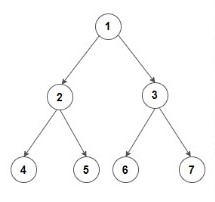
Output: 4 2 6 3 7

Explanation:
Below is the bottom view of the binary tree.

1 is the root node, so its horizontal distance = 0.
Since 2 lies to the left of 0, its horizontal distance = 0-1= -1
3 lies to the right of 0, its horizontal distance = 0+1 = 1
Similarly, horizontal distance of 4 = Horizontal distance of 2 - 1= -1-1=-2
Horizontal distance of 5 = Horizontal distance of 2 + 1=  -1+1 = 0
Horizontal distance of 6 = 1-1 =0
Horizontal distance of 7 = 1+1 = 2

The bottom-most node at a horizontal distance of -2 is 4.
The bottom-most node at a horizontal distance of -1 is 2.
The bottom-most node at a horizontal distance of 0 is 5 and 6. However, 6 is more towards the right, so 6 is included.
The bottom-most node at a horizontal distance of 1 is 3.
The bottom-most node at a horizontal distance of 2 is 7.

Hence, the bottom view would be 4 2 6 3 7
Problem approach
he following are steps to print the Bottom View of the Binary Tree.
Initialize variable hd = 0,map m with int-int key value pair and queue q to store nodes level-wise.
Set root->hd = hd and push root in q
Run a while loop till q is empty
Store the front element in node temp and temp ->hd in variable hd and pop it then set temp->data as value for key hd in m i.e. m[hd] = temp->data.
If temp -> left is not NULL and set temp->left->hd = hd-1 as well as If temp -> right is not NULL and set temp->right->hd = hd+1 respectively.
Iterate over the keys and print the values.
02
Round
Easy
Video Call
Duration60 minutes
Interview date24 Oct 2022
Coding problem2
1. OOPS Question
What is OOPS?
2. Longest Repeating Substring
Moderate
10m average time
90% success
0/80
Asked in companies



You are given a string 'str' of length 'N'. You can perform at most 'k' operations on this string. In one operation, you can choose any character of the string and change it to any other uppercase English alphabet character.
Return the length of the longest substring containing same characters after performing the above operations.
For example :
Input:
str="AABC"  k=1

Output:3

Explanation: Replace 'B' with 'A', we will get "AAAC" and the longest substring with same character is "AAA" of length 3.
Problem approach
We check for each character of English alphabet (both upper and lower cases one by one). We are basically looking for maximum length of sub-string that can be formed by each character and whichever character will form the sub-string of maximum length then that length will be our answer.
We check for maximum length of sub-string that can be formed by every character in a set of 52 characters (From ‘A’ to ‘Z’ and from ‘a’ to ‘z’).
For doing this we traverse whole string and whenever we find a different character, we increase the count.
If count becomes greater than k (at right index), we again start from 0th index and if we found different character we will decrease the count.
When count will be equal to k (at left index) then at that point the length will be rightIndex-leftIndex+1.
We repeat this process until we reach at the end of string and at that point we will return the maximum length.
We do this for all characters and finally return the maximum length.
03
Round
Easy
Video Call
Duration60 minutes
Interview date27 Oct 2022
Coding problem1
1. Longest Common Substring
Moderate
25m average time
75% success
0/80
Asked in companies

You are given two strings, 'str1' and 'str2'. You have to find the length of the longest common substring.
A substring is a continuous segment of a string. For example, "bcd" is a substring of "abcd", while "acd" or "cda" are not.
Example:
Input: ‘str1’ = “abcjklp” , ‘str2’ = “acjkp”.

Output: 3

Explanation:  The longest common substring between ‘str1’ and ‘str2’ is “cjk”, of length 3.
Problem approach
Dynamic Programming can be used to find the longest common substring in O(m*n) time. The idea is to find the length of the longest common suffix for all substrings of both strings and store these lengths in a table.
The longest common suffix has following optimal substructure property.
If last characters match, then we reduce both lengths by 1
LCSuff(X, Y, m, n) = LCSuff(X, Y, m-1, n-1) + 1 if X[m-1] = Y[n-1]
If last characters do not match, then result is 0, i.e.,
LCSuff(X, Y, m, n) = 0 if (X[m-1] != Y[n-1])
Now we consider suffixes of different substrings ending at different indexes.
The maximum length Longest Common Suffix is the longest common substring.
LCSubStr(X, Y, m, n) = Max(LCSuff(X, Y, i, j)) where 1 <= i <= m and 1 <= j <= n
04
Round
Hard
Video Call
Duration60 minutes
Interview date31 Oct 2022
Coding problem1
1. System Design Question
Design a 3 elevator system for 8 floors
Problem approach
Tip 1 : Don't hesitate, interviewer is not. expecting you to solve this problem fully, just tell your approach in a nice way
Tip 2 : Take your time and think.
Tip 3 : Do practice LLD and HLD with DSA.
05
Round
Medium
Video Call
Duration30 minutes
Interview date2 Nov 2022
Coding problem2
It was a managerial round.
1. Puzzle Question
There are 100 doors in a row, all doors are initially closed. A person walks through all doors multiple times and toggle (if open then close, if close then open) them in the following way:
In the first walk, the person toggles every door
In the second walk, the person toggles every second door, i.e., 2nd, 4th, 6th, 8th, …
In the third walk, the person toggles every third door, i.e. 3rd, 6th, 9th, …
Likewise,
In the 100th walk, the person toggles the 100th door.
Which doors are open in the end?
2. Puzzle Question
In a one day international cricket match, considering no extras(no wides, no ‘no’ balls, etc.) and no overthrows.
What is the maximum number of runs that a batsman can score in an ideal case ?


Here's your problem of the day 
Solving this problem will increase your chance to get selected in this company
Skill covered: Programming
How do you remove whitespace from the start of a string?
Choose another skill to practice
Similar interview experiences
SDE - 1
3 rounds | 5 problems
Interviewed by Adobe
 Selected
3191 views

0 comments

0 upvotes
SDE - 1
4 rounds | 10 problems
Interviewed by Adobe
 Selected
 1198 views
0 comments
0 upvotes
SDE - 1
4 rounds | 11 problems
Interviewed by Adobe
Selected 1058 views
0 comments
0 upvotes
SDE - 1
4 rounds | 8 problems
Interviewed by Adobe
Selected 3465 views
0 comments
0 upvotes
Companies with similar interview experiences
SDE - 1
5 rounds | 12 problems
Interviewed by Amazon
 Selected
 115097 views
24 comments
0 upvotes
SDE - 1
4 rounds | 5 problems
Interviewed by Microsoft
Selected 58238 views
5 comments
0 upvotes
SDE - 1
3 rounds | 7 problems
Interviewed by Amazon
 Selected
 35147 views
7 comments
0 upvotes